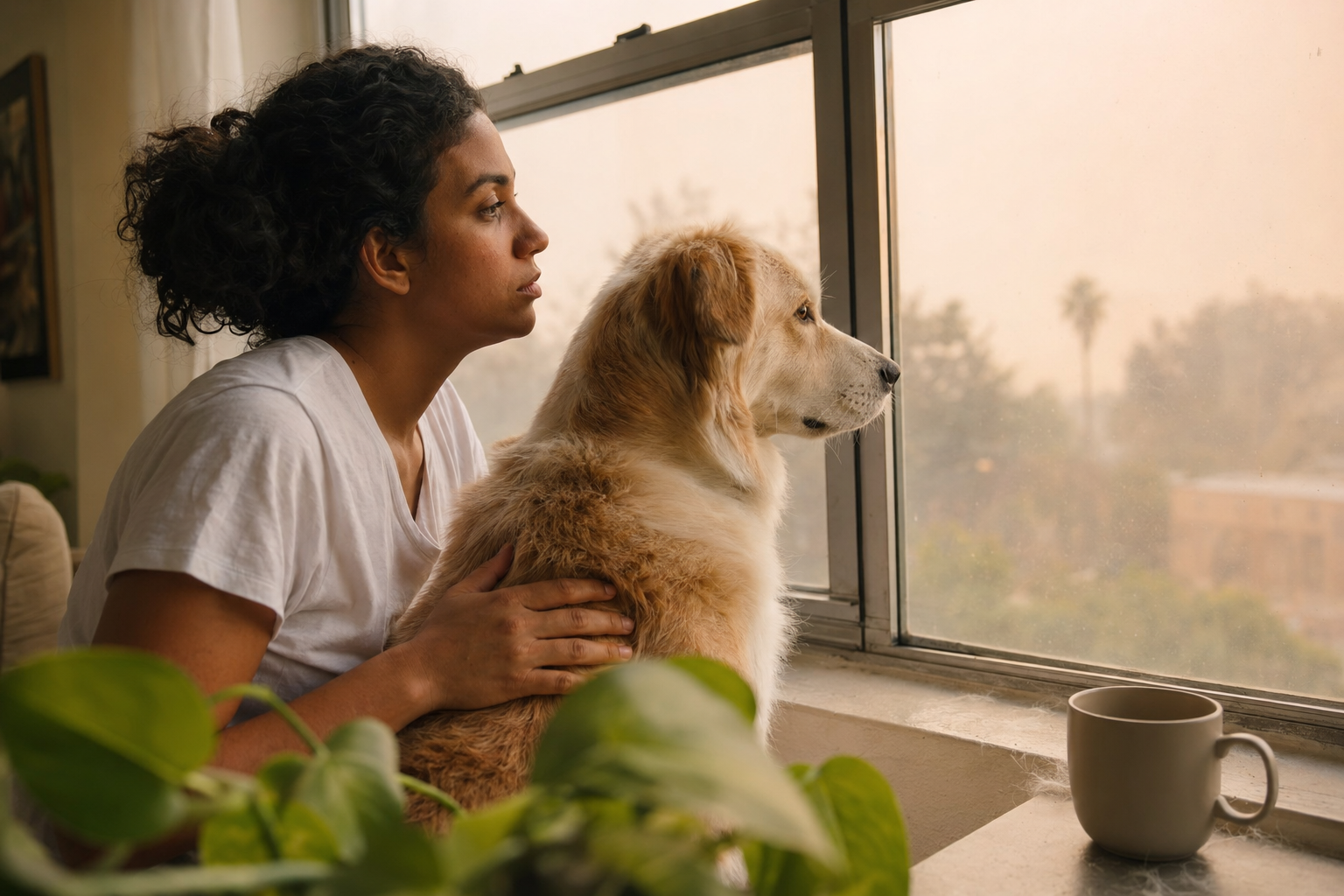
When wildfire smoke turns the sky an eerie orange, most people know to stay indoors themselves. The blind spot is the dog. Owners who wouldn’t dream of jogging through hazardous air will still take the dog on the usual 30-minute loop, as if a leash somehow filters the air. It doesn’t. And dogs actually have a couple of reasons to fare worse than we do in smoke, which makes the walk you skip more important than the walk you take.
So here’s the whole article in one rule, and then the detail behind it: if the air is too smoky for you to want to breathe it, it’s too smoky for your dog. Everything else is just knowing how to measure “too smoky” and what to watch for.
Why dogs are more exposed, not less
Wildfire smoke’s main hazard is fine particulate matter called PM2.5: particles small enough to slip deep into the lungs and even cross into the bloodstream. Roughly nine-tenths of the particle mass in wildfire smoke is this fine fraction, and it’s the reason smoky-day air is genuinely dangerous rather than just unpleasant.
Two things stack the deck against dogs. First, a lot of that heavy particulate settles low, and dogs live closer to the ground than we do, breathing the layer where it concentrates. Second, many dogs exercise harder than their owners on a walk, pulling far more air, and more particulate, into their lungs per minute. A dog trotting and sniffing through smoke is not having the mild experience their strolling human is.
Measuring “too smoky”: the AQI
You don’t have to eyeball the haze. The EPA’s Air Quality Index (AQI) puts a number on it, from 0 to 500, where higher means more pollution and more risk. It’s on most weather apps and at AirNow.gov. Here’s the scale, and what it means for a dog:
- 0 to 50 (Good): Normal outdoor activity is fine.
- 51 to 100 (Moderate): Generally okay; watch sensitive dogs.
- 101 to 150 (Unhealthy for sensitive groups): Start cutting back on hard exercise. This is the threshold where veterinary guidance says to ease off.
- 151 to 200 (Unhealthy): Walks off, bathroom breaks only.
- 201 to 300 (Very unhealthy): Keep outdoor time to the bare minimum.
- 301 to 500 (Hazardous): Everyone stays in.
Some dogs need a stricter line than the number suggests. Flat-faced breeds like Bulldogs and Boxers, who already work harder to move air, dogs with pre-existing heart or lung disease, puppies and seniors, and working dogs who spend long, active hours outdoors should all be pulled inside sooner rather than later.
The smoky-day playbook
The good news, and it’s worth holding onto, is that smoke is temporary. A few days of small adjustments gets you through it. Here’s the routine.
Time the mild days. When smoke is light, air quality often swings over the course of a day. Check it morning, midday, and evening, and slot any necessary outdoor time into the cleanest window, frequently early morning or late evening.
Shrink the outings when it’s bad. Once the air is unhealthy, cancel walks and heavy exercise. Outdoor time becomes purely functional: out to potty, no lingering, back inside. Short bursts with no exercise attached are fine even on a rough day.
Seal and filter the indoors. Keep windows and doors shut and run the AC, ideally with a clean filter. If you live somewhere smoke visits often, a home air purifier is a worthwhile investment.
Beat the boredom. A dog cooped up for consecutive days gets restless, so replace the missing physical outlet with a mental one. Short training sessions, a new trick, and meals served from a stuffable toy or puzzle feeder burn real energy without a single step outdoors.
When it’s a vet trip, not a wait-it-out
Some smoke exposure calls for more than patience. Watch for these signs of respiratory irritation: coughing or gagging, faster or noisier breathing, watery or irritated eyes, nasal discharge, fatigue or weakness, disorientation or stumbling, and a drop in appetite or thirst.
A few of those cross the line from “monitor” to “go now.” Labored breathing while your dog is at rest, breathing distress that doesn’t ease, a cough that keeps going, or a dog who’s uncomfortable, off their food, and getting lethargic all warrant prompt veterinary attention.
“The mistake I see is owners waiting to ‘see if it settles’ when a dog is already struggling to breathe at rest. Smoke-related breathing trouble can escalate, so at-rest labored breathing is a same-day call, not a tomorrow-morning one,” says Dr. Amara Solis.
The trade is worth it
Skipping walks feels lousy, for you and for a dog who lives for them, especially in the warm months when wildfire season peaks. But the framing that helps is the one Dr. Solis’s warning implies: the discomfort is short, and the payoff is a dog whose lungs come through the season undamaged. The skies clear, the routine returns, and you spent a handful of days keeping your dog genuinely safe.
What’s new since this was written
Wildfire smoke has stopped being a purely Western problem. In recent years, smoke from large Canadian fires has drifted hundreds of miles to blanket cities across the East and Midwest, meaning “smoke days” now reach owners who never used to think about them. Planning for a few of them a year is reasonable almost anywhere.
The veterinary world has caught up to owners’ worry, too. A study published in early 2026 in the Journal of the American Veterinary Medical Association found that dog owners are increasingly concerned about air quality and specifically want guidance from their vets on how to handle it. Cornell’s Riney Canine Health Center has since published owner-facing guidance on dog safety during poor-air-quality alerts, and the AVMA continues to flag that animals with heart or respiratory disease, flat-faced breeds, and the very young and very old face the highest risk. If your dog is in one of those groups, it’s worth asking your vet for a smoke-season plan before the next alert, not during it.
References
- Dog owners are concerned about ambient air quality and require veterinary guidance. Journal of the American Veterinary Medical Association, 2026.
- Dog safety during poor air quality alerts or wildfire smoke. Cornell University College of Veterinary Medicine, Riney Canine Health Center.
- Air Quality Index (AQI) Basics. U.S. Environmental Protection Agency, AirNow.
- Tips for protecting pets and livestock from poor air quality as wildfire smoke spreads in the US. dvm360.