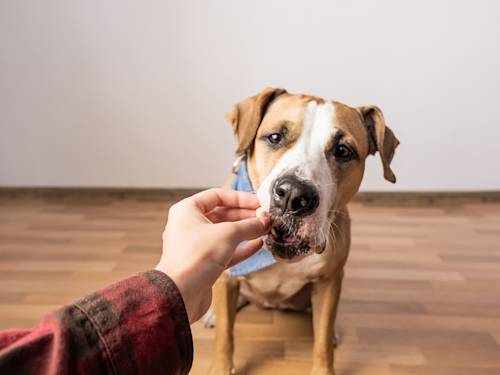
There is a specific moment every dog owner knows. Your dog holds a perfect sit, you reach into your pocket, and then a set of teeth arrives with the velocity of a car door closing on your knuckles.
Most people file this under manners. It is not manners. A hard treat-take is a dashboard light, and what it is reporting is your dog’s arousal level.
That reframe matters, because it changes the fix. If chompiness is rudeness, you correct it. If chompiness is over-arousal, correcting it makes it worse, and the actual job is to bring the dog down before you ask for anything at all. Teaching “gentle” is the tool. Reading the signal is the skill.
The signal you’re throwing away
Pay attention to when the teeth come out. Some dogs are soft-mouthed all day and turn into alligators only in specific situations: at the door, near another dog, in the first thirty seconds of a training session, when guests arrive.
That pattern is free information. It is your dog telling you exactly where their threshold sits. A dog who takes treats politely in the kitchen and lunges at your fingers at the park is not a dog with a manners problem in one location. That is a dog whose brain is at a nine at the park.
“Treat-taking is one of the most honest arousal meters we have, and it costs nothing to read,” says Dr. Mara Chen. “When a dog who is usually careful starts snatching, I stop the session. That mouth is telling me we are past the point where learning happens.”
Use it that way. If the take goes hard mid-session, you have gone too long, gone too fast, or gone too close to whatever is exciting your dog. Add distance, lower the difficulty, or stop.
Now teach the cue: the closed fist
Once you have a calm baseline, “gentle” is straightforward, and it works because of one commitment most people cannot keep: a snatch never produces food. Not once. Not because the eyes were sad.
The full sequence is in the how-to above, but the heart of it is a single moment. Your closed fist is a puzzle your dog will try to solve with teeth first. Every second you keep it closed, the teeth are being paid nothing. The instant the mouth softens into a lick or a nudge, the puzzle opens.
Two things to know going in. First, teach this on its own, not stapled onto another lesson, or your dog will be trying to work out whether they are being paid for the sit or the softness. Second, this will hurt a little. That is why the gloves exist.
Protect your hands while you’re still teaching
The training takes weeks. Your fingers work now. Three ways to bridge the gap:
The wooden spoon. Smear cream cheese or peanut butter on the handle end and let your dog lick it. You get a reward delivery with your skin nowhere near the mouth, which is especially useful for high-value moments like nail trims or crate work.
The flat palm. This is the underrated one. A huge number of dogs who snap at a treat pinched between fingertips will take the same treat politely from an open, flat hand. Fingertips look like a target to grab. A flat palm has nothing to grab. Use this at the dog park, in class, and any time someone else’s dog is involved.
The toss. When all else fails, drop or toss the treat on the ground. It teaches nothing, but it delivers the reward without a bite, and sometimes that is the whole goal.
The rule for other people’s dogs
Do not try to teach “gentle” to a dog you see once a week. The closed-fist method depends on relentless repetition, and a well-meaning stranger holding a treat hostage in front of a strange dog is not training, it is just an unpleasant experience for both of you.
If a dog is not yours, flat-palm the treat or toss it. Save the training for the animals whose lives you are actually in.
When a hard mouth is a medical problem
Here is the piece the manners framing hides completely. A dog who has always been mouthy has a training gap. A dog whose treat-taking changes is a different animal, and that change deserves a vet, not a training plan.
Call your veterinarian if:
- A previously soft-mouthed dog starts grabbing, especially a senior.
- Your dog takes food from one side of their mouth, drops treats, or chews strangely. That points to dental pain or a mouth lesion.
- Your dog misses the treat, overshoots your hand, or gropes for it. Failing vision makes dogs grab, because they can no longer see where your fingers end and the food begins.
- The grabbing comes with a hard stare, a freeze, or a growl over food on the floor. That is guarding, not arousal, and it is worth a professional’s eyes before it escalates.
A change in how a dog uses their mouth is a change in how a dog is feeling. Rule out the body before you blame the manners.
What’s new since this was written
Nothing has overturned the closed-fist method, which is still the standard, and modern positive-reinforcement training has only gotten more insistent about the piece people skip: manage the arousal, then train the behavior. Handing a treat to a dog whose brain is already redlining teaches almost nothing, no matter how good your technique is.
The other shift is in how trainers talk about the flat palm. It used to be a hack. It is increasingly taught as the default delivery for group classes and public spaces, on the reasonable logic that a dog cannot practice snatching if there is nothing to snatch. Habits are built from repetitions, and a flat palm removes the repetition entirely.
References
- Chiandetti, Cinzia, et al. “Can Clicker Training Facilitate Conditioning in Dogs?” Applied Animal Behaviour Science, vol. 184, Nov. 2016, pp. 109–116. https://doi.org/10.1016/j.applanim.2016.08.006
- American Veterinary Society of Animal Behavior. “Position Statement on Humane Dog Training.” AVSAB, 2021. https://avsab.org/wp-content/uploads/2021/08/AVSAB-Humane-Dog-Training-Position-Statement-2021.pdf
- American Veterinary Medical Association. “Pet Dental Care.” AVMA. https://www.avma.org/resources/pet-owners/petcare/pet-dental-care