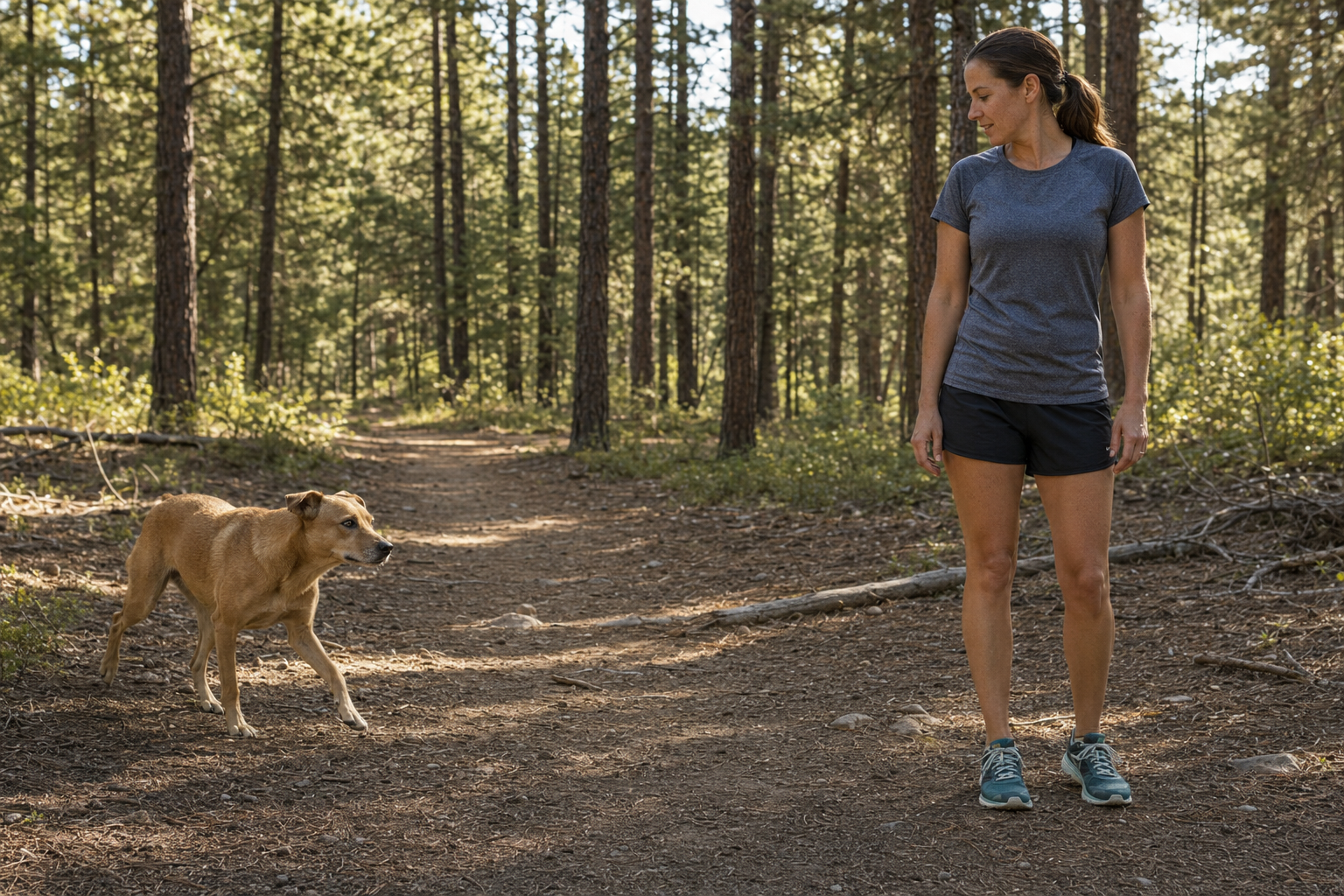
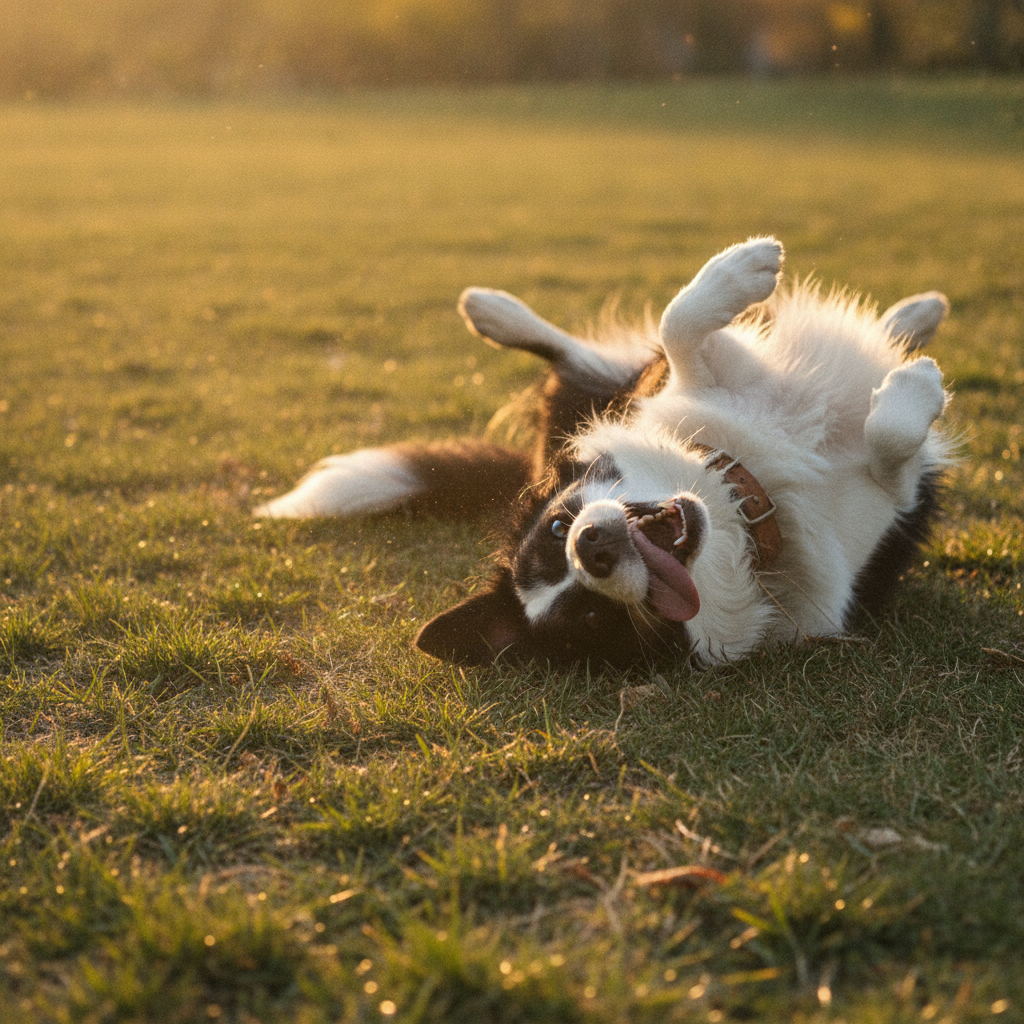
You are two-thirds of the way through a pleasant walk. Your dog stops. They sniff something with an intensity that should have tipped you off. They freeze for half a second. Then the shoulder goes down, the head goes down, and the whole dog corkscrews into a pile of something that came out of an animal you will never identify.
They get up delighted. You get up with a two-hour evening you did not plan on.
The thing everybody says next is that dogs do this to camouflage their scent, the way a wild predator would. It is a satisfying explanation. It is also the weakest one on the list, and if you believe it, you will manage the behavior badly.
What the camouflage theory actually rests on
It is not nothing. Gray foxes, close enough relatives to be worth looking at, have been documented deliberately rubbing head and neck into puma scent, meaning the droppings and urine of an animal that could kill them. The reading is that the fox is smothering its own signature to avoid being noticed by a bigger predator.
Fine. But look at what your dog is choosing. Overwhelmingly, they go for the droppings of other dogs, plus foxes, deer, geese, and cows. They are not seeking out the scent of the apex predator on their block. They are seeking out whatever is new. A Labrador at the park is not hiding from the Great Dane by wearing the Great Dane’s poop.
The gray fox research explains gray foxes. It does not explain your dog.
The theory that fits better: novelty
Here is the study that is more useful, and it is almost forty years old.
Researchers studying scent rubbing in wolves found the behavior was driven by novelty. Present a wolf with an unfamiliar substance and they will roll in it. And critically, the substances that got rolled in were not limited to anything a wild canid would encounter naturally. Wolves rolled in motor oil.
Nothing about motor oil helps a wolf hunt, hide, or communicate. It is simply new, and strong, and worth investigating with the whole body.
Which is a far better description of what you actually watched. Your dog did not evaluate the tactical situation. Your dog found the most interesting new information available and wore it.
“We keep looking for a survival explanation because the behavior is so disgusting that it feels like it must have a serious reason,” says Dr. Nina Kohl. “The honest answer is closer to the truth about dogs generally, which is that a very strong new smell is its own reward, and rolling is how you get the most of it.”
The reasons that are still plausible
Novelty is the lead, but it is not the only candidate, and honest reporting means naming what we do not know.
Information sharing. Dogs communicate through scent constantly, and it is at least conceivable that coming home covered in the smell of something is a way of carrying a message back. It is a real hypothesis. It is not a proven one.
Scent marking. Sometimes floated, but it does not survive contact with the evidence. Dogs mark with their own scent by depositing it. Rolling in another animal’s droppings does the opposite: it takes their scent on. If this were marking, dogs would mostly roll in their own, and they emphatically do not.
Because it feels good. Understated and probably significant. Rolling on the ground is physically satisfying, it scratches, and it is a whole-body activity. Some of the enthusiasm you are watching is just the roll.
The truthful summary: nobody has nailed this. The best-supported driver is novelty, camouflage is on shaky ground, and communication is an open question.
The part that actually matters medically
Everyone treats this as a comedy problem. It is mostly a hygiene problem.
Other animals’ feces can carry Giardia, roundworm and hookworm eggs, Salmonella, and other parasites and bacteria. Your dog then does the thing dogs do, which is groom themselves, which means anything on the coat has a direct route to the mouth. From there it has a route to your carpet, your hands, and, in the case of several of these, to you.
Wildlife droppings are the worst offenders, because you have no idea what the animal was carrying. Fox and raccoon feces in particular are worth treating as genuinely contaminated, not just gross.
So the reason to interrupt this is not your nose. It is the parasite load.
How to actually stop it
You will not extinguish the drive. You can consistently beat it to the punch, and the trick is timing.
Interrupt at the freeze, not the roll. There is a wind-up: the hard stop, the long sniff, the shoulder starting to drop. That two-second window is where the whole intervention lives. Once the dog is down, you have lost. Watch for the freeze and call before the shoulder goes.
Make the recall worth more than the roll. This is the honest bar, and it is a high one. You are competing with one of the most rewarding things your dog will encounter all week. Freeze-dried liver, the good stuff, saved for exactly this. A tennis ball produced from nowhere. Whatever your dog would sell you out for. Reward heavily every time they turn away from something disgusting, and you build a dog whose default on finding a pile is to look at you first.
Reduce the opportunities. Scoop your own yard, and check it before letting the dog out if you have foxes or other wildlife visiting. Walk in places that are actually maintained. On a leash, spot the pile before your dog does and steer wide, which requires you to look up from your phone.
And pick up after your dog, which is both basic decency and the thing that keeps the next dog’s owner from having this evening.
When it happens anyway
It will happen anyway. Do it in this order:
- Dry first. Get the solid material off with paper towels before water touches anything. Water turns a surface problem into a coat-deep one.
- Then bathe. Dog shampoo, warm water, work in sections, and hit the neck, shoulders, and the side of the face, which is where the concentration always is.
- Rinse thoroughly, because leftover shampoo makes for itchy skin, and an itchy dog rolls more.
- Wash your hands and the towels. Hot water. This is the step people skip, and it is the one that keeps a dog’s bad decision from becoming a household one.
What newer research adds
The interesting movement in the last few years has been on the other end of the nose. Work on canine olfaction, including studies of dogs’ scent preferences, keeps confirming that dogs are not neutral about smells, they have favorites, and strong, complex, novel odors are actively attractive rather than merely tolerated. Alexandra Horowitz’s work showing that dogs spend longer investigating their own odor when it has been modified points the same way: the interesting thing is the change, the new information, the thing that was not there before.
That is the through-line. Your dog is not disguising themselves. Your dog found something new and important, and did the only thing an animal without hands can do with it.
The bottom line
Stop explaining it as camouflage. Start managing it as a hygiene risk with a two-second warning window.
Then buy better treats, because you are going to need them.
References
- Ryon, Jenny, et al. “Scent Rubbing in Wolves (Canis lupus): The Effect of Novelty.” Canadian Journal of Zoology, vol. 64, no. 3, March 1986, pp. 573–77. doi.org/10.1139/z86-084
- Allen, Maximilian L., et al. “The Scent of Your Enemy Is My Friend? The Acquisition of Large Carnivore Scent by a Smaller Carnivore.” Journal of Ethology, vol. 25, no. 1, January 2017, pp. 13–19. doi.org/10.1007/s10164-016-0492-6
- Horowitz, Alexandra. “Smelling Themselves: Dogs Investigate Their Own Odours Longer When Modified in an ‘Olfactory Mirror’ Test.” Behavioural Processes, vol. 143, August 2017, pp. 17–24. doi.org/10.1016/j.beproc.2017.08.001
- Kokocińska, Agata, et al. “Canine Smell Preferences: Do Dogs Have Their Favorite Scents?” Animals, vol. 12, no. 12, June 8, 2022, p. 1488. doi.org/10.3390/ani12121488
- Centers for Disease Control and Prevention. “Parasites: Zoonotic Hookworm and Roundworm.” cdc.gov