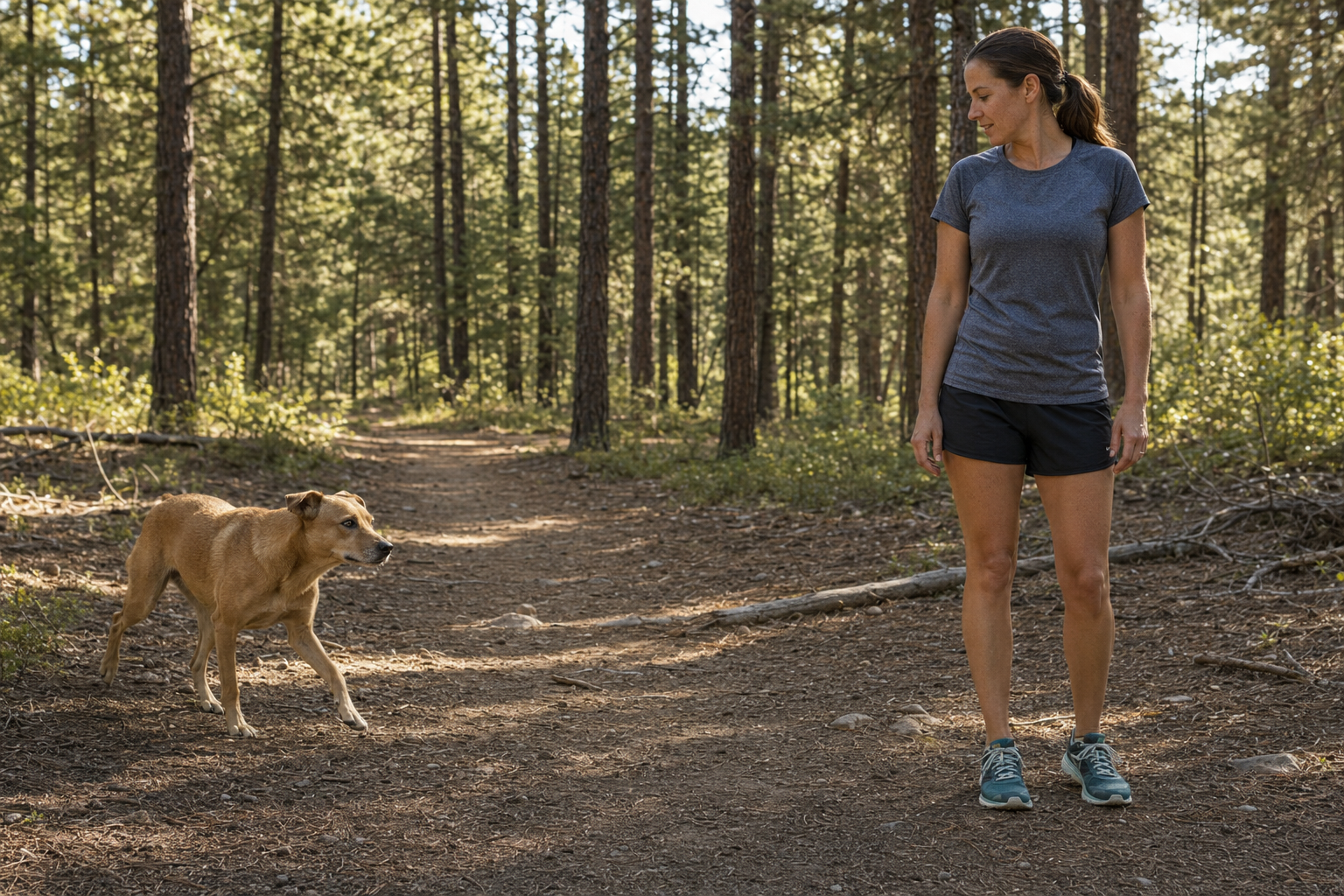
Almost every runner has a version of the story. You are settled into a good rhythm on a trail or a quiet road when a dog you have never met comes barreling toward you, no leash, no fence, and sometimes no owner in sight. If there is a person, they are rarely reassuring. It is either the frantic “No! Come! Leave it!” or the breezy “Don’t worry, he’s friendly!” shouted while an eighty-pound stranger closes the gap.
Here is the frustrating part. In that moment, your body wants to do three things, run faster, make yourself loud and big, and lock eyes with the threat, and all three are close to the worst possible choices. The single most useful idea to carry on every run is this: to a worked-up dog, the goal is to become as boring and unthreatening as a mailbox.
Why “boring” beats “brave”
Most loose-dog charges are not a dog trying to maul you. They are a dog reacting, to movement, to territory, or to fear. Understanding which one you are dealing with is less important than refusing to feed it.
Speed is the biggest trigger. A moving object is intoxicating to a dog with any chase instinct, the same reflex that sends them after squirrels and bikes. Faster, smoother runners actually get chased more, partly because that gliding gait reads as prey. Some dogs are not hunting at all but herding, trying to control a moving thing, which is why so many bites land low, around the calves and ankles. Either way, sprinting pours fuel on the fire.
“The runners who get through these encounters cleanly are almost never the ones who out-tough the dog,” says Dr. Nina Kohl. “They are the ones who make themselves uninteresting. You slow down, you soften, you take the drama out of the situation, and most dogs lose the plot and wander off.”
What to actually do
Slow down or stop. The instant you register a loose dog on your line, drop to a walk or come to a full stop. You are removing the chase trigger. It feels deeply counterintuitive to stand still while a dog approaches, which is exactly why so few people do it.
Shrink your outline. If you are wearing a hat or sunglasses, take them off. A surprising number of dogs charge because an altered human silhouette, a brimmed hat, a hood, reads as something monstrous rather than human. Dog behaviorist Patricia McConnell has written about how much a strange outline can spook a dog. Let them see a normal person and some ease off on their own.
Give ground on purpose. Swing wide and put distance between you and the dog. Many chargers are guarding territory and simply want you gone. Move in the direction the dog is asking for and you often defuse the whole thing.
Change the dog’s mood with your voice. This one sounds ridiculous until you watch it work. In a bright, cheerful tone, say the things dogs are conditioned to love: some version of “wanna go for a walk?”, “is it dinnertime?”, “where’s your ball?”, or just a warm, repeated “good dog.” You are trying to flip the dog’s emotional state, and a happy voice, even a faked one, does a lot of the lifting. A calm cue like “sit” or “go home” sometimes lands too. It will not always work, but it almost never makes things worse.
Have a plan B: leave. If nothing is landing, turn and go the other way, slowly. Yes, it is maddening to reroute because of someone else’s untrained dog. Do it anyway. A slow, undramatic exit tells a territorial dog it won, which is all it wanted.
What never to do
Your panic instincts live here, so name them in advance and override them.
Do not yell or scream at the dog. Most charging dogs are frightened, and screaming ratchets that fear up and makes them more erratic, not less.
Do not stare it down. A hard stare is a threat in dog language. Locking eyes rarely backs a dog off and often escalates them. Keep the dog in your peripheral vision and your body angled slightly away instead.
Do not throw things. Hurling a rock or a water bottle reads as an attack and invites one back.
Do not grab a stick to wield as a weapon. It is far more likely to terrify an already fearful dog or to convince a confident one that it now has a real fight on its hands.
None of this is foolproof, and no single tactic works on every dog. The through-line is simple: extract yourself calmly and without fuss, adding nothing that raises the dog’s arousal. This is not about who is legally right or whether the dog should be leashed. It is about finishing today’s run in one piece and being able to run again tomorrow.
What newer guidance emphasizes
More recent advice from running and veterinary-behavior circles leans even harder into the “become boring” approach, and adds one practical tool. If you often run in areas with loose dogs, consider carrying a small handful of treats. Tossing them onto the ground a few feet to the side gives a chasing dog’s nose something to do and buys you space to back away, and it works far better than any confrontation.
The posture guidance has also sharpened. If a dog reaches you, the recommended stance is to stand still, keep your arms in close, turn slightly sideways, and avoid direct eye contact until the dog loses interest, essentially becoming a tree. It is the opposite of every heroic impulse, and it is what behavior professionals now consistently recommend.