
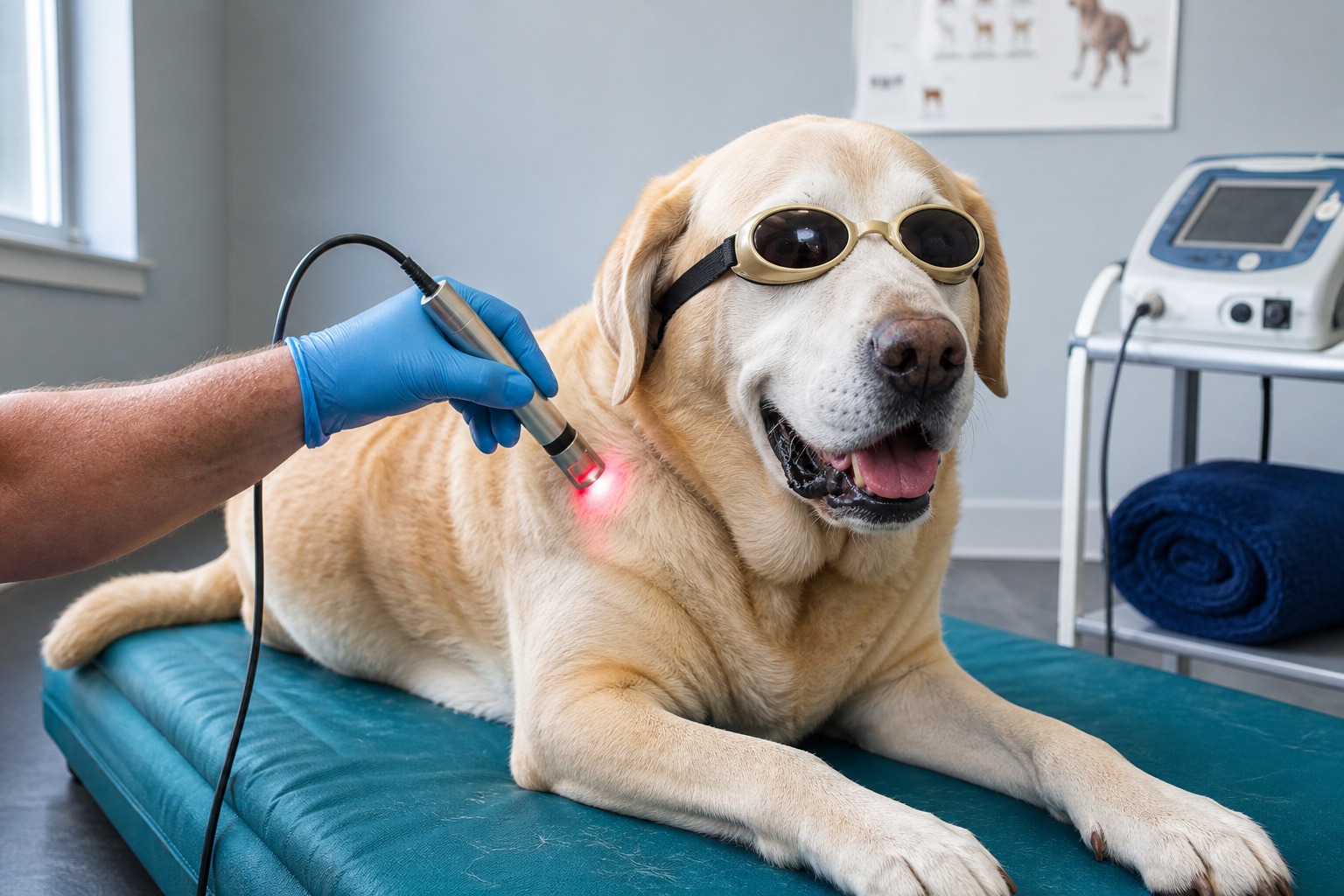
Walk into a lot of veterinary clinics these days and you will find a glowing wand, a pair of tinted goggles, and a brochure promising to speed healing and melt away your dog’s pain. It looks futuristic. It also looks, to a skeptical pet owner, a little like the wellness-industrial complex came for our dogs. So here is the fair question: is a therapy laser doing something real for your dog, or are you paying for an expensive light show?
The honest answer sits in the middle, and it is more useful than either extreme. Laser therapy is legitimate medicine with real mechanisms and a growing body of research behind it. It is also routinely oversold, wildly non-standardized, and never, on its own, a cure. Knowing the difference is what keeps you from wasting money, and what helps you actually help your dog.
What it actually is
“Laser” is an acronym: light amplification by stimulated emission of radiation. Strip away the sci-fi and a therapeutic laser is just light delivered at very specific wavelengths, tuned to reach particular tissues in the body.
The kind used to ease pain and speed healing has a proper name, photobiomodulation, or PBM. The light penetrates to the cellular level at a wound or a sore joint and nudges cells to release the factors involved in tissue repair. It also improves local circulation, which reduces swelling and brings in white blood cells that clear out damaged tissue. (That’s a different job from other laser types, like photodynamic therapy, which sets out to kill pathogens or cancer cells outright.) When a vet uses PBM, they follow a planned protocol: a set wavelength, a set session length, and a set number of visits spread over days, weeks, or months depending on how the dog responds.
What it genuinely does
The benefits are real, and they cluster around two goals: less pain, and faster healing.
Laser therapy can reduce inflammation, the redness, swelling, and tenderness that flares around an injury. It can prompt the release of endorphins and desensitize certain nerve fibers, which dulls the pain signal itself. By easing pain and swelling, it can help a stiff dog move more comfortably, and it supports healthy tissue formation, including the collagen that gives tissue its strength and stretch. And by boosting blood flow to an injured area, it speeds the whole cleanup-and-rebuild cycle along. None of that is nothing. For the right dog, it is a meaningful assist.
What it’s used for
In practice, PBM shows up for a fairly specific set of problems:
- Chronic joint pain, especially arthritis and other joint disease, where reducing pain and inflammation improves day-to-day comfort.
- Soft-tissue injuries, where it can speed healing, calm inflammation, and encourage new tissue to form.
- Surgical recovery, applied to incisions to support healing and take the edge off post-op pain and swelling.
- Focal skin conditions, the small, stubborn spots like lick granulomas, where a painful, inflamed patch of skin can be targeted directly.
The catch nobody puts on the brochure
Here is the part that matters most, and it is usually buried: there is no accepted standard for how to use laser therapy in dogs.
There are convincing studies. There is also no agreed-upon protocol tying a given condition to a given dose, which means the beam is only as good as the person aiming it. Two clinics can run the same treatment and get very different results depending on how skilled the operator is and how good the machine is. A practice using a purpose-built Class IV laser with a real protocol is a different proposition from someone waving a cheap handheld device around. So the single biggest variable in whether laser therapy helps your dog is not the technology. It is who is holding it. Choose a vet with genuine experience who matches the wavelength and protocol to your dog’s specific problem, or find a board-certified rehabilitation and pain-management specialist.
The safety picture
Used appropriately, laser therapy is considered relatively safe, and most of the risks are avoidable with the correct laser and wavelength. Worth knowing:
- Burns. A dog with a dark coat and dark skin soaks up more of the beam’s energy, which can singe fur and, in more serious cases, burn skin.
- Sensitive tissue. Lasers can harm delicate structures, including the eyes, a developing fetus, and glands that make hormones and other secretions. Those areas are strictly off-limits, and everyone present, the dog included, needs protective goggles for the session.
- Underdelivery. The subtler “risk” is simply paying for a treatment that does little because the equipment or technique is not up to the job. See the section above.
What it costs
The old guides skip this, so let’s be concrete. Most clinics charge roughly $40 to $100 per session. Because chronic conditions rarely resolve in one visit, a typical course runs six to twelve sessions, which puts a full plan somewhere around $180 to $720 or more. Many practices soften that with packages, a discounted bundle of six or ten treatments, or a “buy five, get the sixth free” deal. Price swings with geography and equipment: an urban clinic running a high-end laser will charge more than a rural practice with a basic unit.
Questions to ask before you book
A short script that separates a good laser program from an upsell:
- What condition are we treating, and what improvement should I expect to see, and by when?
- What type of laser is this, and what protocol are you using for this specific problem?
- How many sessions before we reassess whether it’s working?
- What else are we doing alongside the laser?
If the answer to that last one is “just the laser,” push back. Which brings us to the real point.
It’s one tool, not the tool
Laser therapy works best as part of a multi-modal plan, and that is not a hedge, it is how good pain and healing medicine actually works. Stacking several complementary treatments maximizes benefit and lets each one do less harm, which matters enormously in chronic conditions like arthritis or back injuries that need long-term management.
For pain, the fuller toolkit spans prescription pain relief, physical rehab, massage, acupuncture, joint and anti-inflammatory supplements, and practical tweaks to your dog’s home and daily routine that make moving around easier. For wounds, the non-negotiable first step is keeping things clean: every wound needs a vet to clean and decontaminate it properly, possibly with antibiotics or other medications, and, depending on the injury, drains, bandaging, or stitches, alongside pain control and ice or heat. Laser is a helpful layer on top of that foundation. It is not a substitute for it.
“Owners sometimes come in hoping the laser is the thing that fixes their dog, and I have to gently reset that,” says Dr. Ravi Mehta. “It earns its place inside a real plan, next to good pain control and rehab. On its own, it’s a nice light. Alongside everything else, it can genuinely move a dog’s recovery forward.”
What newer research adds
The science is still catching up to the marketing, in a good way and a cautious one. Randomized studies, including a double-blinded trial in dogs with osteoarthritis, continue to support PBM’s role in easing chronic joint pain, and the mechanisms behind it are better understood every year. What has not arrived is the thing owners most need: a standardized, condition-by-condition dosing protocol. Until that exists, “does it work” will keep depending partly on “who’s doing it.”
One newer wrinkle worth knowing about is the rise of at-home laser units, including rental devices marketed to owners of dogs with conditions like IVDD who need frequent treatment between vet visits. They can lower cost and hassle, but they also put the dose in untrained hands, which raises the odds of both underdelivery and the eye-and-skin risks above. If you go that route, do it under the direct guidance of your vet, with a clear protocol and proper eye protection, never freelance.
References
- Alves, J., et al., “A randomized double-blinded controlled trial on the effects of photobiomodulation therapy in dogs with osteoarthritis,” American Journal of Veterinary Research, 83(8), 2022
- Dompe, C., et al., “Photobiomodulation — Underlying Mechanism and Clinical Applications,” Journal of Clinical Medicine, 9(6), 2020
- Draper, W. E., et al., “Low-level laser therapy reduces time to ambulation in dogs after hemilaminectomy,” Journal of Small Animal Practice, 54(1), 2013
- Wardlaw, J., et al., “Laser Therapy for Incision Healing in 9 Dogs,” Frontiers in Veterinary Science, 5, 2019
- Koh, R., “Applications of Therapeutic Laser in Your Daily Practice,” World Small Animal Veterinary Association Congress Proceedings, 2018