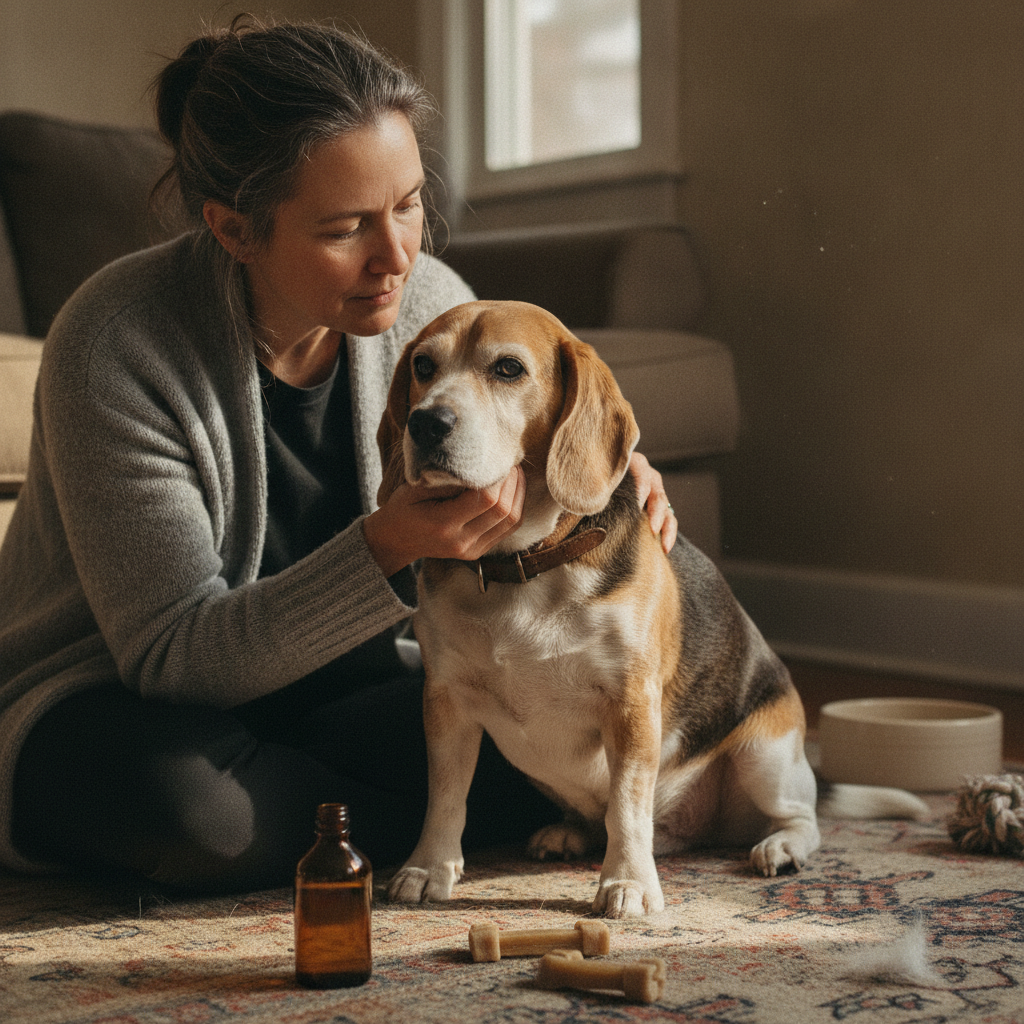
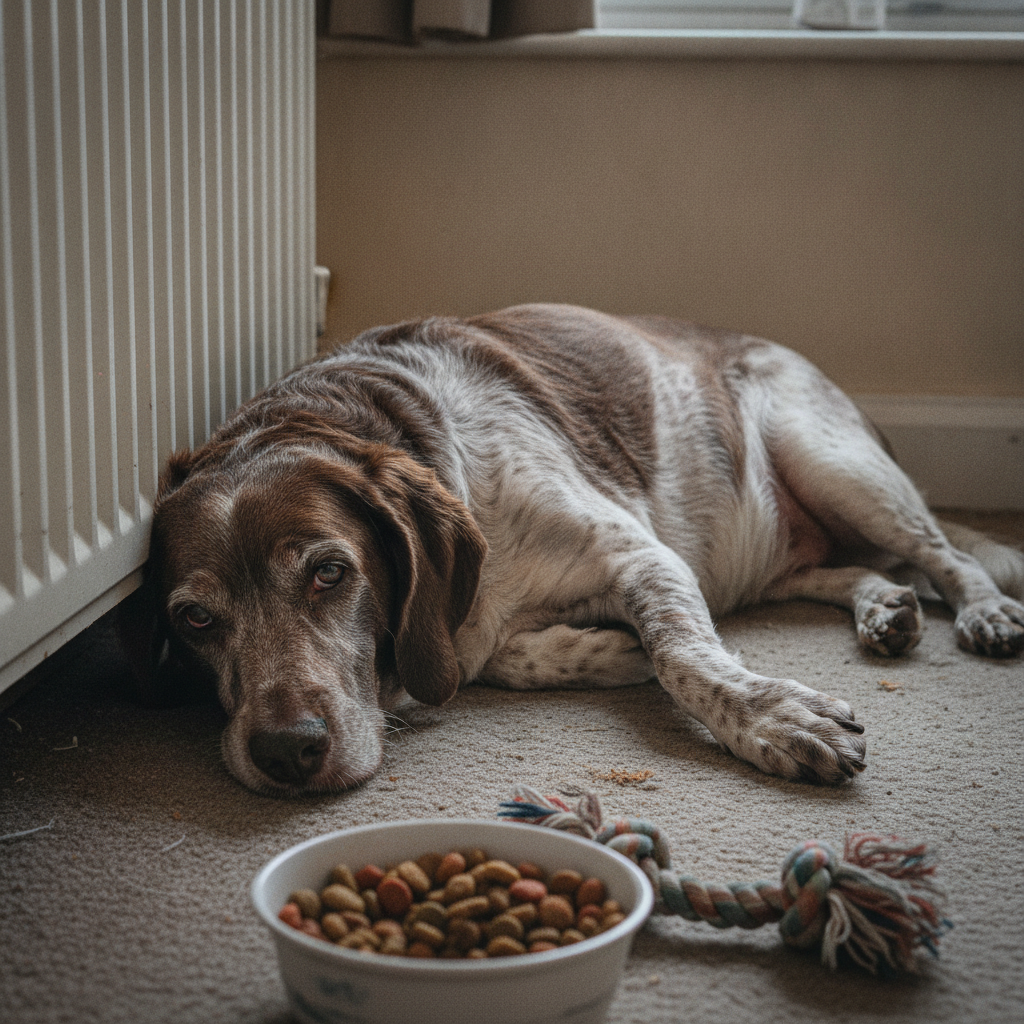
Your dog sleeps a lot. Fine, dogs sleep a lot. But he is also getting heavy on the same amount of food, he seeks out the radiator in a house you keep perfectly warm, his coat has gone thin and slightly rank, and the whole thing crept up so gradually that you never had a day where you thought, something is wrong.
That is the classic presentation, and hypothyroidism is worth taking seriously. Primary hypothyroidism is the most common hormonal disorder in dogs, and it is thoroughly treatable.
It is also over-diagnosed, and under-diagnosed, at the same time. Both of those failures come from the same source, which is that the blood test everyone relies on is far less decisive than it looks on the printout. A number on a page feels like an answer. Here, it frequently isn’t.
What the disease actually is
The thyroid gland sits in the neck and sets the pace of the body’s metabolism. It responds to TSH, thyroid-stimulating hormone, sent down from the pituitary, and it produces T4, also called thyroxine, and T3, or triiodothyronine, which are the currency the body spends on turning food into energy.
In hypothyroidism, the gland shrinks or is inflamed and cannot answer the pituitary’s request properly. Output drops. Metabolism slows to a crawl, and everything downstream of metabolism slows with it.
More than 95 percent of canine cases come from one of two causes: idiopathic atrophy, where the gland simply wastes away for no known reason, or immune-mediated destruction, where the dog’s own immune system dismantles it. Cancer, which is what most people fear, is a rare cause in dogs.
The average dog with this is about seven years old. It skews large-breed, Dobermans, Golden Retrievers, Irish Setters, Great Danes, and Boxers, but it turns up plenty in Cocker Spaniels, Dachshunds, Poodles, and Miniature Schnauzers too.
The signs, and why they hide
The tell-tale picture is weight gain, lethargy, cold intolerance, and skin and coat changes, and the coat changes are often what actually gets a dog through the door: yeasty-smelling fur, excessive shedding, and dark, lacy patches of pigment appearing in the groin.
On bloodwork, hypothyroid dogs tend to run elevated fasting cholesterol and triglycerides, elevated liver values, and a mild anemia. Less often you see neurological weakness, poor appetite, deposits on the cornea, a slow heart rate, a heart arrhythmia, or infertility.
What makes it a difficult diagnosis is not the signs themselves. It is that every one of them is also a plausible description of a middle-aged dog getting older, and they arrive so gradually that there is never an alarming moment. The disease’s best camouflage is that it looks like time passing.
The part nobody explains: the test is unreliable in both directions
Here is where most owners get lost, and where a great many dogs get put on a lifelong drug they never needed.
A low T4 does not mean hypothyroid. This is called euthyroid sick syndrome, and it is common. Any significant illness elsewhere in the body, kidney disease, infection, cancer, will suppress thyroid values in a dog whose thyroid is perfectly healthy. So will a long list of drugs. Phenobarbital, trimethoprim-sulfonamide, zonisamide, clomipramine, and any glucocorticoid all lower T4, and the steroids include the topical ones, the drops you have been putting in his ears for a chronic infection.
Some dogs also just run low as a matter of breed. Sighthounds, Basenjis, and highly athletic dogs have normally lower thyroid values, and testing them against a general reference range will make a healthy dog look sick.
A normal TSH does not rule it out, either. Between roughly 13 and 38 percent of genuinely hypothyroid dogs have a normal TSH concentration, which knocks out the single most intuitive confirmatory test in a substantial minority of real cases. Around 85 percent of hypothyroid dogs with a low total T4 will show elevated TSH. The other 15 percent are the ones that turn a diagnosis into detective work.
So the panel can call a sick dog healthy, and it can call a healthy dog sick, and the direction of the error depends on things that have nothing to do with the thyroid.
“The number of dogs on lifelong levothyroxine who were never hypothyroid is not small,” says Dr. Lena Park. “Somebody drew a T4 on a dog who happened to be on steroid ear drops, the number came back low, and that dog has been on a hormone for six years. The test result was real. The conclusion wasn’t.”
Reading the Michigan panel
When results are ambiguous, and they very often are, vets turn to the fuller thyroid panel offered by the Michigan State University Diagnostic Center for Population and Animal Health, universally referred to as the Michigan panel. It is the most thorough option available, and even it is frequently less than crystal clear.
Here is what each line actually means.
TT4, total T4. The grand total of thyroxine in the blood, counting both the portion locked to carrier proteins and the portion floating free. It drops in hypothyroid dogs, and it also drops in dogs who are merely sick or medicated. Where it earns its keep is in the negative: a normal TT4 makes hypothyroidism very unlikely, and you can usually stop testing there.
fT4, free T4. Just the unbound portion, which is the portion the body can actually convert to T3 and spend. Also low in hypothyroid dogs, and also vulnerable to being dragged down by unrelated illness and drugs.
fT4ED, free T4 by equilibrium dialysis. The upgrade, and worth understanding. Rather than measuring the free fraction directly, the lab first dialyzes the sample so the free hormone physically separates from the protein-bound hormone, and assays what comes through the membrane. The payoff is resistance to interference: seizure drugs, steroids, and unrelated illness knock it around far less, and thyroid autoantibodies do not distort it at all. Its one blind spot is sulfa drugs, where it cannot settle an ambiguous result.
Total T3, free T3, reverse T3. Free T3 is the active hormone. Unfortunately T3 values fluctuate independently of thyroid status, so they are poor indicators of hypothyroidism and are not what a diagnosis should rest on.
TSH. Secreted by the pituitary to push a lagging thyroid harder. Elevated in about 85 percent of hypothyroid dogs with a low TT4. The dogs whose TSH stays normal are the ones who make confirmation genuinely hard, and as noted above, that group is meaningfully large.
TgAA, antithyroglobulin antibodies. Above 35 percent of the positive control value, this is positive for lymphocytic thyroiditis, meaning the immune system is attacking the gland. Read this one carefully, because it is the most misunderstood line on the sheet. A positive TgAA tells you there is thyroid pathology. It does not tell you the dog is hypothyroid yet.
Why not? Because a thyroid gland has enormous reserve. Somewhere north of 60 percent of its function has to be gone before a dog looks unwell at all, and grinding through that much tissue can take years. In some dogs it stalls partway and never finishes. A dog can be TgAA-positive and clinically fine for a long time. What that dog needs is not medication. It is a recheck every six to twelve months.
TgAA has one more effect worth knowing: the antibodies themselves can interfere with TT4 and free T4 results, which is one more way the panel can mislead you.
When the panel and the dog disagree
The lab itself flags three situations where the fT4ED is worth adding: a dog already known to carry thyroid autoantibodies, a dog with some other illness muddying the picture, and a dog who has been on one of the drugs that skews the assay, steroids and phenobarbital being the usual suspects.
If your dog is on one of the interfering medications, the cleanest path is to work with your vet on safely weaning him off it, waiting the prescribed period, and rerunning the bloodwork on a clean slate. That is not always possible. Some dogs cannot come off their seizure medication to satisfy a thyroid question.
In that situation, vets sometimes run a therapeutic trial: six to eight weeks of levothyroxine, and then a hard look at whether the dog actually changed. This is a reasonable tool and it has a trap in it, which is that owners are highly motivated to see improvement. Decide before you start what specific, observable thing would count as a response, weight, coat, energy measured against something concrete, and hold yourself to it.
Treatment, and what recovery looks like
Once the diagnosis is real, treatment is genuinely gratifying, which is part of why this disease is worth chasing.
Oral levothyroxine, usually started around 0.02 mg/kg twice daily, is the standard. Most dogs respond well and they respond visibly. Within four to six weeks, expect more energy, sharper mental alertness, weight coming off, and a coat that starts to look like it belongs to the dog it did three years ago. Once T4 levels have normalized, many dogs can be shifted to a once-daily schedule.
Treatment is lifelong, and it needs monitoring. Follow-up bloodwork, checking total T4 and TSH, is how you confirm the dose is right rather than merely present.
The rule that beats the panel
After all the grey zones, the ambiguous numbers, and the drugs that lie to your lab, the guiding principle is short.
Treat the dog, not the bloodwork.
A low number on a dog with no clinical signs is a reason to look harder, not a reason to medicate. A normal TSH on a dog with the coat, the weight, the cold-seeking, and the cholesterol is a reason to keep investigating, not a reason to send him home. The panel is a tool for thinking about the animal. It is not a verdict about him.
And do not sleep on the warning signs on the other side of that. Slow, boring, easy-to-dismiss changes over months are exactly how this disease presents, and it is a shame to attribute five years of a dog’s flattened energy to age when it was a hormone the whole time.
What newer guidance adds
Two updates are worth knowing.
The first is that the American Animal Hospital Association’s 2023 endocrinopathies guidelines pushed the profession firmly toward a clinical-signs-first approach: start from the dog’s presentation, and use the panel to confirm or refute it, rather than screening thyroid values on dogs with no reason to suspect the disease. That is a direct response to over-diagnosis, and it is the formal version of “treat the dog, not the bloodwork.”
The second is diagnostic. Current guidance leans on evaluating fT4 and TSH together as confirmatory tests rather than trusting either alone, and there is active work on more accurate measurement of free thyroid hormones, including mass spectrometry methods that avoid some of the interference immunoassays are prone to. None of that has replaced the Michigan panel yet, but the direction is clear: better free-hormone measurement, less reliance on any single value, and more weight on what the dog in front of you is actually doing.
If your dog is already on levothyroxine and you have never been entirely sure why, that is a fair conversation to have at your next visit. Bring the original bloodwork, and bring the list of everything he was taking on the day it was drawn.
References
- Behrend, E., Ward, C., et al. “2023 AAHA Selected Endocrinopathies of Dogs and Cats Guidelines.” Journal of the American Animal Hospital Association, vol. 59, no. 3, 2023.
- Michigan State University Veterinary Diagnostic Laboratory (DCPAH). “Thyroid Diagnostics: Test Selection and Interpretation.” Michigan State University.
- Mooney, C.T. “Canine hypothyroidism: a review of aetiology and diagnosis.” New Zealand Veterinary Journal, vol. 59, no. 3, 2011, pp. 105–114.
- Scott-Moncrieff, J.C. “Clinical Signs and Concurrent Diseases of Hypothyroidism in Dogs and Cats.” Veterinary Clinics of North America: Small Animal Practice, vol. 37, no. 4, 2007, pp. 709–722.
- “Canine Hypothyroidism: Diagnosis and Treatment.” Today’s Veterinary Practice.