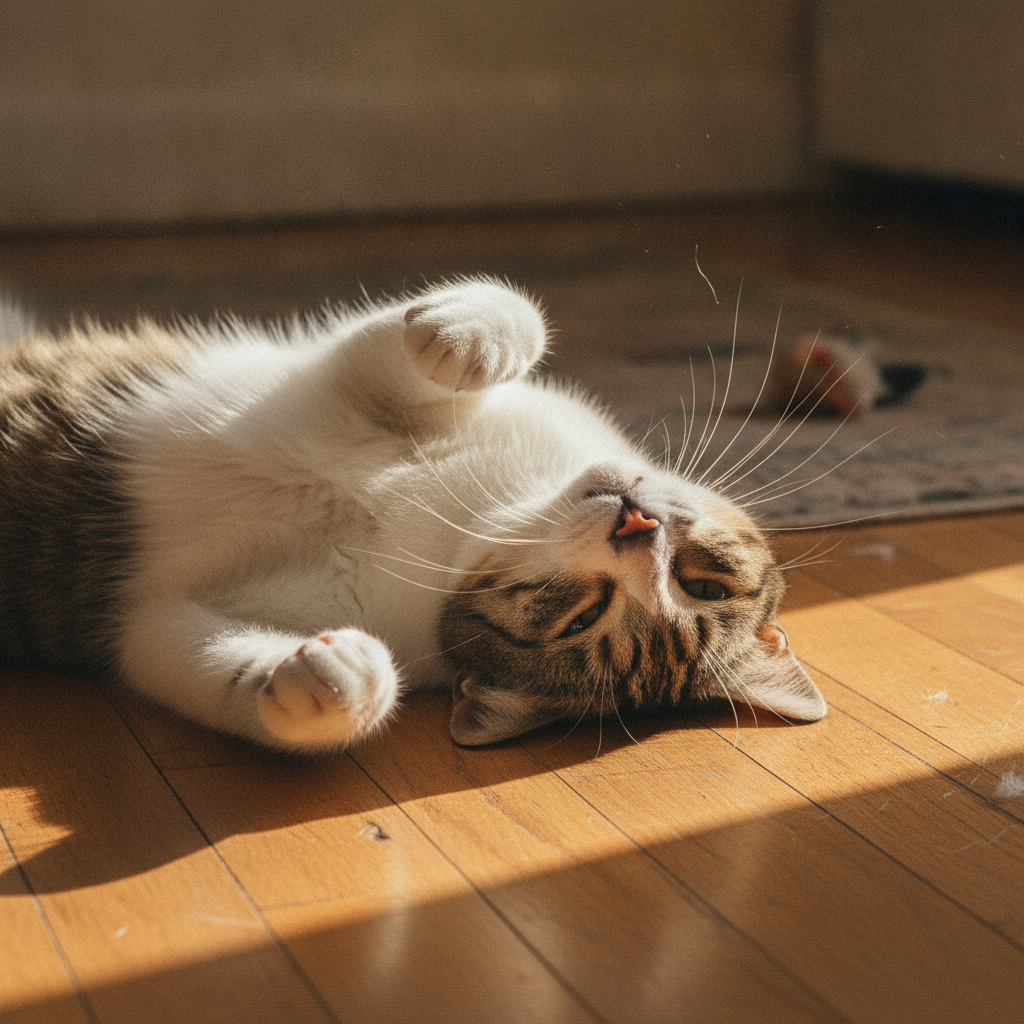
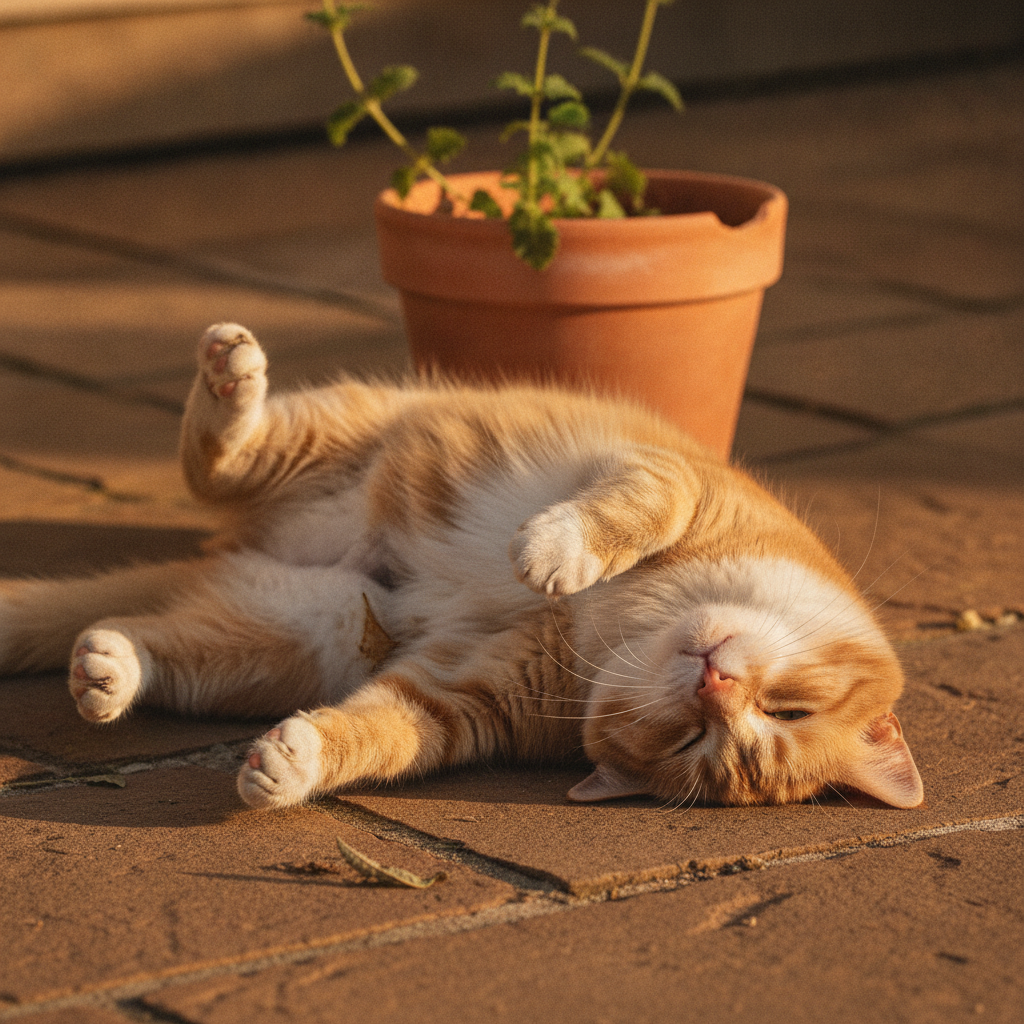
Your cat flops over, exposes their entire soft underside, and squirms around on the floor like something being electrocuted in slow motion. Every human instinct says one thing: belly.
Do not take the bait. Or at least, know what you are taking.
The belly-up roll is one of the most misread signals in the entire cat repertoire, and the reason is that we read it as an invitation when it is almost never addressed to us at all. Cats roll for at least eight distinct reasons. “I would like my stomach touched” is somewhere near the bottom, and one of the reasons near the top is genuinely astonishing: rolling is how a cat applies insect repellent.
We will get there. First, why the belly is not an offer.
The belly is a loaded position
Here is the tension at the heart of the pose.
The abdomen is a highly vulnerable area on a cat, thinly protected and holding everything that matters. Exposing it in the presence of a predator would be catastrophic. So a cat lying belly-up in your living room is, in one sense, making a statement about how safe they feel.
But belly-up is also a fighting stance. All four legs are free. All four sets of claws are pointing up at whatever is above the cat. It is the single best defensive position a cat has. A cat on its back is not disarmed; a cat on its back is fully armed.
So the same posture can mean I am completely relaxed, I am exposing something sensitive and I am aware of it, or come closer and find out. Same shape. Three meanings. This is why the confident dive toward the stomach goes wrong so often.
With a cat you know extremely well, who has a track record of enjoying belly contact, go ahead. Be gentle and watch their body. The moment you see the tail start swishing harder, the ears rotate, the pupils blow, the body stiffen, or the head turn toward your hand: stop. That is a cat crossing from tolerating to defending, and the bite that follows is not a betrayal, it is the fourth or fifth warning.
With a cat you do not know well, admire the belly from a respectful distance. If you want to say hello, start with the head, if they seem open to it, and read what happens next. Going straight for the stomach of an unfamiliar cat is not friendliness. It is a lunge.
Now the eight reasons they are actually doing it
1. It feels good
The least glamorous explanation and probably the most common. Rolling on a firm surface is a back scratch and a massage in one. If your cat enjoys the sensation, they will repeat it. That is the whole mechanism.
2. It leaves their scent
Cats carry scent glands in multiple places on the body, and rolling presses those glands against the floor, the rug, your leg, or the sun-warmed patio. Scent-marking is one of the primary ways cats organize their world, and depositing their own smell on a surface is self-soothing, especially in an environment that feels a bit uncertain.
3. It is territorial
The same mechanism, aimed outward. A rolled-on surface carries a scent signature that tells any visiting cat who has been here, and, crucially, how recently. Scent decays predictably, so the strength of a mark is a timestamp. A strong mark says the resident is probably still around and you may want to move along.
4. It is thermoregulation
Cats instinctively hunt for surfaces at the right temperature. On a hot day, they will roll on cool tile or stone, pressing the thin-furred belly against it. On a cold day, they will roll in front of a heat vent or a fire, exposing that same belly to the warmth. The roll is a way of putting the least-insulated part of their body against the thing they want.
5. It is a mating display
An unspayed female in heat rolls constantly. The hormonal surge that comes with a heat cycle drives exactly this trio of behaviors, rolling, loud vocalizing, and heavy scent deposition, and all three are aimed at broadcasting availability to any male within range. If your unspayed cat has suddenly become a rolling, yowling, extremely affectionate machine, this is what you are looking at.
6. It works on you
Cats are excellent at operant learning. If the exposed belly reliably produces a squeal, a delighted voice, and immediate attention, then the exposed belly is a functioning tool for getting attention. Many cats have figured this out. This is not manipulation; it is your cat correctly identifying which of their behaviors you reward.
7. It is relief-seeking, and this one is a symptom
Cats in physical discomfort roll. Itchy skin drives it, and cats with allergies will roll and squirm to scratch what they cannot reach. Pain drives it, in the same way a person with a bad back cannot get comfortable and keeps shifting.
This is the version you need to be able to spot, and there is a section on it below.
8. It is chemical warfare
And here is the one that reframes the whole behavior.
The catnip roll is not a high. It is application.
Everybody knows cats roll in catnip. The assumption is that it is recreational: the plant makes them euphoric, they wriggle around in it, we film it.
In 2021, researchers published work in Science Advances showing that the rolling has a function, and the function is defensive.
Catnip produces an iridoid compound called nepetalactone; silver vine, its Asian cousin, produces nepetalactol among several related compounds. When a cat rubs and rolls against these plants, it transfers those iridoids onto the cat’s face, head, and fur. The researchers then tested whether that mattered, and found that significantly fewer mosquitoes landed on cats carrying the compounds than on cats without them.
The euphoria is real, and the mechanism for it is now mapped: the olfactory system detects nepetalactol, which triggers the release of β-endorphin and activation of μ-opioid receptors, the same reward pathway that produces the bliss face. That opioid rush is what drives the rubbing and rolling.
Which means the “high” is not the point. The high is the delivery system. Evolution built a reward loop that makes cats compulsively coat themselves in a mosquito repellent, and, in the process, plausibly protects them from mosquito-borne disease. And follow-up work found the effect is enhanced when cats damage the leaves by chewing and mauling them, which increases the release of the active compounds.
Your cat is not getting stoned. Your cat is spraying themselves down before going outside, and has been doing it for a very long time without telling you.
The difference between a happy roll and a medical roll
This is the practical core of the article. Three questions, in order.
Is it new? A cat who has rolled around like an idiot since kittenhood, and is still doing it, is fine. A cat who has suddenly started rolling in a way they never did before, especially alongside any other change, appetite, energy, play, tolerance for being touched, needs a vet.
Can you interrupt it? This is the sharpest test. Toss their favorite toy. Say their name. Pick them up and set them down. A cat rolling for fun will stop, get distracted, and go do something else. A cat rolling to relieve discomfort will ignore you, or pause and go straight back to it, because the rolling is more important to them than you are. That is a red flag, and it is a good one, because it is easy to run.
Do they look like they are enjoying it? There is an obvious difference between loose, silly, carefree flopping and intense, tense rolling, with the ears back, vocalizing, pupils wide, body rigid. Distress looks like distress. Trust yourself here.
If any of those point the wrong way, take a video before you go to the vet. A clinician watching thirty seconds of the actual behavior can see things you cannot: whether your cat is targeting one part of their body, whether their gait is off, whether the face shows pain. Your description of the rolling is worth far less than the rolling.
What’s new since this was written
The catnip finding is the update, and it is a big one, because it turns a piece of comedy into a piece of biology. Cats rubbing and rolling in iridoid-producing plants gain a measurable defense against mosquito landings, and the opioid reward system is the machinery that makes them do it reliably. Later work confirmed that when cats chew and tear the leaves, the chemical release, and therefore the repellency, increases.
There is a modest practical upshot. If your cat goes outdoors and enjoys silver vine or catnip, a plant in the garden is doing more for them than entertainment. It is not a substitute for veterinary parasite prevention, which handles fleas, ticks, and heartworm, and none of that changes. But the roll in the catnip has earned some respect.
The wider shift is that behaviors we filed under “cats are silly” keep turning out to be load-bearing. The belly-up roll is a scent tool, a thermal tool, a social signal, a symptom, and a chemical applicator. It is almost never a request for a belly rub.
References
- Uenoyama, R., Miyazaki, T., Hurst, J. L., et al. (2021). The characteristic response of domestic cats to plant iridoids allows them to gain chemical defense against mosquitoes. Science Advances.
- Uenoyama, R., et al. (2022). Domestic cat damage to plant leaves containing iridoids enhances chemical repellency to pests. iScience.
- Ohio State University Indoor Pet Initiative. Reading Your Cat’s Body Language.
- Merola, I., & Mills, D. S. (2016). Behavioural signs of pain in cats: an expert consensus. PLOS ONE.