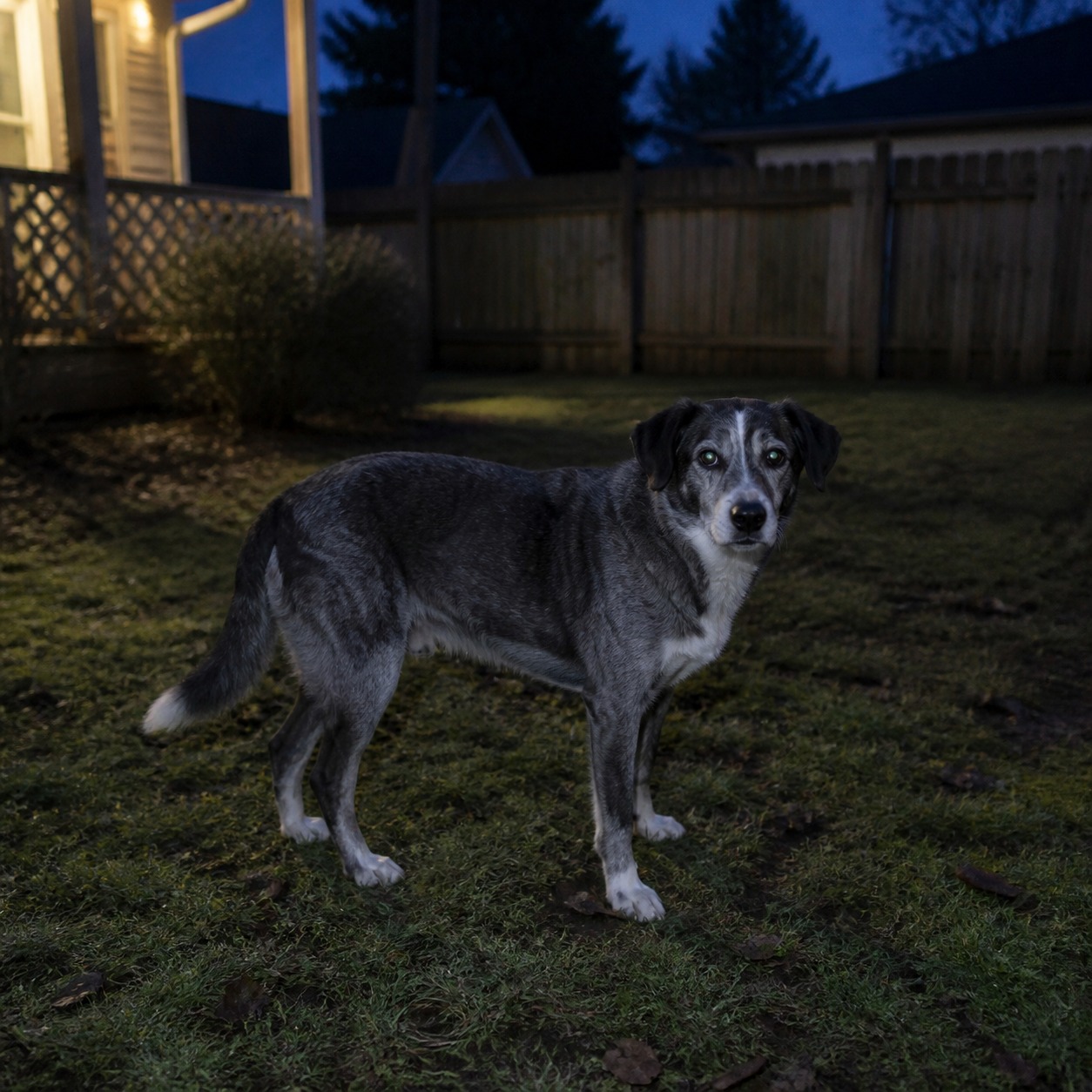
You walk into a dark room, two coins of green light swing toward you, and for one undignified second you are certain something has broken into your house. It is the dog. It is always the dog.
Here is what is actually happening, and it is better than the jump scare: your dog is carrying a mirror behind each retina. It is a genuine biological reflector, and it is the reason they can work at dusk while you are squinting.
It is also, in a trade nobody talks about, the reason your dog’s eyesight is blurrier than yours. The glow is not a superpower with no price tag. It is a deal, and understanding the deal is what makes your dog’s whole sensory world make sense.
Nothing is glowing
First, the correction that reframes everything. Dogs’ eyes do not emit light. They reflect it.
Follow a photon in. It enters through the cornea, the clear front surface. It passes through the pupil, the opening whose size the iris adjusts to control how much light gets through. It hits the lens, which changes shape to focus it. And then it lands on the retina, the layer at the rear of the eye that is sensitive to light, where photoreceptor cells are meant to catch it and hand the signal off to the optic nerve and the brain.
Except plenty of photons miss. They sail straight past the receptors.
In your eye, those are simply lost. In your dog’s eye, sitting between the retina and the blood vessels behind it, there is a structure called the tapetum lucidum: a layer, typically nine to twenty cells thick, packed with reflective crystals rich in zinc and the amino acid cysteine. It functions as a mirror. It bounces the missed light back through the retina, giving every photon a second run at a receptor.
Some of that reflected light escapes back out through the pupil. That is the glow. You are seeing your dog’s leftovers.
Why evolution wanted this
Dogs are not nocturnal. But they are crepuscular, most active at dawn and dusk, and those are precisely the hours when there is light but not much of it. Doubling the effective use of available light is an enormous advantage when you are hunting at dusk or trying not to be hunted.
The specific gain is motion detection. A tapetum-equipped eye is far better at picking up movement in low light than yours is. So when your dog locks onto an apparently empty corner of the yard at dusk and refuses to break the stare, take it seriously. There is a reasonable chance they are looking at something.
The price of the mirror
Now the part that almost never gets said, and it is the most interesting thing about the whole system.
Bouncing light back through the retina scatters it. A photon on its second pass is not landing cleanly where it started. The image gets a little smeared, and fine detail is lost.
This is one of the reasons dogs have worse visual acuity than we do. A human with typical vision is 20/20: they see at 20 feet what an average person sees at 20 feet. Dogs are estimated at around 20/75. Your dog would have to stand 20 feet from an object to make out the detail you can resolve from 75 feet away.
So the trade is stark. Your dog gave up sharpness to buy sensitivity. They see a blurrier world, and they see it in the dark.
“Once you understand that a dog is running a low-light, motion-sensitive system rather than a high-detail one, a lot of behavior stops looking odd,” says Dr. Nina Kohl. “The dog who does not recognize you across a field until you wave is not being aloof. They genuinely cannot resolve your face at that distance. Move, and you appear. That is the machine working exactly as designed.”
The rest of the night-vision kit
The tapetum is the headline, but it is one of three adaptations working together.
- The tapetum lucidum, giving light a second pass.
- Large pupils, which admit more light to begin with.
- A rod-heavy retina. Photoreceptors come in two types: rods, which detect light and motion, and cones, which detect color. Dogs carry proportionally more rods than we do, which makes their vision more sensitive to light and less rich in color. It is the same trade-off, repeated at the cellular level: sensitivity over detail.
Why the colors differ, and what your dog’s coat has to do with it
Not all glows are the same color, and the variation is not random.
The amount of zinc-cysteine in the tapetum affects both how reflective it is and what wavelengths it throws back. Yellow-green and orange are the most common. Blue-green, yellow, and plain green turn up regularly too.
And here is the odd, delightful part: researchers have found that eye-shine color tracks loosely with coat color. A red or brown dog skews toward an orange reflection. A white or grey dog skews green. Your dog’s eyes are, roughly speaking, coordinated with their fur, which is either a beautiful piece of shared pigment biology or a cosmic coincidence, depending on your temperament.
Age shifts it too. The tapetum is not visible at all in the first 35 days of life. It gradually develops color and prominence through early puppyhood and settles into a stable color around three months. In a senior dog, the glow can appear brighter, because the retina in front of it has thinned or degenerated with age. That is worth sitting with: a suddenly more brilliant eye-shine in an old dog is not a charming quirk, it is a structural change.
Not every dog has one
Siberian Huskies and other white-coated, blue-eyed dogs are more likely to lack a tapetum entirely. So are many dogs with one blue eye, where the tapetum on that side may be absent, unpigmented, or underdeveloped. Toy breeds like Pomeranians have smaller tapetums than large-breed dogs.
Which brings us to the red glow. If your dog’s eyes reflect red, they likely have no tapetum in that eye. With no mirror, light bounces off the retina itself, which is dense with blood vessels, and you get red back. It is exactly why human eyes go red in flash photographs. We have no tapetum either.
A dog with two different-colored reflections, or one eye that glows and one that does not, is often completely normal, particularly a dog with heterochromia. The key word is often.
The one thing that means call the vet
Here is the rule that makes this article useful rather than merely interesting.
If a dog has always had a particular eye-shine, or lack of it, that is almost certainly just their anatomy. If an adult dog’s eye-shine suddenly changes, especially in one eye, get them seen.
A new asymmetry, a newly absent glow, or a newly and unusually bright one is a change in the structures behind the eye, and those changes can signal retinal disease, degeneration, or other problems worth catching early. Eye-glow is one of the very few internal structures you can casually observe from across a room with a phone flashlight. Use it.
Otherwise, the glow is nothing. It is not harmful, it is not a symptom, and it is not a raccoon in your kitchen. It is a mirror, doing its job.
References
- Ollivier, F. J., et al. “Comparative morphology of the tapetum lucidum (among selected species).” Veterinary Ophthalmology, vol. 7, no. 1, 2004, pp. 11–22. https://onlinelibrary.wiley.com/journal/14635224
- Byosiere, S. E., Chouinard, P. A., Howell, T. J., and Bennett, P. C. “What do dogs (Canis familiaris) see? A review of vision in dogs and implications for cognition research.” Psychonomic Bulletin & Review, vol. 25, 2018, pp. 1798–1813. https://link.springer.com/article/10.3758/s13423-017-1404-7
- Ekesten, B., and Narfström, K. “Normal colour variations of the canine ocular fundus, a retrospective study in Swedish dogs.” Acta Veterinaria Scandinavica. https://actavetscand.biomedcentral.com/
- Merck Veterinary Manual. “Eye Structure and Function in Dogs.” https://www.merckvetmanual.com/dog-owners/eye-disorders-of-dogs/structure-and-function-of-the-eyes-in-dogs
- American College of Veterinary Ophthalmologists. “Vision in Dogs.” https://www.acvo.org/