

There's a Number for 'Drinking Too Much.' Most Dog Owners Don't Know It.
Vets don't eyeball excessive thirst, they measure it. Above 100 ml per kg per day is polydipsia, full stop. Here's how to run the number on your own dog, and the six conditions it points to.

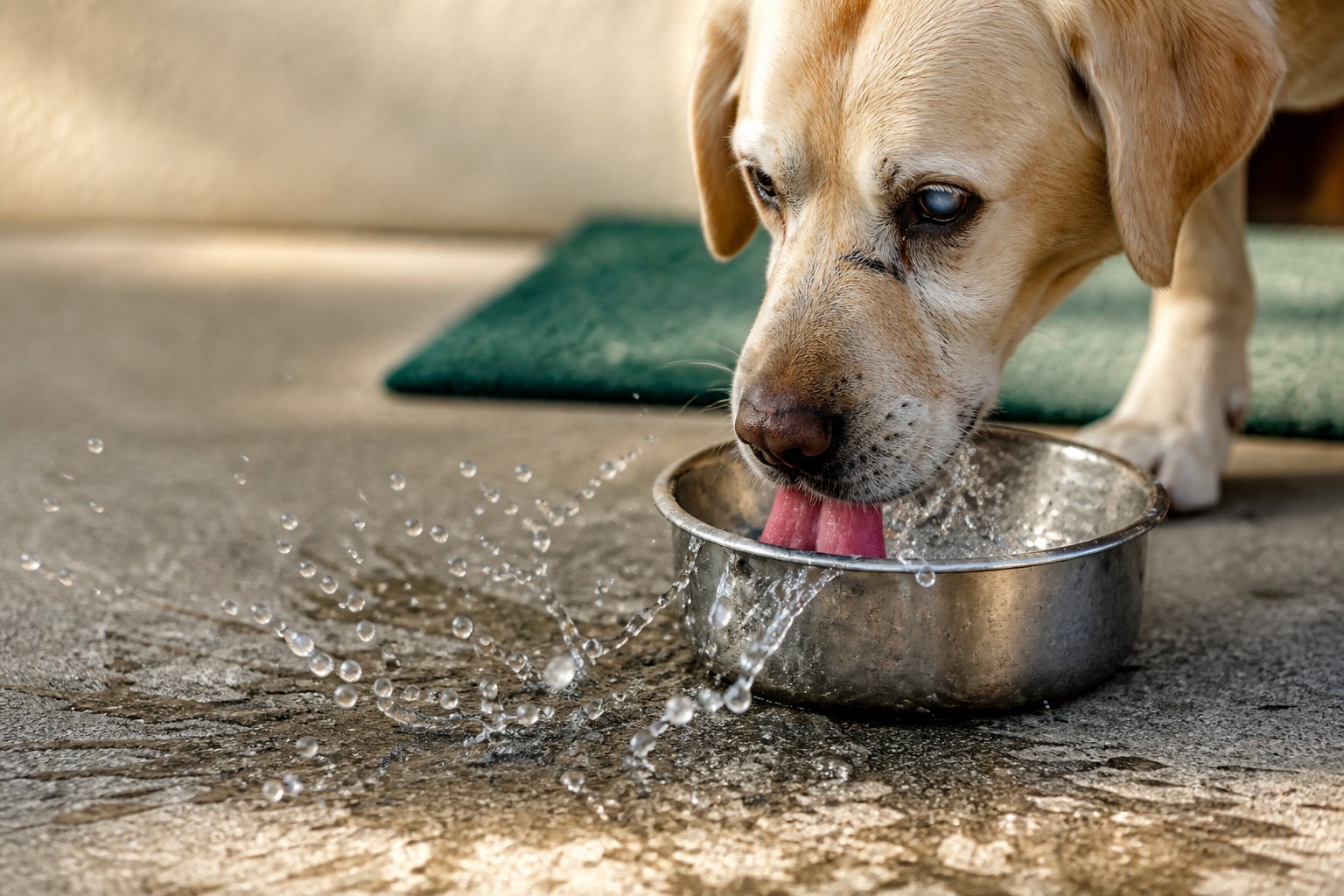
Almost every article about a dog drinking too much water tells you to “watch for a change” and “see your vet if you’re concerned.” That is not useless, exactly, but it puts the entire burden of judgment on the person least equipped to make it: you, at 11 p.m., staring at a bowl you have refilled twice.
Vets do not work that way. They have a number. Water intake above 100 ml per kilogram of body weight per day is polydipsia, and it is treated as abnormal. You can measure that at home, in a weekend, and walk into the appointment with the single most useful piece of information your vet is going to ask for.
Run the number
Normal intake for most dogs sits around 60 to 80 ml per kg per day, and under 60 is common. The upper limit of normal is 100 ml per kg per day. Above that line, your vet has a name for it and a diagnostic pathway to go with it.
Translated into a bowl:
| Dog’s weight | Typical daily intake | Polydipsia threshold (100 ml/kg) |
|---|---|---|
| 5 kg / 11 lb | ~1.3–1.7 cups | above ~2 cups |
| 10 kg / 22 lb | ~2.5–3.4 cups | above ~4.2 cups |
| 20 kg / 44 lb | ~5–6.8 cups | above ~8.5 cups |
| 30 kg / 66 lb | ~7.6–10 cups | above ~12.7 cups |
| 40 kg / 88 lb | ~10–13.5 cups | above ~17 cups |
Two honest caveats. These figures come largely from laboratory-housed dogs, so treat them as guidelines rather than gospel, and heat, humidity, and activity all legitimately move the number. And measuring is genuinely awkward: total intake includes water in canned food, juicy fruit, puddles, and toilet bowls, and in a multi-dog house you may not know who drank what.
Do it anyway, imperfectly. Measure the water in, measure what is left after 24 hours, and do it for two or three days. Even a rough figure is worth more than a vibe.
Then check the other end. Polydipsia almost always travels with polyuria, urination above about 50 ml per kg per day. You do not need to measure that. You need to notice it: more trips outside, bigger puddles, urine that has gone very pale and dilute, and sudden accidents in a house-trained dog. A dog drinking heavily and urinating heavily is a very different animal from a dog drinking heavily on a hot day.
The most valuable thing an owner can bring me is not a worry, it is a measurement. Two days of a measuring jug tells me more than an hour of description, and it is the difference between running the right test now and telling you to come back in a month.
The boring reasons, which are most of them
Most dogs who drink more this week than last week are fine. Increased thirst is a normal, healthy response to a normal, healthy cause.
Exercise. Dogs do not sweat the way we do, they pant. Panting is evaporative cooling, and evaporative cooling costs water. Hard exercise means more panting means more drinking.
Heat and dry air. Same mechanism, no exercise required.
Stress, fear, and excitement. Nervous panting loses fluid too. This is why the bowl gets emptied after a car ride, a vet visit, or a thunderstorm.
Diet. Salt drives thirst, so jerky-style treats and table scraps will do it. Some prescription diets are formulated to increase drinking deliberately, in order to dilute the urine. And switching a dog from wet food to kibble sharply reduces the water they get from food, so their drinking rises to compensate. That is not a symptom, that is arithmetic.
Medications. A long list, and it matters. Steroids like prednisone are the classic offender. Also thyroid medication, certain anti-seizure drugs, and diuretics like furosemide, which is used in heart disease and whose entire job is to move fluid. If your dog started a new drug and started drinking, call your vet, but do not panic: this is often expected.
Age. Puppies under about four months cannot concentrate their urine the way adults can. They urinate more, the urine is more dilute, and they drink more to keep up.
The pattern that reassures a vet is a one-off or short-lived rise with an obvious cause. The pattern that concerns them is sustained, progressive, and unexplained.
The six conditions on the other side of the line
Chronic, unexplained polydipsia rarely arrives alone. It usually brings other changes with it, and those companions are how the diagnosis gets made.
Dehydration. After vomiting, diarrhea, or a fever, a dog drinks to replace what they lost. A dog who is also not eating is at real risk and should be seen promptly, not monitored.
Diabetes mellitus. The classic picture: heavy drinking, large volumes of pale dilute urine, an increased appetite, and weight loss despite eating more. Diagnosed easily on routine blood and urine tests.
Kidney disease. Damaged kidneys lose the ability to concentrate urine, so water runs straight through. The dog urinates more, and drinks more to stay ahead of it. Often paired with a fading appetite and lethargy.
Cushing’s disease (hyperadrenocorticism). Overproduction of cortisol. Expect heavy drinking and urination, a pot-bellied appearance, thinning coat, panting, and a big appetite.
Pyometra. A uterine infection in an unspayed female, and a genuine emergency. Increased thirst plus lethargy plus any vaginal discharge in an intact bitch, particularly a few weeks after a season, means go now.
Everything else. Certain toxins, some tumors, liver disease, urinary problems, and excessive drooling can all present this way, which is exactly why the diagnosis belongs to a vet with bloodwork and a urinalysis, not to an article.
The accompanying signs that should sharpen your urgency: lethargy, not eating, vomiting, diarrhea, weight loss, weakness, and a coat that has gone dull or thin.
What to do at home, and what not to do
Leave the water down. This is the one rule that matters. Depriving a dog of water because they are drinking a lot can cause life-threatening dehydration, and it does not treat anything. It also erases the symptom your vet needs to see.
If house-training accidents are the real problem, solve that with more frequent trips outside, a crate or a confined area with washable flooring, and, if needed, a certified behaviorist. Not with an empty bowl.
Keep the water clean and available, particularly in heat, after exercise, and if your dog has a condition or takes a drug that drives thirst.
Do not try to make a dog drink more in normal circumstances. Healthy dogs regulate their own intake and drink to thirst. If you want to add water on a hot day, do it through food: canned food, water-rich fruit, a few ice cubes, or a splash of low-sodium broth.
Know the rare exception. Water intoxication is a rare condition in which a dog takes in so much water that blood sodium falls dangerously low. It typically happens by accident, when a dog repeatedly retrieves a toy from a pool or lake and swallows water each time, not from drinking at a bowl. Most dogs drinking to thirst stop long before this becomes possible.
What newer research adds
The single most useful development for owners is the one this whole article is built on: the field has a threshold, and it is knowable. Polydipsia is defined as intake above 100 ml/kg/day, and polyuria as output above 50 ml/kg/day, and those numbers turn a vague anxiety into a testable question.
Veterinary guidance now leans hard on a stepwise diagnostic approach: confirm the polyuria and polydipsia are real, then run a urinalysis with a urine specific gravity and a chemistry panel, then narrow from there. Which means the most valuable thing you can hand your vet is not a worry. It is a measurement, plus a note of what else changed.
Measure the bowl for three days. Watch the urine. If you cross 100 ml per kilogram and cannot explain it with heat, exercise, salt, or a new drug, make the appointment. That is the whole test.
References
- A Stepwise Diagnostic Approach to Polyuria and Polydipsia — Today’s Veterinary Practice
- Canine Polyuria and Polydipsia (PU/PD) — Cornell Richard P. Riney Canine Health Center
- Cushing’s Syndrome (Hyperadrenocorticism) in Dogs — Merck Veterinary Manual
- Total Water Intake and Urine Measures of Hydration in Adult Dogs Drinking Tap Water or a Nutrient-Enriched Water — Frontiers in Veterinary Science
- Chronic Kidney Disease in Dogs and Cats — Morris Animal Foundation
Common questions
Should I limit my dog's water if they're drinking a lot?
No. Restricting water in a dog who is drinking excessively can cause life-threatening dehydration, and it hides the very symptom your vet needs to see. Leave the water down and book the appointment.
My dog drank a huge amount after a hot walk. Is that a problem?
Almost certainly not. One-off spikes after exercise, heat, stress, or a salty meal are normal. What matters to a vet is a sustained pattern, not a single big afternoon.
What is water intoxication?
A rare but serious condition where a dog takes in so much water that blood sodium drops dangerously. It usually happens by accident, such as swallowing water while repeatedly retrieving a toy from a pool or lake, not from ordinary thirst-driven drinking.
Not a substitute for your vet. Our guidance is educational. For urgent symptoms, contact a vet or emergency clinic right away. Editorial standards
Dr. Park is a board-certified emergency and critical care specialist. She reviews our health and safety content for clinical accuracy and contributes guides on recognising urgent conditions. Her focus is helping owners act quickly and correctly when it matters most.
Meet our experts ↗Keep reading
 Health & WellnessYour Dog Pukes Every Morning? It's Probably the Clock, Not a Disease.Dr. Lena Park · 6 min
 FoodGrain-Free Was Never the Villain. Look at What Replaced the Grain.Dr. Amara Solis · 7 min
 Health & WellnessYour Dog's Burping Is Normal. Until It's the Thing That Kills Them.Dr. Lena Park · 7 min
 FoodRice Isn't a Superfood for Dogs. It's Something More Useful.Dr. Nina Kohl · 8 min
 Health & WellnessYour Dog Has Diarrhea. Step Away From the Medicine Cabinet.Dr. Lena Park · 5 min
 Health & WellnessDon't Fast a Dog With Diarrhea. The Advice Flipped, and Here's What to Feed Instead.Dr. Lena Park · 7 min