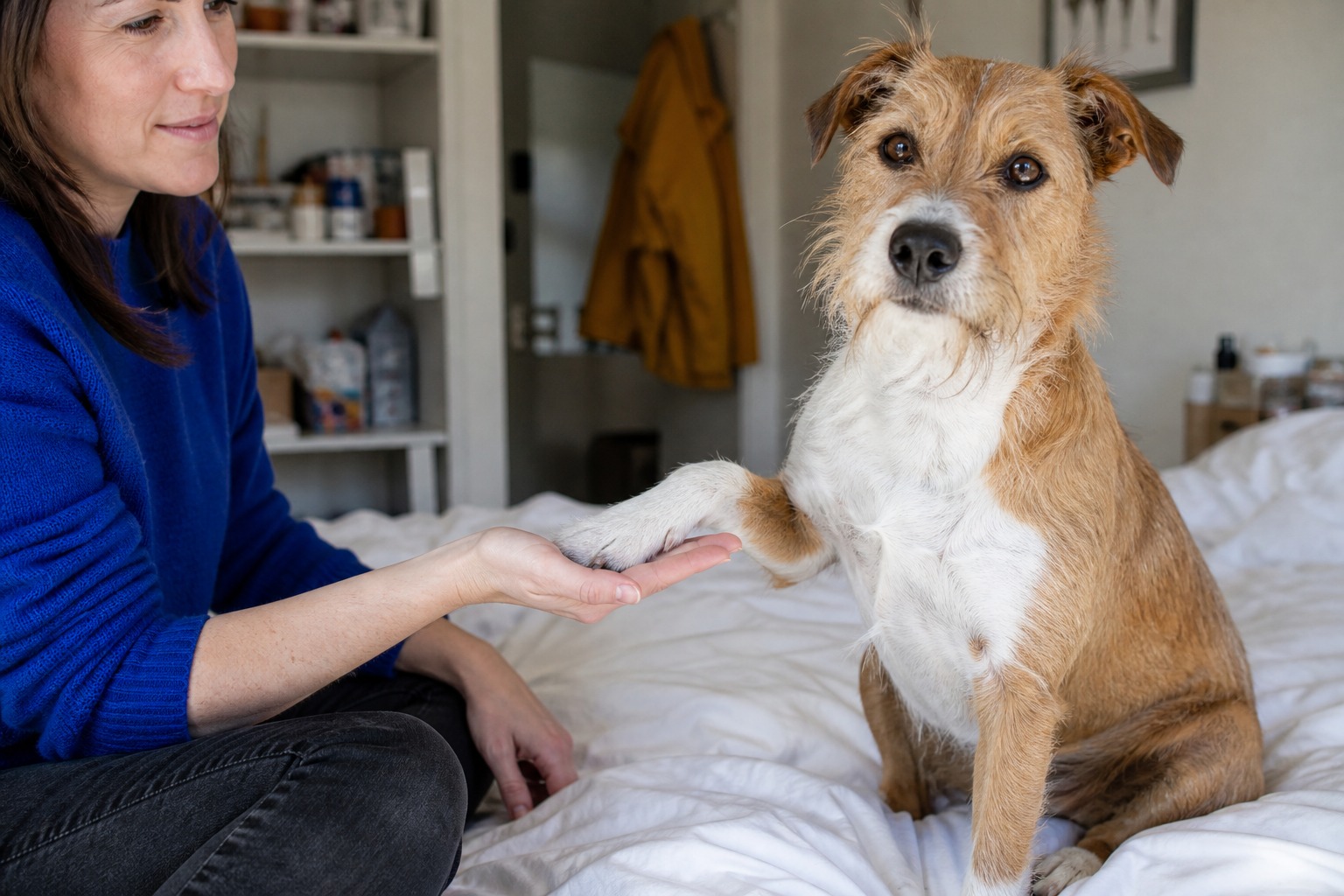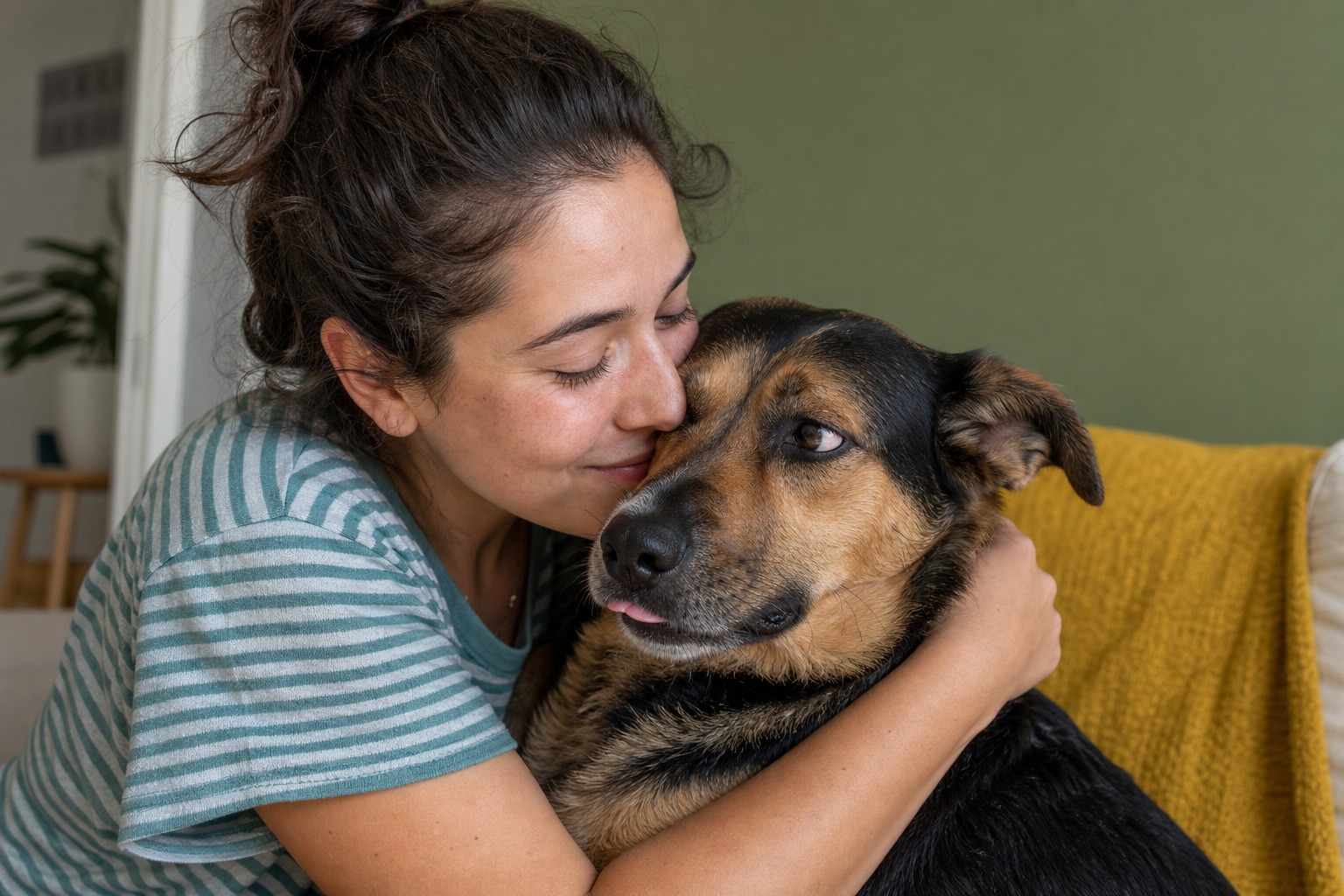
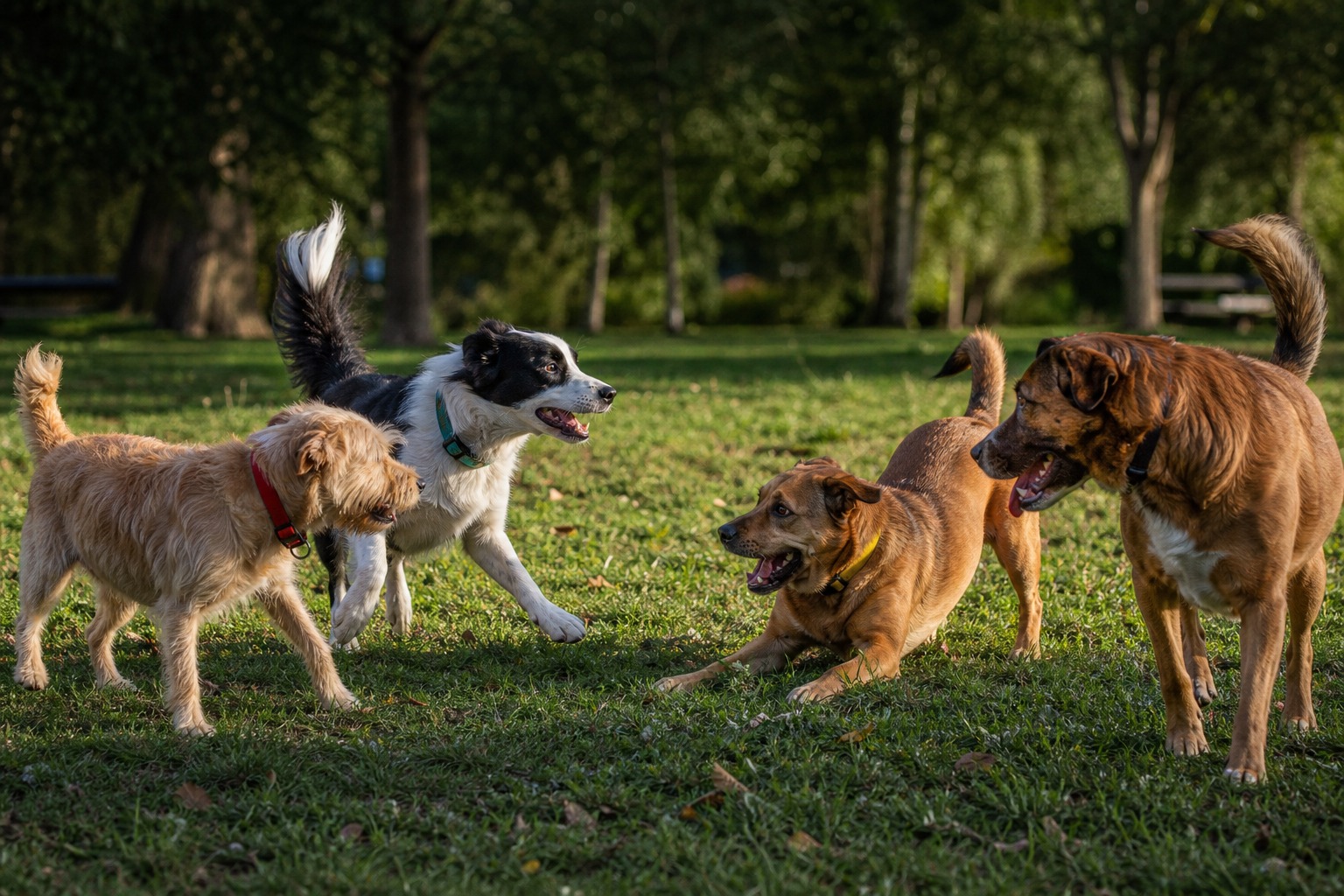
Two dogs share a home. The younger one routinely takes food and toys straight out of the older one’s mouth, which looks like textbook “dominance.” But when they reunite after time apart, that same pushy young dog greets the elder with unmistakably deferential body language, licking under the chin. And when the older dog truly cares about something, a favorite ball, he guards it with a low growl the younger one instantly respects. So which dog is “in charge”? The honest answer is that the question itself is half-broken.
For decades, a tidy story filled that gap: dogs live in rigid dominance hierarchies, they’re forever angling to climb the ladder, and if you don’t assert yourself as the “alpha,” your dog will. It’s one of the most durable ideas in dog culture. It’s also, by the lights of modern behavior science, largely wrong, and the version that made it into dog training is actively harmful.
What “dominance theory” claims
The theory goes like this: a great deal of canine aggression is really an attempt to claim higher rank over a lower-status group member, so you can supposedly defuse it by performing “high-status” behaviors yourself, borrowed from dogs or their wolf relatives. In practice this became a familiar set of rituals: always walk through doors ahead of your dog, eat before they do, never let them “win” a game of tug. The idea is that you’re constantly reminding your dog who’s boss.
Prominent behaviorists have spent years pushing back. One has half-jokingly called dominance “the D-word,” so loaded it’s barely worth discussing. Another, the applied animal behaviorist Patricia McConnell, has publicly argued that few terms in dog training get twisted and misunderstood as often as “dominance.” Their core objection: the theory was never grounded in any real science of how animal behavior actually changes, and applying it can backfire badly, increasing aggression, getting people bitten, and landing dogs in shelters or worse.
Why the science was thin for so long
Part of the problem is that hierarchy in dogs was barely studied. Researchers pored over rank in wolves, captive and wild, and in primates, but rarely in domestic dogs, who were long dismissed as a human-tainted, “unnatural” species not worth a behavioral ecologist’s attention. Combine sparse data with a charged, opinionated debate, and you get a lot of confident claims resting on very little evidence. Only recently, as the science of dog cognition has become respectable and productive, has that started to change.
What one careful study actually found
The best way to learn how dogs relate is to watch a lot of dogs relate, and that’s what researchers at Utrecht University in the Netherlands did, recording a group of 10 dogs over about two months. It was a young crew: only one adult, a two-year-old Cairn Terrier, with the rest puppies and adolescents under 18 months. Tellingly, the three top-ranked dogs were all juveniles, a six-month-old male Beagle, a one-year-old female Malinois, and a five-month-old male Doberman.
Each morning the dogs were released into an outdoor enclosure, and among thousands of interactions, researchers analyzed one-on-one exchanges to answer specific questions. How rigid was the divide between ranks? Was the hierarchy a clean line or a tangled loop? And crucially, did higher-ranking dogs bully lower-ranking ones?
The findings are worth sitting with. This group wasn’t especially egalitarian, deference between ranks was usually strict, with a lower dog greeting even a slightly higher one using submissive postures. But the hierarchy was strictly linear: if A outranked B and B outranked C, then A reliably outranked C, no weird circular upsets where the bottom dog somehow dominated the top. A couple of middle-ranking pairs were exceptions, interacting without formal rank signals, possibly because precise rank matters less in the middle, or because they were quietly jockeying for a rung.
And the headline result: aggression had nothing to do with rank. Higher-ranking dogs approached lower-ranking ones carrying raised tails and forward ears, and the subordinates answered by dropping their bodies low, sometimes dissolving into a full-body wag. Growls and lip-lifts did occur, but they flowed in both directions, from high to low and low to high alike. In this group, dominance did not predict aggression, a direct blow to the theory that treats aggression as a rank grab.
“The dominance model survives because it feels intuitive, not because it’s supported,” says Dr. Amara Solis. “When you actually measure it, rank and aggression come apart, and dogs turn out to signal status through deference, not through picking fights. Trying to ‘out-alpha’ your dog solves a problem that mostly doesn’t exist, and often creates a new one.”
What we still don’t know
One study doesn’t settle everything, and this one had real limits worth naming. The group was unusually young, and adult dogs might rank each other differently, a puppy’s full-body wag isn’t necessarily an adult’s status signal. The dogs were also fairly uniform in size and breed, roughly half Beagles, and a group of easygoing Labs might form a looser hierarchy while rule-bound German Shepherds form a tighter one. Very small dogs might behave differently again. These dogs also lived in kennels and met only briefly each day, unlike housemates who interact constantly, and we know from wolves that captivity can force more rigid hierarchies than animals choose in the wild.
Biggest of all: dominance-based training assumes dogs slot humans into their social hierarchy at all, and that assumption remains largely untested. Dogs might fold us into their ranking, or file us under a completely separate one. We simply don’t know yet.
What newer guidance adds
While the pure science is still filling in, the professional consensus on what to do with it has hardened. In 2021, the American Veterinary Society of Animal Behavior issued a position statement on humane dog training that leaves little room for the old model. It advises against using dominance theory as a training guide precisely because it invites punishment and coercion, and it recommends reward-based methods for all training, including behavior problems. Its verdict on aversive tools and techniques, prong and shock collars, intimidation, “alpha” corrections, is blunt: there’s no evidence they work better than reward-based methods in any context, and they damage both animal welfare and the human-animal bond. Leadership, the statement notes, comes from positively reinforcing the behavior you want, not from force.
So where does that leave the question we started with, who’s the “boss” of your two dogs? Probably nowhere useful. Your dogs are working out a fluid, context-dependent set of relationships that has little to do with a throne and even less to do with you. The most effective, and kindest, thing you can be isn’t their alpha. It’s their teacher.
References
- van der Borg, J. A. M., et al. “Dominance in Domestic Dogs Revisited: Useful Habit and Useful Construct?” Journal of Veterinary Behavior, 2015. https://www.sciencedirect.com/science/article/abs/pii/S1558787815000982
- American Veterinary Society of Animal Behavior. “Position Statement on Humane Dog Training,” 2021. https://avsab.org/wp-content/uploads/2021/08/AVSAB-Humane-Dog-Training-Position-Statement-2021.pdf
- American Veterinary Society of Animal Behavior. “Position Statement on the Use of Dominance Theory in Behavior Modification of Animals.” https://avsab.org/resources/position-statements/