


Your Dog Doesn't Out-Muscle You. They Out-Balance You.
Dog-walking fractures in older adults more than doubled in a decade. The fix isn't a stronger grip, it's a better stance, and Tai Chi has been teaching it for centuries. Five adjustments that keep you on your feet.

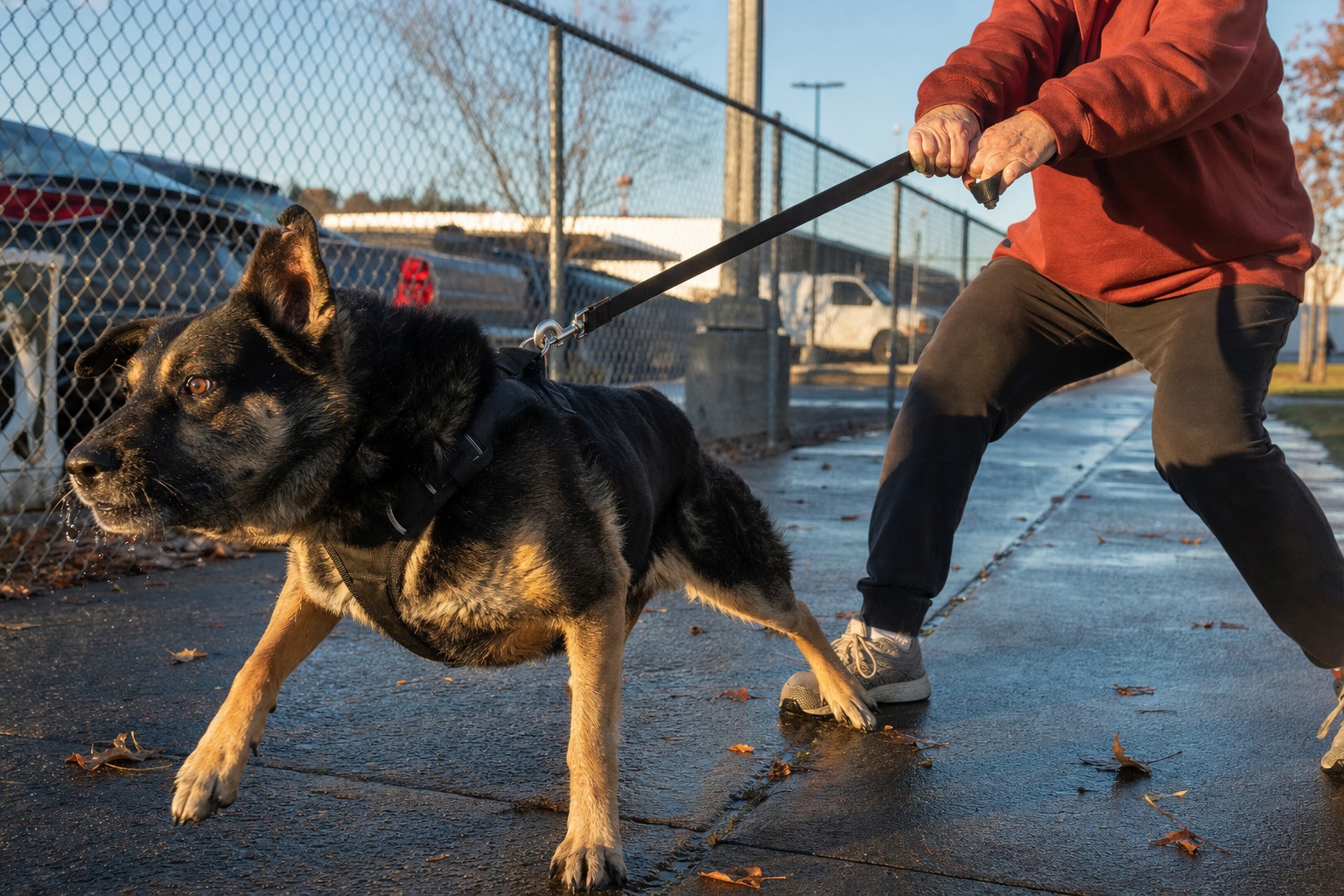
A volunteer is walking a 120-pound Mastiff across a shelter parking lot. She is a gentle dog, and she has been perfect all morning. Then something moves in the hedge, and the dog is gone, hard, at a dead sprint, and the leash is a lit fuse in a human hand.
The volunteer does not let go, because letting go and telling the staff you lost their dog is not an option. What saves her is not her grip and not her back. She gets her feet under her, drops her whole weight straight down into the asphalt, and the dog hits the end of the leash like it is anchored to the earth.
Strength did not do that. Structure did.
This is a safety issue, not a party trick
It is tempting to treat getting yanked around by a dog as comedy. The data does not.
A study in JAMA Surgery pulled national injury data and found 32,624 fall-related fractures tied to walking a leashed dog between 2004 and 2017. Among adults 65 and older, the annual number more than doubled over that span, from 1,671 to 4,396. The most common break was the hip, at about 17 percent of those injuries, which is the one that matters most: mortality in the year following a hip fracture in people over 65 runs close to 30 percent. Nearly 80 percent of the patients were women.
A separate analysis from Johns Hopkins researchers found that traumatic brain injuries were the second most common injury among adults treated in U.S. emergency rooms for leash-related incidents, and that women and adults over 65 were the most likely to be seriously hurt.
Dog walking is one of the healthiest habits in the world, and it should not stop. But the failure mode is not “the dog is too strong.” It is “the human was standing wrong when the dog moved.”
Why Tai Chi, of all things
Tai Chi, which you will also see written as tai chi chuan, taiji, or taijiquan, has a murky history that even scholars argue about. It may go back around 300 years to the Chen family, or it may stretch back more than seven centuries. What is not disputed is what it is: a martial art whose slow, dance-like choreography is unusually strict about body alignment.
That strictness has two purposes. It builds a kinetic chain through the body, so force travels from the ground up through the whole structure rather than dying in one muscle. And it obsesses over balance in any situation, which is exactly the thing a lunging dog takes away from you.
The reason it is practiced in slow motion is that slowness is how alignment gets into muscle memory. And muscle memory is the only kind you will have access to at the moment a squirrel appears.
Five principles from the Yang style, in the order they will save you.
1. For the dog who jumps: turn, don’t brace
The instinct when a dog launches at your chest is to plant and absorb it. You will lose. You are a static object accepting the full force of a moving one.
A Tai Chi practitioner refuses to be the wall. Force arriving from the right? Soften, and let your midsection swing open to the right, the way a revolving door yields to a shoulder. The dog’s momentum travels past you instead of into you, and you are still standing when it is finished.
One critical detail: the turn belongs in your waist. Twisting at the hips with your feet nailed to the ground is how knees get wrecked.
2. For the dog who pulls: get your back into it
Here is the mechanism nobody explains. When a dog pulls you forward, your center of gravity travels up, out of your gut and into your chest and shoulders. That is a double disaster: it makes you harder to balance, and it feeds your dog’s forward momentum, which is precisely the thing you are trying to interrupt.
Then, from that already-bad position, you pull back with your arm. You are now pitting one bicep against every muscle in a dog’s body. It is not a fair fight and you are not the favorite.
Three small adjustments hand the job to your back instead:
- Let the shoulders settle. Unclench the tops of them and let the shoulder blades slide down your back and a little toward the front of your body. Desk workers will find this the hardest of the three and need it the most.
- Point the elbows down. Heavy elbows, aimed at the floor, never winged out to the sides. Winged elbows recruit small, comparatively weak muscles high in the back and shoulder. Heavy ones recruit the big ones underneath.
- Soften the chest. Draw the middle of your chest a fraction inward and down. It is a millimeter of movement, and your thoracic spine should not round at all. It just rounds the feeling across the chest and back enough to keep the large muscles engaged and the spine supported.
Together, those three link your entire upper body into a single unit. That is what should be holding the leash, not an arm.
3. For the constant puller: shift, don’t yank
Your dog believes everything worthwhile in this world sits about four feet past the end of the leash. Do not pull back against that. Pulling invites pulling.
Instead, stagger your stance as though you have been frozen mid-stride, and let roughly 60 percent of your weight settle onto the rear leg, sinking into it like a slow single-leg squat. Leave the front foot lightly loaded so it can still act as a brake. Do not tip your upper body backward, which only puts your head behind your hips and turns you into a falling object. Hips and torso travel back together, as one piece.
The leash is now anchored to your mass rather than your bicep. Mass wins that argument.
4. For anything sudden: root
Rooting is the one that saved the volunteer in the parking lot. Send your weight and your attention straight down through your feet, the way a tree sends everything downward before it grows a single inch upward. Squat if you have to. Nobody is watching.
When your dog erupts, picture every ounce of your force firing into the pavement. What the dog feels on the other end of that leash is no longer a person who can be moved. It is landscaping. It works on jumpers too: when a dog is too short for a waist turn to help, do not brace and topple. Get low instead.
5. For all of it: relax, because tension is slow
Tension makes you slow. That is the whole claim, and the tradition means it literally: a clenched body restricts the flow of blood, and of qi, its word for internal energy, to the muscles that are about to be asked for something. But there is a second bottleneck, and it sits between your ears. Deliberating costs time you do not have. The response you are busy selecting could already be happening.
So loosen the muscles, quiet the head, and your reaction gets faster. Easy to write. Hard enough to do that people practice it for decades.
Standing meditation sounds like a contradiction and is a cornerstone of the training. Set your feet apart at whatever width feels sustainable, narrower is harder, because your balance has to do more of the work, and float your arms up in front of your chest as if a large beach ball were resting in them. Now run the checklist: shoulders settled, elbows heavy, chest soft, center of gravity located, weight sinking through the floor.
That is the whole drill. Five minutes in a hallway, no form to memorize, no class to join. It is how these alignments get into your body before the afternoon you need them.
What newer research adds
The good news buried in the injury numbers is that most of these incidents are preventable, and the prevention is not exotic. Researchers looking at leash injuries consistently land on the same three levers: the equipment, the training, and the handler’s own stability.
The equipment part is simple. A fixed-length leash, held with a relaxed grip, and a well-fitted front-clip harness will reduce the peak force that reaches your body in the first place. Retractable leashes are the worst possible tool here, because they guarantee your dog reaches full speed before the line goes tight. Never wrap a leash around your wrist or your hand.
The training part is the long game, and it is the real answer. A dog with a reliable loose-leash walk and a solid “leave it” is not a dog who yanks you into traffic. Teaching that is worth more than any stance.
But training takes months, and squirrels do not wait. Which is the case for the third lever, the one this article is about: while you are teaching the end of the leash that has four legs, spend five minutes a day teaching the end that has two.
References
- Pirruccio K, Yoon YM, Ahn J. Fractures in elderly Americans associated with walking leashed dogs — JAMA Surgery (2019)
- Walking a leashed dog associated with risk of traumatic brain injury among adults — Johns Hopkins Medicine
- Leash-related injuries associated with dog walking: an understudied risk for dog owners? — Journal of the American Veterinary Medical Association (2024)
- Tai chi and chronic disease: health benefits — National Center for Complementary and Integrative Health
Marcus Webb writes about the gear, gadgets, and everyday choices that make life with a pet easier. His coverage runs from product picks to training and the causes worth paying attention to, always with an eye on what actually earns a place in your home.
Meet our experts ↗Keep reading
 TrainingOne Cue Gets Your Dog Off the Door and Out From Under Your FeetDr. Mara Chen · 7 min
 TrainingYour Dog Doesn't Fail at Restaurants. They Fail in the First 90 Seconds.Dr. Nina Kohl · 7 min
 TrainingYour Dog Has a Perfect Recall. It's Just Not to the Word 'Come.'Dr. Lena Park · 7 min
 Training'Back Up' Is the Most Useful Trick Your Dog Doesn't KnowDr. Nina Kohl · 6 min
 TrainingYour Dog Isn't Being Stubborn About the Snow. They're Confused.Dr. Amara Solis · 7 min
 TrainingYour Dog Isn't Being Bad at the Door. They're Winning a Game You Keep Playing.Dr. Nina Kohl · 6 min