

The 'Contentment Ceremony' Is Just Your Dog Being a Dog
PetTok says the post-meal flop-and-roll is your dog's thank-you ritual. The truth is sweeter and simpler, with one real caution about timing it around dinner.

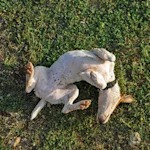
If you spend any time on PetTok, you have seen it: a dog flops onto their back, legs paddling at the sky, and rolls around rubbing their face into a blanket or the grass, usually right after a meal or a good moment. The videos have a name for it — the “contentment ceremony” — and a story to go with it: your dog is performing a little ritual to say thank you, to express pure joy.
It is genuinely adorable. It is also a case of the internet wrapping a tidy narrative around something looser and, honestly, more interesting. Let’s separate what your dog is actually doing from what the caption claims.
Is a “contentment ceremony” real?
Sort of, but not as a defined phenomenon. There is no study that identifies a specific canine ritual called a contentment ceremony. What there is, and what those videos are capturing, is relaxed, happy body language. A dog rolling on their back with loose, floppy limbs and an open posture is showing you classic signs of a dog who feels safe and comfortable. That part is real and worth celebrating. It just is not a ceremony so much as a dog being unguarded.
And often, more than one thing is going on at once. That roll might be pure feel-good flopping. It might also be practical — scratching an itchy back or face against a surface the dog cannot easily reach with a paw. Or it might be the ancient urge to roll in something interesting-smelling out in the yard, an instinct with roots in masking their own scent. A single roll can be joy and an itch and a scent thing all braided together.
There is one more ingredient the videos tend to miss: you. If your dog rolls around after dinner and you respond with a delighted, high-pitched “oh my gosh, look at you!” — congratulations, you just reinforced it. Dogs repeat what earns a happy reaction from their favorite person. A lot of “ceremonies” are partly a behavior your dog learned gets a joyful squeal out of you, which is its own kind of sweet.
When a dog throws themselves onto their back with everything loose and open, that’s a dog telling you they feel safe in your home, and that’s the real headline. I just don’t want people reading a rigid meaning into it. Sometimes it’s bliss, sometimes it’s an itch, sometimes it’s both. The skill isn’t naming the ritual — it’s learning your own dog’s particular tells.
The one caution worth taking seriously
Here is where a cute trend meets real veterinary advice. Encouraging a big, high-energy flop-fest is fine most of the time, but be careful right after your dog eats. Riling a dog up immediately after a meal can lead to digestive upset, and in deep-chested dogs especially it is a factor associated with bloat, or gastric dilatation-volvulus (GDV) — a twisted stomach that is a true, life-threatening emergency. The old “rest and digest” wisdom applies: let the meal settle before the zoomies.
While you are watching post-meal behavior, keep an eye out for signs that are the opposite of contentment. Lip-smacking, hard or repeated swallowing, excessive burping, staring into space, or tucking the belly upward can signal nausea, reflux, or pain rather than joy. And if you ever see a hard, distended, or tense abdomen along with unproductive retching, that is a call-your-vet-immediately situation, not a ceremony.
So how do you actually know your dog is content?
You read your dog, not a trend. Dogs communicate mostly through body language, and happiness looks different across individuals and breeds. A Labrador’s open-mouthed, loose-bodied joy is easy to spot; a Bulldog’s wrinkled face takes more practice to interpret. Watch the reliable channels: a loose, sweeping tail, soft relaxed ears, an easy open posture, a face without tension. Some dogs broadcast their good mood by bouncing around; others show it quietly with a gentle wag and a settled body.
When your dog does flop over, belly up, tongue lolling, without a care in the world, take the compliment. Exposing the belly is an act of trust — a dog only gets that vulnerable when they feel genuinely safe with you. Even if part of that roll is scratching a hard-to-reach spot, they are choosing to do it right there in front of you, which tells you plenty.
The real takeaway
Call it a contentment ceremony if you like; the label is harmless and the videos are delightful. Just do not mistake a cute caption for a scientific fact, and do not force the behavior around mealtime. The genuinely useful move is quieter than any trend: learn the specific signals your own dog uses to say “I’m happy and I feel safe,” and trust those. A dog who rolls, flops, and goes soft in your presence is usually telling you the best thing an owner can hear — that you are doing a good job.
Dr. Chen is a small-animal veterinarian who leads health and safety coverage at The Pet Times. She writes and reviews the bulk of our illness, condition, and safety content, translating clinical guidance into clear, practical advice owners can act on at home.
Meet our experts ↗Keep reading
 LivingThe Real Danger of Tying Your Dog Outside a Store Isn't Your DogDr. Nina Kohl · 6 min
 First DaysIf Your Dog Needed Emergency Surgery Tomorrow, Could Your Sitter Say Yes?Claire Sutton · 7 min
 LivingTied Up for a Few Minutes, Gone in Seconds: A Chicago Dog's Close CallJames Okafor · 5 min
 LivingA Dog Invented the Booty Call. Now Science Is Building the Dog PhoneJames Okafor · 4 min
 Living8 Floppy-Eared Breeds, and the Strange Reason Dogs Have Those Ears at AllClaire Sutton · 7 min
 Health & WellnessDon't Skip Your Dog's Summer Workout. Move It. Here Are 7 Ways.Dr. Lena Park · 7 min