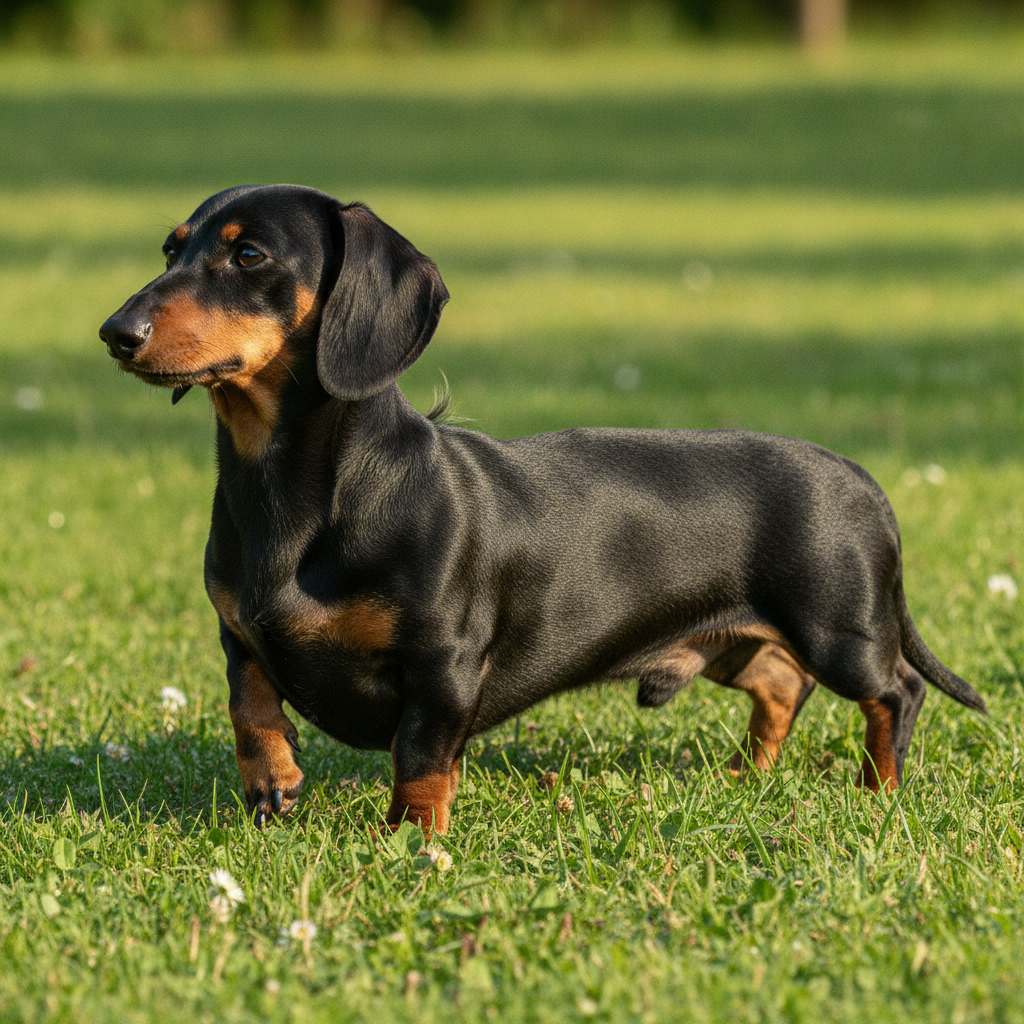
Ask a Dachshund lover their least favorite word and it might just be “Dachshund” — partly because it’s a nightmare to spell, and partly because these dogs already have better names. Hot dog. Wiener dog. Sausage dog. The long, low, faintly absurd silhouette is the most recognizable in dogdom.
But the shape isn’t a happy accident of cuteness, and it definitely wasn’t drawn up for how good they’d look in a bun costume come Halloween. Every exaggerated feature was deliberately bred in for a single, specific, surprisingly hardcore purpose. And that same purpose explains both why your Dachshund is such a character and why their back is a genuine medical liability.
Built to fight a badger underground
The name gives the whole thing away once you translate it: “Dachshund” is German for “badger dog.” By the 1700s, German breeders were shaping these dogs for the express job of diving into badger dens and taking on the resident, which is not a fight for the faint of heart. Nearly every physical trait follows from that mission.
To fit down a burrow, the dog had to be narrow, with short, slightly curved legs and compact feet. Those feet were bred paddle-shaped and turned out for digging. The barrel chest and prominent breastbone gave the front legs a big range of motion — essential for excavating fast and worming through tight tunnels. The long ribcage made room for an oversized heart and lungs, because badger-hunting underground is an endurance event. And the famously short legs did double duty: they kept the dog small enough to burrow and low enough to the ground to follow a scent trail nose-down.
Nobody wrote down which breeds went into the original recipe, so the ancestry is educated guesswork — various Pointers, Terriers, Bloodhounds, and Bassets get named, including German Pinschers, Hanover Hounds, and German Shorthaired Pointers. What’s certain is the result: a purpose-built digging machine in a comically compact package.
Not one wiener dog, but several
Today’s Dachshunds come in more than one flavor. Size-wise, there’s the standard (roughly 15 to 35 pounds) and the miniature (up to about 11 pounds), with the in-betweeners affectionately called “tweenies.” The standard is the original badger hunter; large Dachshunds have historically been put on bigger game too, including deer, boar, and fox. The mini has its own origin story: in the 1800s, Germany had a rabbit problem, and the answer was a scaled-down Dachshund that could slip into rabbit holes.
They also come in three coat types — smooth, wire-haired, and long-haired. Smooth is the original; the others came from different ancestors mixed in along the way. Fans of the wire-haired variety often claim they’re the mellowest of the three, a temperament possibly inherited from their Terrier relatives.
The job is still running in their brains
Breeding for a hard job didn’t just shape the body — it shaped the personality, and it’s still switched on. Badger dogs needed brains, and Dachshunds have them: in Stanley Coren’s ranking from The Intelligence of Dogs, they land 49th — not a Border Collie, but no fool either.
They’re also famously stubborn, and that’s the same trait wearing a different hat. E.B. White, who adored his Dachshund Fred, once joked that a book on dog discipline read to him like inspired comedy, because Fred disobeyed him even about things Fred wanted to do. (White’s affection for the breed is collected in E.B. White on Dogs.) That defiance is a feature, not a bug: chasing a badger down a hole is solitary, dangerous work, so the dogs had to be bold, scrappy, and independent enough to make their own calls without a human directing every move. The modern payoff is a dog that’s clever, loyal, tough, often suspicious of strangers, and not especially interested in your opinions.
“People label Dachshunds as difficult, but that reactivity and independence are exactly what the breed was selected for,” says Dr. Ravi Mehta, a veterinarian who advises The Pet Times. “A dog bred to corner dangerous prey alone is going to be alert to every sound and smell, and it’s going to have its own agenda. The barking at the doorbell and the selective hearing on the recall are the same instinct that once made them good at a very rough job.”
There’s a cuter tell, too: today’s Dachshunds still love to dig, which for a house dog usually means burrowing under every available blanket. A wiener dog tunneling to the bottom of the covers isn’t being weird. It’s checking for badgers.
The cute shape comes with a serious cost
Not everything about the design is charming. The very proportions that make a Dachshund a Dachshund also set them up for real orthopedic trouble.
Dachshunds are what vets call a chondrodystrophic breed, meaning the short-legged, long-bodied look they were selected for came bundled with certain bone deformities. Those slightly curved forelimb bones give the classic bow-legged front, which is normal for the breed — but in more extreme cases it can strain the elbows and joints, leading to pain, arthritis, or trouble walking.
The bigger worry is the back. Sausage dogs are notorious for intervertebral disc disease, or IVDD — essentially a herniated disc that compresses the spinal cord and can cause weakness, pain, and in the worst cases paralysis. The most aggressive form tends to strike younger dogs, and it’s no coincidence that the breeds prone to it are the short-legged, long-backed ones: Dachshunds, Corgis, Lhasa Apsos, Shih Tzus, Beagles, and their kin.
“The single most useful thing owners can do is treat the furniture like a cliff,” Dr. Mehta says. “High-impact landings — leaping off the couch or the bed — are what push a compromised disc into the spinal cord. You can’t eliminate the risk in a long-backed breed, but ramps, steps, and teaching them not to jump down from height genuinely lower it. And any sign of back pain is a same-day vet visit, because IVDD can progress from sore to paralyzed fast.”
Keep the rest of the equation in your favor, too. Extra weight makes back problems worse, so keeping a Dachshund lean is one of the kindest things you can do for their spine, and — as with any breed — steady exercise and a balanced diet do the long-term heavy lifting.
What newer research adds
Here’s the development that would have sounded like science fiction when your parents had a Dachshund: we now know the specific genetic culprit behind that iconic shape and its downside. Researchers traced the short legs and the disc disease to an extra copy of a gene called FGF4 — a retrogene inserted on canine chromosome 12 — that switches on during development and drives the chondrodystrophic body plan. Dachshunds carry it at extremely high rates, along with a second FGF4 insertion on chromosome 18, which is part of why the breed sits at the severe end of the spectrum.
That discovery turned “wiener dogs get bad backs” from folklore into biology, and it came with a practical tool: there’s now a DNA test for the chromosome-12 variant (often labeled CDDY/IVDD). Estimates for how many Dachshunds develop IVDD run anywhere from about 20 to 60 percent, so the test can’t promise your dog will or won’t — but it gives breeders real information and gives owners one more reason to take the ramp-and-lean-weight advice seriously from day one.
Bottom line
The Dachshund’s shape reads as a joke and works as a résumé. The narrow build, paddle feet, deep chest, long ribcage, and stubby legs were all engineered to send a bold, independent little dog down a badger hole — which is also why your wiener dog barks at everything, ignores your commands, and burrows into the laundry. The catch is that the same blueprint strains their joints and, more seriously, their spine. Love the funny shape, and protect the back that comes with it: skip the big jumps, use ramps, keep them trim, and move fast at the first sign of pain. Then go build them a blanket fort. They’ve earned it.
Because this piece covers a painful, potentially serious spinal condition, anything resembling back pain, weakness, or wobbliness in a Dachshund warrants prompt veterinary attention rather than waiting.
References
- Brown, Emily A., et al. “FGF4 retrogene on CFA12 is responsible for chondrodystrophy and intervertebral disc disease in dogs.” PNAS, 2017. https://www.pnas.org/doi/10.1073/pnas.1709082114
- Batcher, Kevin, et al. “Phenotypic Effects of FGF4 Retrogenes on Intervertebral Disc Disease in Dogs.” Genes, 2019. https://www.mdpi.com/2073-4425/10/6/435
- ASPCA. “Fun Facts About Dachshunds.” https://www.aspcapetinsurance.com/resources/dachshund-facts/
- Coren, Stanley. The Intelligence of Dogs: A Guide to the Thoughts, Emotions, and Inner Lives of Our Canine Companions.