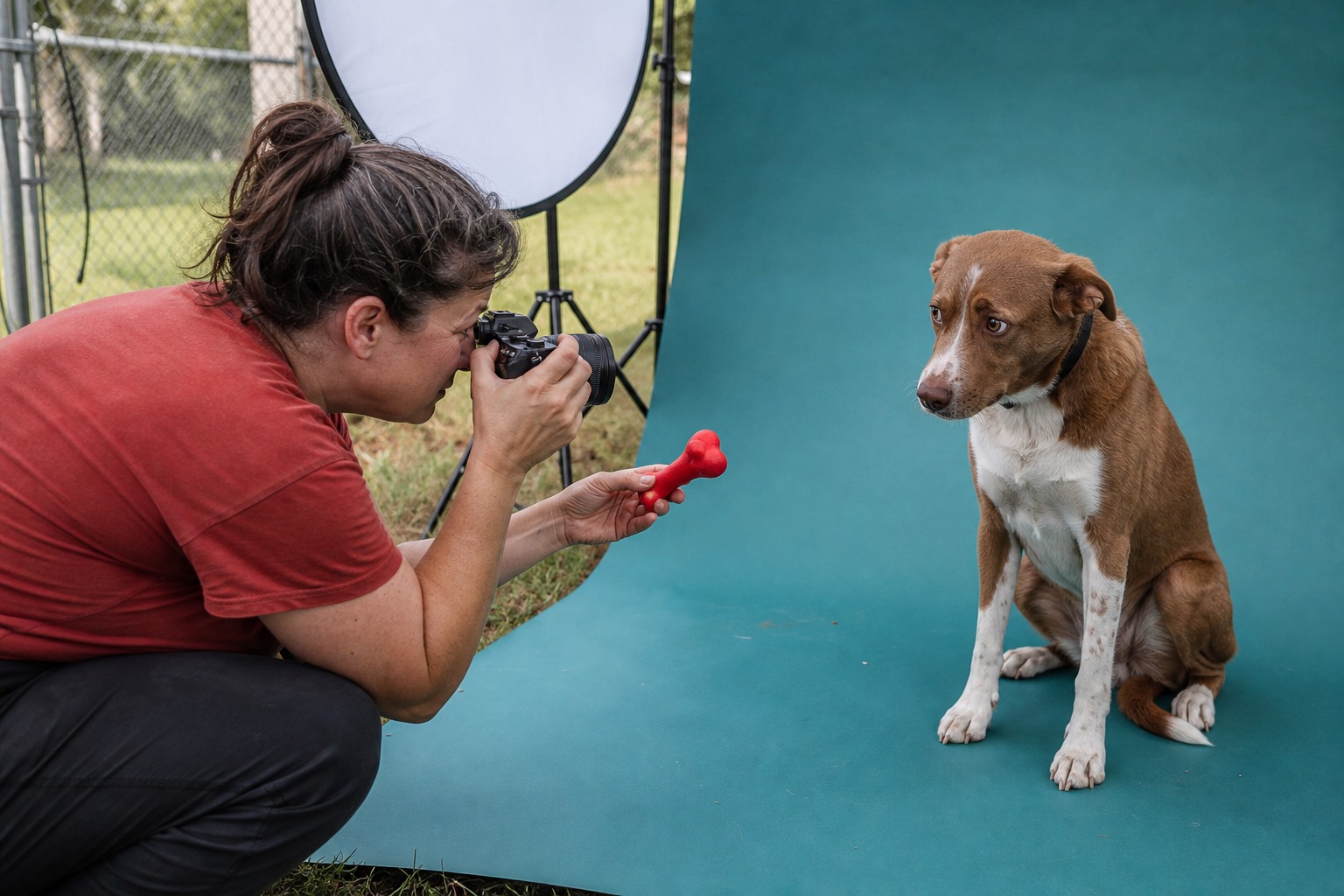
You look at your dog. Something rises in your chest that is 90 percent tenderness and 10 percent the desire to put her entire head in your mouth. You do not want to hurt her. You want to compress her, and you cannot fully explain why.
This is a well-documented psychological phenomenon with a name, and the name is doing you a disservice. It is called cute aggression, and the word “aggression” makes it sound like a sliver of something dangerous smuggled inside your affection.
It is closer to the opposite. The squeeze is a brake, not an accelerator. The current best explanation is that the impulse exists to regulate an emotion that would otherwise flood you and leave you useless, and the evidence for that reading is more interesting than the folk version of “you love her so much you want to crush her.”
Which means the useful question is not why you want to squeeze your dog. It is: what is the squeeze doing for you?
The category it belongs to
Cute aggression is a dimorphous expression: an outward display that appears to contradict the inner feeling. You already know several. Crying at a wedding. Laughing when you are furious. Tears at good news. Nervous giggling at a funeral.
The term was coined by Dr. Oriana Aragón, now at the University of Cincinnati, in a 2015 paper studying what people do with their faces and hands when something adorable overwhelms them. Her framing is that these expressions are not glitches. They are the emotional system self-correcting when one channel gets overloaded.
The prevalence is not marginal. Somewhere around half to two-thirds of people, by that research’s estimate, meet a flood of positive feeling with something that looks physically hostile: a clenched fist, a set jaw, the urge to pinch.
And, tellingly, these responses cluster. If you are a person who cries at weddings, you are more likely to be a person who wants to bite a puppy. It is the same underlying machinery being used twice.
What is being regulated, and why
Here is the part that reframes the whole thing.
Cuteness is not decorative. Cuteness is a signal that demands resources, and it works by hijacking your attention and holding it. Big eyes, a large head relative to the body, round cheeks, short limbs, clumsy movement: this cluster was named the baby schema in the 1940s, and it is a set of features that reliably makes an adult human want to protect, feed, and stay near.
That is not a metaphor. It is a survival mechanism running in both directions. A dog cannot open the food bin, and a newborn cannot do anything at all; both are utterly reliant on a larger animal choosing to help. The cuter the creature, the more caretaking it pulls in, and the more resources come with it. Cuteness is, bluntly, a way of staying alive.
The catch is that the emotion is strong, and strong emotion is not free. An adult flooded with overwhelming tenderness is an adult who is not doing anything useful. So, on the current hypothesis, the brain deploys a counter-signal. Something sharp and physical, gritted teeth, a fist, a squeeze, that dampens the flood and returns you to a functional state where you can, in fact, take care of the thing.
The neuroimaging supports the frame. A 2018 study out of UC Riverside using EEG found that cute aggression lights up both the brain’s reward system and its emotional salience circuitry, and the authors landed on a description of it as a layered response whose job is to moderate an overwhelming feeling so that caretaking can actually happen.
That last part is the whole thesis. The squeeze is not competing with the love. It is what makes the love actionable.
Why it is worst with your own pet
Because familiarity turns the volume up.
A stranger’s puppy on your feed gets an aww. A photo of the animal currently asleep on your feet, taken when they were nine weeks old, does something considerably more violent to your chest. That gradient is not sentiment. Emotional intensity tracks with attachment, which is why the squeeze impulse is reserved almost entirely for the creature you actually live with.
Aragón’s read on this is quietly complimentary. On her account the response requires an unusually strong positive feeling to fire at all, which makes it a marker of investment rather than a warning sign, and she has been willing to speculate that a pet owner who feels it is probably a pet owner who is paying attention.
So: the feeling is not evidence of something wrong with you. It is evidence that you are all the way in.
The one place it actually matters
There is exactly one practical consequence in this entire subject, and it involves children.
Kids feel cute aggression too, at least as strongly as adults, and with dramatically less impulse control between the feeling and the hands. The squeeze that an adult performs entirely inside their own head, a child performs on the actual kitten. From the animal’s side, none of the neuroscience is visible. There is just a small creature being gripped by a large one.
The teachable version is simple, and it works because it validates the feeling instead of shaming it: the feeling is allowed, the squeeze is not. Give the child something to do with the impulse instead. Squeeze your own hands. Squeeze a pillow. Then pet the dog gently, in the direction of the fur, and stop when the dog moves away.
Which is, for what it is worth, the same rule that applies to you. Learn your animal’s body language, respect the exit, and squeeze the sofa cushion.
What’s new since this was written
In March 2025, the Oxford English Dictionary formally added “gigil,” the Tagalog word for exactly this feeling, that overwhelming rush at something cute that clenches your hands and your teeth. It arrived as part of an update of 42 words judged to have no direct English equivalent, alongside ten other Philippine loanwords.
That is a small thing, and also not. English speakers have spent decades describing this experience with clumsy circumlocutions (“I could just eat her up”) precisely because we lacked a word for it. Languages that already had one, Tagalog’s gigil, Indonesian’s gemas, treated it as an ordinary, nameable human feeling all along. Now it is in the dictionary, which is about as official as psychology gets.
The research itself has kept moving in the same direction: cross-cultural work comparing U.S. and South Korean samples has found similar dimorphous expressions across both, suggesting the underlying mechanism is not a Western quirk. Aragón’s ongoing work has turned to how the response differs depending on whose baby, or whose puppy, is in front of you, which is the natural next question given how strongly the effect tracks with attachment.
The short version: it is universal, it is normal, it is regulatory, and now it has a name. Squeeze responsibly.
References
- Aragón, O. R., Clark, M. S., Dyer, R. L., & Bargh, J. A. (2015). Dimorphous Expressions of Positive Emotion: Displays of Both Care and Aggression in Response to Cute Stimuli. Psychological Science.
- Stavropoulos, K. K. M., & Alba, L. A. (2018). “It’s so Cute I Could Crush It!”: Understanding Neural Mechanisms of Cute Aggression. Frontiers in Behavioral Neuroscience.
- Nittono, H., Fukushima, M., Yano, A., & Moriya, H. (2012). The Power of Kawaii: Viewing Cute Images Promotes a Careful Behavior and Narrows Attentional Focus. PLOS ONE.
- Oxford English Dictionary. New words from around the world in the OED March 2025 update.
- Wilkins, A. S., Wrangham, R. W., & Fitch, W. T. (2014). The “Domestication Syndrome” in Mammals: A Unified Explanation Based on Neural Crest Cell Behavior and Genetics. Genetics.