


The Cruelest Thing in Your Makeup Bag Is Still Perfectly Legal
A four-minute stop-motion film about a rabbit named Ralph made 14 million people confront cosmetics testing. Five years on, the US still has no federal ban. Here is exactly where the law stands, and where it is finally moving.

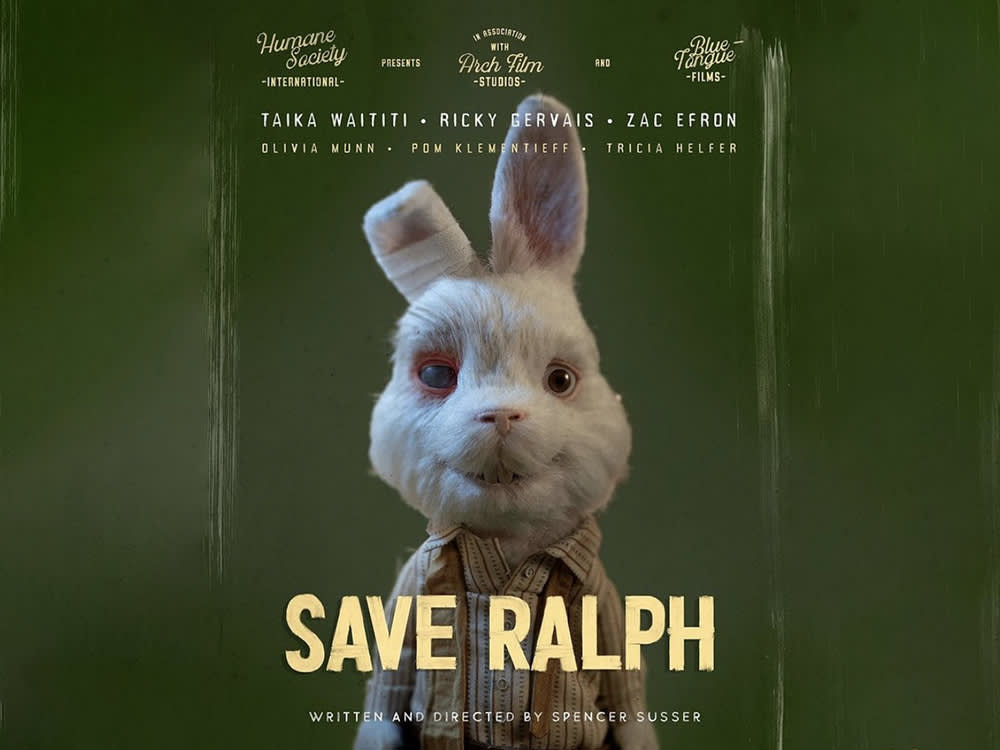
There is a four-minute film you can watch right now, for free, that will change how you look at your bathroom shelf. It is called Save Ralph, it has been seen more than 14 million times on YouTube, and it is one of the most effective pieces of animal advocacy ever made.
It is also five years old, and the thing it was made to stop is still legal in most of the United States.
That gap, between the enormous public reaction and the almost complete legislative silence that followed, is the real story now. So let us talk about the film for a minute, and then about the law, which is the part that determines whether Ralph was worth anything.
The film
Save Ralph was written and directed by Spencer Susser and produced for Humane Society International as part of its campaign to ban cosmetics testing on animals. Taika Waititi voices Ralph, a stop-motion rabbit, in a cast that includes Zac Efron, George Lopez, and Olivia Wilde.
Knowing Waititi’s work, you might reasonably expect something light. It is not. The film is shot as a mock documentary. Ralph sits for an interview, describes his job as a lab “tester,” and inventories the damage the job has done to his body: an ear that no longer hears, an eye that no longer sees, burns in his fur. He is not angry about any of it. That is what makes it unbearable. He is calm, faintly proud, sure that his suffering is a fair price for the benefit of the humans he calls superior, and he mentions the generations of his family who did the same work before him. Then the camera follows him into a day at the lab, and there is an injection into the eye.
That injection is a real procedure. It is the Draize test, developed more than 70 years ago to assess chemical irritation to eyes and skin, performed without pain relief. Non-animal alternatives exist. Companies still use it.
The film’s final line does the work of a thousand press releases: no animal should suffer in the name of beauty.
The numbers
Humane Society International reports that more than 500,000 animals suffer and die every year globally in cosmetics testing. As many as 10,000 animals are killed for every new chemical tested.
And here is the detail people find hardest to believe. In some categories, animal testing is not a choice a company makes. It is legally required. Fragrances and clothing dyes are among the products for which regulators around the world still demand animal-poisoning tests before a chemical, pesticide, or medicinal product can go to market. The cruelty is not always a corporate failing. Sometimes it is a statutory requirement.
Where the law actually stands
This is the part the film could not tell you, because it had not happened yet.
In the US, there is still no federal ban. The Humane Cosmetics Act, which would prohibit cosmetics animal testing in the United States and bar the sale of cosmetics developed through it, was reintroduced in February 2025 as H.R. 1657. It has drawn a substantial bipartisan cosponsor list, and it sits in the House Committee on Energy and Commerce, which is where its predecessors also sat. It has never passed.
States have moved instead. Twelve states, California, New York, and Virginia among them, have enacted their own cruelty-free cosmetics laws. That is up from the ten that had done so when the film was released, and it is the reason a lot of American shelves look cleaner than the federal law would suggest.
The rest of the world is ahead. More than 40 countries have banned or limited cosmetics animal testing outright.
Industry has moved too. Lush, Unilever, P&G, Avon, and L’Oréal have all pushed back against animal testing requirements, which is a meaningful thing for large chemical purchasers to do.
What’s new since this was written
The most significant development is not in cosmetics at all. It is at the FDA, and it may end up mattering more.
The FDA Modernization Act 2.0, passed in 2022, removed the statutory language that had explicitly required animal testing in drug development, allowing sponsors to use non-animal methods instead. In April 2025, the FDA published a roadmap for actually implementing that, announcing a plan to phase out the animal testing requirement for monoclonal antibodies and other drugs, replacing it with New Approach Methodologies: cell-based assays, organ-on-a-chip systems, and computational models. Crucially, the roadmap set timelines and validation frameworks rather than merely encouraging alternatives, and the agency has since reported hitting its first-year goals.
The scientific rationale is bleak and persuasive. More than 90 percent of drugs that pass animal testing go on to fail in human trials. The animal model is not just cruel. It is frequently a bad predictor.
Why this matters for your mascara: the single biggest argument against banning cosmetics testing has always been that there is no validated alternative. Every year that regulators formally validate a non-animal method for drugs, that argument gets weaker for cosmetics too. The alternatives are no longer hypothetical. They are being written into federal roadmaps.
What you can actually do
Buy certified, not claimed. “Cruelty-free” is not a legally defined term in the US and nobody polices it. Leaping Bunny certification requires a fixed cut-off date for testing, supplier monitoring down the supply chain, independent audits, and annual recommitment. Look for the logo, not the language.
Contact your representative about H.R. 1657. The Humane Cosmetics Act does not fail because it is controversial. It fails because it never reaches the floor. Bills that reach the floor need cosponsors, and cosponsors respond to constituents.
Support the organizations doing the litigation and the lobbying. Humane Society International runs the campaign the film was made for.
Watch the film, and send it to one person. Four minutes. It is the whole reason any of this is on anyone’s radar.
Ralph is not real. The Draize test is, it is still being performed, and in the United States there is still no law that says it has to stop.
References
- Humane Society International. “Be Cruelty-Free campaign.” https://www.hsi.org/issues/be-cruelty-free/
- Humane Society International. “Animal testing.” https://www.hsi.org/issues/animal-testing/
- Congress.gov. “H.R.1657 - Humane Cosmetics Act of 2025.” https://www.congress.gov/bill/119th-congress/house-bill/1657/text
- US Food and Drug Administration. “FDA Announces Plan to Phase Out Animal Testing Requirement for Monoclonal Antibodies and Other Drugs,” April 2025. https://www.fda.gov/news-events/press-announcements/fda-announces-plan-phase-out-animal-testing-requirement-monoclonal-antibodies-and-other-drugs
- US Food and Drug Administration. “Roadmap to Reducing Animal Testing in Preclinical Safety Studies.” https://www.fda.gov/files/newsroom/published/roadmap_to_reducing_animal_testing_in_preclinical_safety_studies.pdf
- US Food and Drug Administration. “New Approach Methodologies (NAMs).” https://www.fda.gov/science-research/science-and-research-special-topics/new-approach-methodologies-nams
- Leaping Bunny Program. “Our Standard.” https://www.leapingbunny.org/about/standard
Leila Torres leads our Living coverage, from home life and travel to the products and rescue stories that come with sharing a life with animals. She edits and writes across the section, with a soft spot for pieces about the bond between people and their pets.
Meet our experts ↗Keep reading
 Health & WellnessWashington's Senate Voted 48-0 to Let You Idle for Your Dog. The Bill Died Anyway.Sasha Ford · 6 min
 LivingHow the Animal-Rescue Network Beat Helene's FloodwatersNina Vasquez · 5 min
 Living43 Arrests at a Texas Dogfight. Nearly All of Them Bonded Out.Dr. Amara Solis · 7 min
 LivingYour Dog Slips the Yard. A Cop Shows Up. What the Data Says Happens Next.Marcus Webb · 6 min
 Health & WellnessLeaving Your Dog Out in the Cold Isn't Just Cruel. In These States, It's a Felony.Dr. Priya Nair · 5 min
 Health & WellnessDeclawing Isn't a Manicure. It's Ten Amputations, and the Law Is Catching UpDr. Ravi Mehta · 8 min