


Before You Buy a Self-Cleaning Litter Box, Understand the One Way They Kill
Cheap automatic litter boxes have flooded the market, and the deaths they've caused trace to a single failure mode. Here's how to vet any model so it never happens to your cat.

Affiliate disclosure. This article contains affiliate links. We may earn a small commission if you buy through a link, at no extra cost to you. How we handle recommendations.
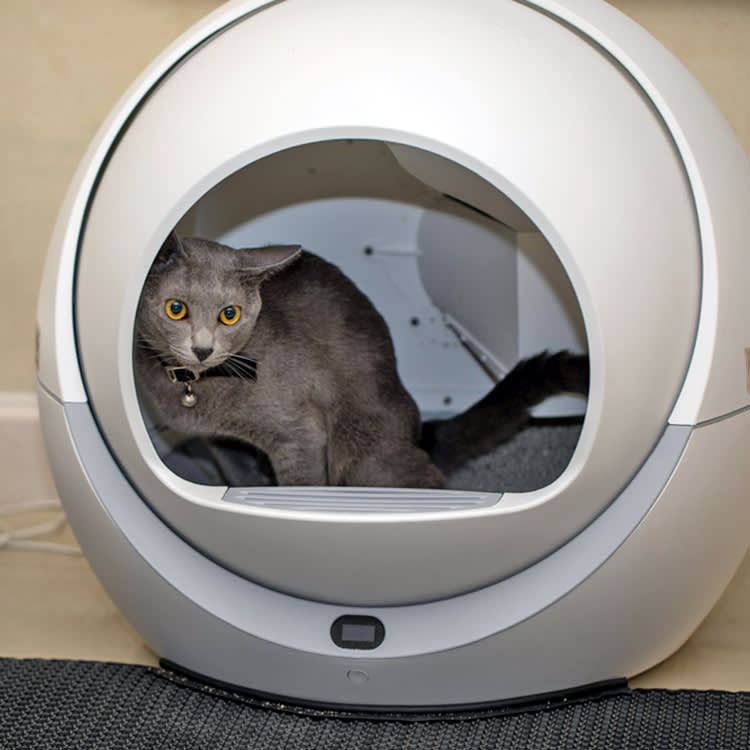
Most coverage of the automatic-litter-box deaths frames it as a single villain: one shoddy product killing cats. That is true as far as it goes, but it leaves you no better equipped the next time you are staring at a wall of nearly identical machines online, half of them a third of the price of the rest. The product names change monthly. The danger does not.
So here is the more useful version of this story. There is essentially one failure mode behind these tragedies, the cat gets caught when the cleaning cycle starts and the safety system fails to stop it, and once you understand that mechanism, you can evaluate any model on the market against it. We will get to the heartbreaking case that put this on everyone’s radar, because it matters, but the durable takeaway is a buyer’s framework you can use long after this particular box is gone. (This is a safety topic; when a device involves your cat’s physical safety, err toward caution.)
The failure mode, in one paragraph
A self-cleaning litter box works by rotating, raking, or tilting the litter chamber to sift out waste. On the most dangerous designs, the globe rotates on its axis and the entryway closes completely during the cycle, so a cat caught inside has no way out. To do that safely, the machine must reliably detect when a cat is present and refuse to start, or instantly stop and reverse, the cycle. That detection is the entire safety system. On a well-engineered box, redundant weight and laser sensors plus a physical anti-pinch fail-safe make entrapment extremely unlikely. On a cheaply made dupe, the sensors can be underbuilt, miscalibrated, or simply too insensitive to register a small or young cat, and the cycle proceeds with the animal still inside. That gap, between “the sensor works every time” and “the sensor works most of the time,” is where cats die. Everything below comes back to closing it.
The case that exposed it
In the summer of 2024, a TikTok user, Carli Jay, posted a since-deleted video describing the death of her one-year-old Siamese cat, Mochi. Jay says Mochi’s head became trapped when the machine began its cleaning cycle overnight, killing the cat while the family slept. A content creator who reviews these devices, One Man Five Cats, recapped the incident and demonstrated how the specific product, sold under the brand Amztoy whose font eerily echoed the well-known Litter-Robot by Whisker, could fail this way.
What happened next is the part that should worry every shopper. According to the reviewer, Jay reached a financial settlement under which Amztoy agreed to pull the product from Amazon, but in exchange she had to delete her viral videos and remove her Amazon review. Her husband, unable to delete the negative review outright, reportedly changed it: the original warning, “This machine killed my cat… do not buy this machine,” became “Good machine with cute ears.” The Amazon listing that had hosted those negative reviews later led to a “Sorry we couldn’t find that page” message. If you have a box that looks like that model, stop using it now.
The settlement mechanics are exactly why you cannot trust the reviews on these listings, and why a framework beats a blocklist.
Why banning one brand fixes nothing
Amztoy did not manufacture the box; it only branded and sold it. The same underlying hardware, per One Man Five Cats, has appeared under different names across Amazon, Wayfair, eBay, and Temu. Pull one listing and the identical machine resurfaces under a new label next week. As of 2025, consumer-safety writers and reviewers have flagged the same lethal closing-globe design selling under brand names including Catlk, CozyBlue, and Kikquze, with product pages stacked with warnings from alarmed buyers. The reviewer also ties three additional cat deaths to similar boxes, and separately flags a model from Popur whose design, he says, could trap a kitten in the waste compartment; he reports that Popur’s CEO threatened to sue over a negative review and, asked why the box lacked an automatic shut-off, reportedly said he found mid-cycle stops annoying.
That last detail is the whole problem distilled: a manufacturer treating the safety fail-safe as an inconvenience. The lesson is not “avoid Amztoy.” It is “assume a too-cheap box may have cut the corner that keeps your cat alive.”
What a real safety system looks like
It helps to see what the protection looks like when a manufacturer actually invests in it, because that sets the bar you are shopping against. The current Litter-Robot 4 layers several independent systems: an OmniSense detection array that combines three laser sensors in the bezel with a weight scale in the base, plus what Whisker calls a SafeCat system that continuously watches four zones around the opening. If a cat enters mid-cycle, the globe stops, the light bar turns red, and the cycle will not resume until 15 seconds after the cat is no longer detected. There are also anti-pinch sensors on both sides of the waste-drawer chute that halt and retract the globe if they sense an obstruction. You do not have to buy this exact unit. But notice how specific those claims are, named sensors, redundant systems, defined behavior. That specificity is the tell. A bargain box’s “smart safety” with no mechanism described is the opposite tell.
A buyer’s safety checklist for any automatic box
Use this before you spend a dollar:
- Prefer an open-top design that cannot fully enclose your cat. The deadliest failures happen in closing-globe boxes where the entrance seals during the cycle. A box that physically cannot trap a cat inside removes the worst-case outcome entirely.
- Look for redundant, named sensors. A safe box describes specifically how it detects a cat (weight scale, laser, infrared) and uses more than one. Vague marketing with no mechanism named is a red flag.
- Demand a physical fail-safe and a clear weight threshold. Reputable models publish a minimum cat weight that reliably triggers the stop, and pause the cycle the instant a cat re-enters.
- Check that you can see the waste. A drawer you can inspect at any time is a safety and a health feature, more on that below.
- Distrust the price gap. When a box costs roughly a third of the category leaders, ask what was removed to get there. Sensors and fail-safes are expensive; cute molded ears are not.
- Ignore the on-listing reviews. As the Mochi case shows, negative reviews on these products can be suppressed through settlements. Look for independent video teardowns and third-party testing instead.
- Never put a kitten in one. This is non-negotiable. Kittens are too light to trip most sensors and should use a simple open box, period.
The quieter cost: you stop watching your cat’s health
Even a perfectly safe automatic box carries a trade-off that rarely makes the headlines, and for many cats it is the more important one. When a machine scoops for you, you stop seeing your cat’s waste, and that waste is one of your best early-warning systems.
The single biggest thing owners give up with a self-cleaning box is the daily look at what’s coming out of their cat. Blood in the urine, a change in stool, the smell that tips you off to a parasite, those are things you catch with your own eyes and nose while scooping. I have had cases where that daily observation is the only reason a serious problem got caught in time.
Concrete examples make the point. A cat with early bladder disease or a bladder tumor may show only faint blood in the urine, the kind of clue an owner spots in a scoop and a machine simply buries; in some cases that pink tinge is the only sign for weeks before imaging even catches the cause. An intestinal parasite like giardia is often first noticed by the look and smell of the stool. Hand the scooping to a robot and you forfeit that surveillance. The better automatic models at least let you view the waste drawer, which partly preserves it; the bargain ones often do not.
They are machines, so they are never zero-risk
Even clinicians who like automatic boxes are candid that no automation is failure-proof.
These boxes are genuinely useful for hygiene and for cutting down daily chores, and plenty of cats do fine with them. But any technology can malfunction, and the stakes here are a living animal. The right posture is not fear, it is homework: know exactly how a given box protects your cat before it ever comes through the door.
And it is not just litter boxes. Any mechanized pet device, automatic feeders, certain interactive toys, can fail when you are not there to supervise. Feeders clog or skip a scheduled meal. Cords get chewed. There are documented stories of automatic toys tangling around a cat and feeders that never dispensed while a family was away for days. If you rely on one while traveling, have a human physically check that it is working. Automation is a convenience layered on top of supervision, not a replacement for it.
When in doubt, keep it simple
There is also a plain behavioral reality: a lot of cats just do not like these machines.
“Many cats are wary of a box that moves and makes noise, and some stop using it altogether, occasionally even after you remove it,” says Dr. Lena Park. “Cats are sensitive to anything that startles them near the box, and an aversion can be hard to undo. As cats age, climbing into a tall self-cleaning unit also gets harder. For a lot of households, an easy-entry traditional box is simply the better tool.”
Scooping is a chore, but it beats a litter-box aversion or a safety risk. And if, after all this, you still want an automatic box, buy a genuinely safe model and pay for it. Saving a few hundred dollars on a bargain dupe is not a saving if it costs your cat their life. Buy for the sensor, not the price tag, and your cat never has to be the cautionary tale.
This article addresses pet-product safety. If you suspect a device has injured your cat, stop using it immediately and contact your veterinarian.
References
- The Daily Dot, “A cat owner says her cat died after getting stuck in an automatic litter box” (reporting on the Mochi case)
- Figo Pet Insurance, “Automated Litter Boxes Are Putting Cats at Risk” (dupe brands and closing-globe failure mode)
- Whisker, “Litter-Robot 4 Safety Features” (OmniSense and SafeCat sensor documentation)
- Cornell Feline Health Center, “Feline Lower Urinary Tract Disease” (early signs detectable in urine)
- U.S. Food and Drug Administration, “It’s No Treat: Pet Food Safety” (general pet-product handling caution)
Not a substitute for your vet. Our guidance is educational. For urgent symptoms, contact a vet or emergency clinic right away. Editorial standards
Dr. Chen is a small-animal veterinarian who leads health and safety coverage at The Pet Times. She writes and reviews the bulk of our illness, condition, and safety content, translating clinical guidance into clear, practical advice owners can act on at home.
Meet our experts ↗Keep reading
 Health & WellnessCat Scratch Fever Isn't a Rock Song. It's a Real Infection (You Still Don't Need to Panic).Dr. Nina Kohl · 5 min
 Health & WellnessPetunias Are Safe for Cats. The Pot They're Sitting In Might Not BeDr. Amara Solis · 8 min
 Health & WellnessHalloween Is Your Cat's Least Favorite Night. Six Ways to Fix That.Dr. Lena Park · 5 min
 LivingThe Litter Scoop in the Dishwasher: It Was Never About the IckNina Vasquez · 5 min
 Health & WellnessYour Cat Doesn't Have to Eat the Lily. The Vase Water Will Do.Dr. Amara Solis · 9 min
 Health & WellnessThe Monarch Bird Flu Cases Were Not a Fluke. They Were a PatternDr. Ravi Mehta · 5 min