


Raspberries Are Safe for Your Cat. Your Cat Just Doesn't Care.
Raspberries are non-toxic to cats and even a little nutritious, but there's a biological reason your cat shrugs at them. Here's what a few berries actually do, and when to skip them.

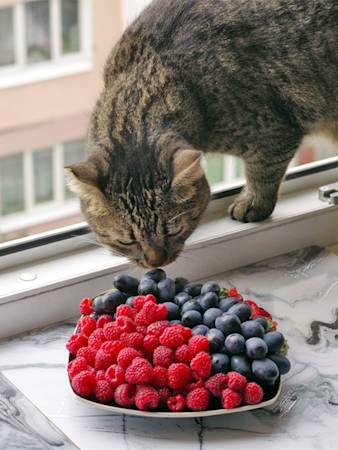
Here is the short version: your cat can eat a raspberry, and almost certainly won’t want to. That combination is the whole story, and it’s more interesting than the usual “is it safe” checklist, because the reason your cat ignores the berry is the same reason raspberries were never going to be a real part of a cat’s diet in the first place.
Cats are obligate carnivores. Their bodies are built to run on animal protein and fat, and evolution didn’t waste effort on tasting fruit. The clearest proof is in the mouth: cats are missing a functioning sweet taste receptor. That juicy sweetness a raspberry sells to us is, to a cat, essentially nothing. So when people ask whether they should share raspberries with their cat, the honest answer is that safety is the easy part, and appeal is the part that quietly settles the question.
The one myth worth clearing up first
If you’ve read anything about fruit and pets, you’ve probably run into the xylitol scare. Raspberries do contain a trace of naturally occurring xylitol, and that fact gets recycled into alarming warnings.
Here’s the part those warnings leave out. Xylitol toxicity has only ever been documented in dogs. Cats are not the species at risk. On top of that, the amount in the fruit is minuscule, roughly a twentieth of a milligram per gram of berry, far too little to matter even for the animals it can affect. The synthetic xylitol in sugar-free gum, sugar-free peanut butter, and some baked goods is a genuine and serious danger, but it has nothing to do with the pinch of it sitting inside a fresh raspberry. Do not let the internet talk you into fearing a berry.
The xylitol worry is aimed at the wrong animal and the wrong dose. It’s a dog issue to begin with, and even there it’s about sugar-free products, not fruit. For a cat, a raspberry is simply a low-risk, low-interest snack.
What a raspberry actually gives a cat
If your cat is one of the rare few who bats a berry around and then nibbles it, there’s a modest upside. None of this makes raspberries a health food for cats, but a bite now and then isn’t empty.
Raspberries carry a lot of fiber for their size, thanks to all those tiny seeds, which can add a little bulk to stool. They’re mostly water, which is a genuinely useful trait in a species famous for under-drinking, especially cats prone to urinary or kidney trouble. They also hold potassium, calcium, magnesium, vitamin K, iron, and the antioxidants (anthocyanins and ellagitannins) that earn the fruit its superfood reputation in humans. The catch: a cat on a complete, balanced diet is already getting the vitamins and minerals it needs. Anything a raspberry adds is a rounding error, not a requirement.
When to actually skip it
The safety picture is good, but “good” isn’t “always.” A few situations genuinely call for holding back.
That same fiber that helps in tiny amounts turns on you in slightly larger ones. Too much at once, particularly for a cat not used to it, brings gas, bloating, and loose stool. Diabetic or overweight cats should avoid added sugars in general, and while raspberries are lower in sugar than most fruit, they aren’t sugar-free. And a plain berry is one thing; a raspberry muffin, a swirl of raspberry ice cream, or anything with butter, cream, or heavy sweetening is another, since the fruit is rarely the risky ingredient in a prepared dish.
The plant itself deserves a note too. It’s non-toxic, so a cat gnawing a leaf isn’t an emergency, but leaves and stems are loaded with indigestible fiber that reliably causes stomach upset, and raspberry leaf can stimulate uterine contractions. Keep pregnant cats away from the plant as a precaution.
How to offer one (if you bother)
Wash it, offer a single small berry or half of a larger one, and skip anything with added sugar, dairy, or seasoning. Watch for any digestive grumbling over the next day. If your cat turns up its nose, that’s not a failure, that’s a cat behaving exactly like a cat. Keep raspberries and every other snack under 10 percent of daily calories so they don’t crowd out the balanced food that’s actually doing the work, and remember that indoor cats put on weight easily, so treats and play both matter.
What’s new since this was written
The clearest update is on the xylitol question, because the myth has only spread since it started. The current veterinary consensus is blunt: natural xylitol in fruits like raspberries is present in such small concentrations that a pet cannot reach a toxic dose by eating the fruit, and toxicity is a dog-specific problem in the first place. Recent write-ups put numbers on it for dogs, a mid-sized dog would have to eat multiple pounds of raspberries in one sitting to approach the low end of the toxic range, which is not a thing that happens.
For cats, the reassurance is even stronger. Reviewers note that dogs are the only domestic species in which xylitol toxicosis has been reported, so cats aren’t at risk of the hypoglycemia or liver injury that drives the warning at all. The takeaway hasn’t changed, but the evidence behind it has only firmed up: fear the sugar-free gum, not the fruit.
References
- Red Raspberries and Their Bioactive Polyphenols: Cardiometabolic and Neuronal Health Links, Advances in Nutrition
- Xylitol Toxicity in Dogs, VCA Animal Hospitals
- Rubus idaeus, North Carolina Extension Gardener Plant Toolbox
- FoodData Central: Raspberries, raw, USDA
- Feeding Cats: Nutritional Needs, Cornell Feline Health Center
Common questions
Are raspberries toxic to cats?
No. The fruit is non-toxic to cats. The much-repeated worry about natural xylitol doesn't apply to cats at all, since xylitol toxicity has only ever been documented in dogs.
Why doesn't my cat like raspberries?
Cats can't taste sweetness. They lack the working taste receptor for it, so the main thing a raspberry has going for it is invisible to your cat.
Can cats eat raspberry leaves or the plant?
The plant is non-toxic, but the leaves and stems are high in indigestible fiber and can upset the stomach. Raspberry leaf can also stimulate uterine contractions, so keep pregnant cats away from the plant.
Not a substitute for your vet. Our guidance is educational. For urgent symptoms, contact a vet or emergency clinic right away. Editorial standards
Dr. Nair is a veterinarian focused on diet and feeding. She covers everyday nutrition, treats, and the many "can they eat this?" questions owners ask, grounding each answer in what is actually safe and sensible for dogs and cats.
Meet our experts ↗Keep reading
 FoodCats and Marshmallows: The Bag Your Dog Should Worry About MoreDr. Priya Nair · 6 min
 FoodPopcorn Is Safe for Cats. The Stuff We Put on It Is the ProblemDr. Ravi Mehta · 6 min
 FoodWatermelon Won't Hydrate Your Cat the Way You ThinkDr. Ravi Mehta · 5 min
 FoodYour Cat Can Eat Pomegranate. That's Not the Same as Should.Dr. Priya Nair · 5 min
 FoodYour Cat Begs for Olives and Cheetos. There's a Chemical Reason Why.Dr. Priya Nair · 7 min
 FoodWhy Your Cat Runs From Bananas (and Whether a Bite Is Safe)Dr. Priya Nair · 5 min