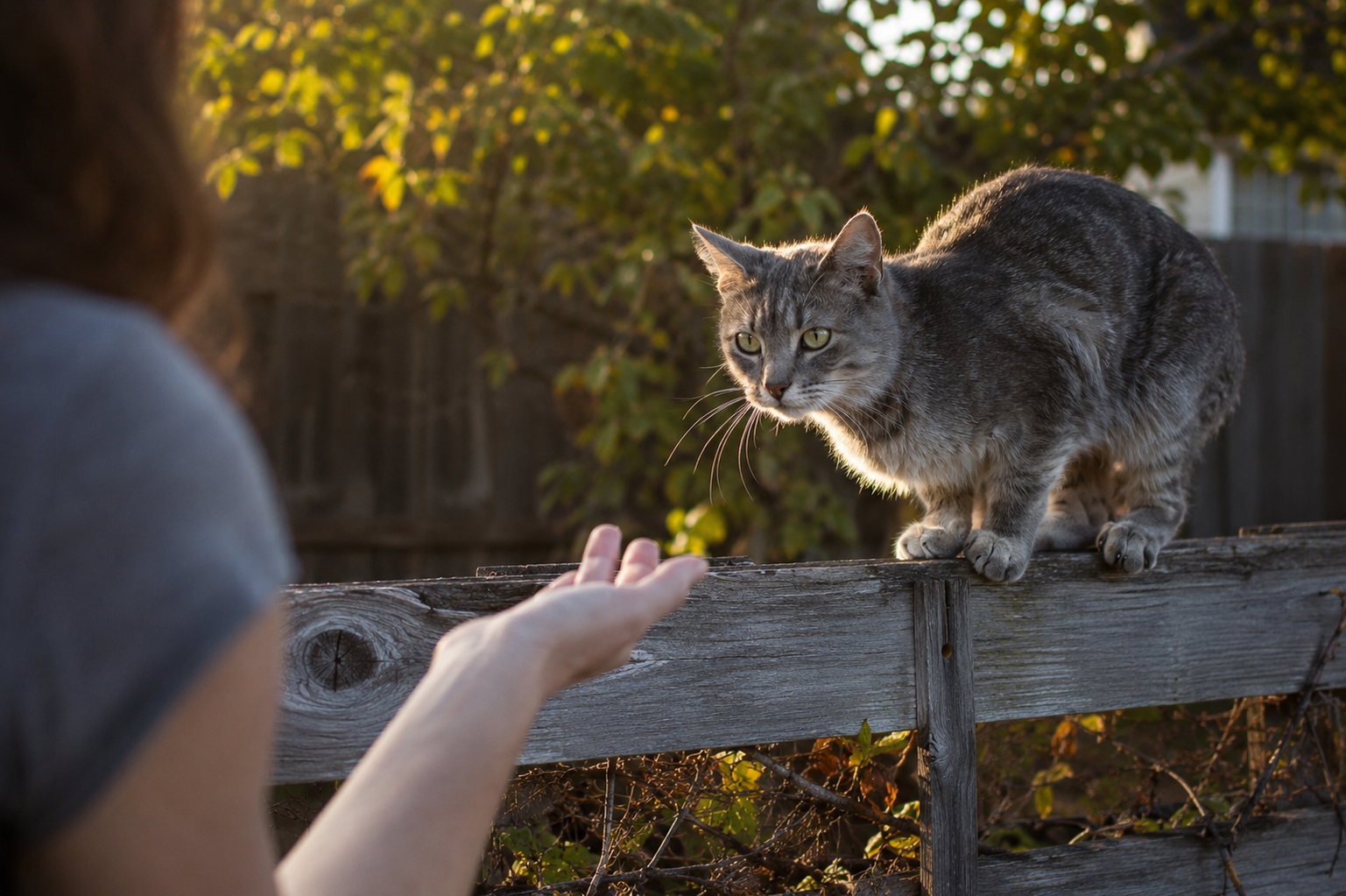
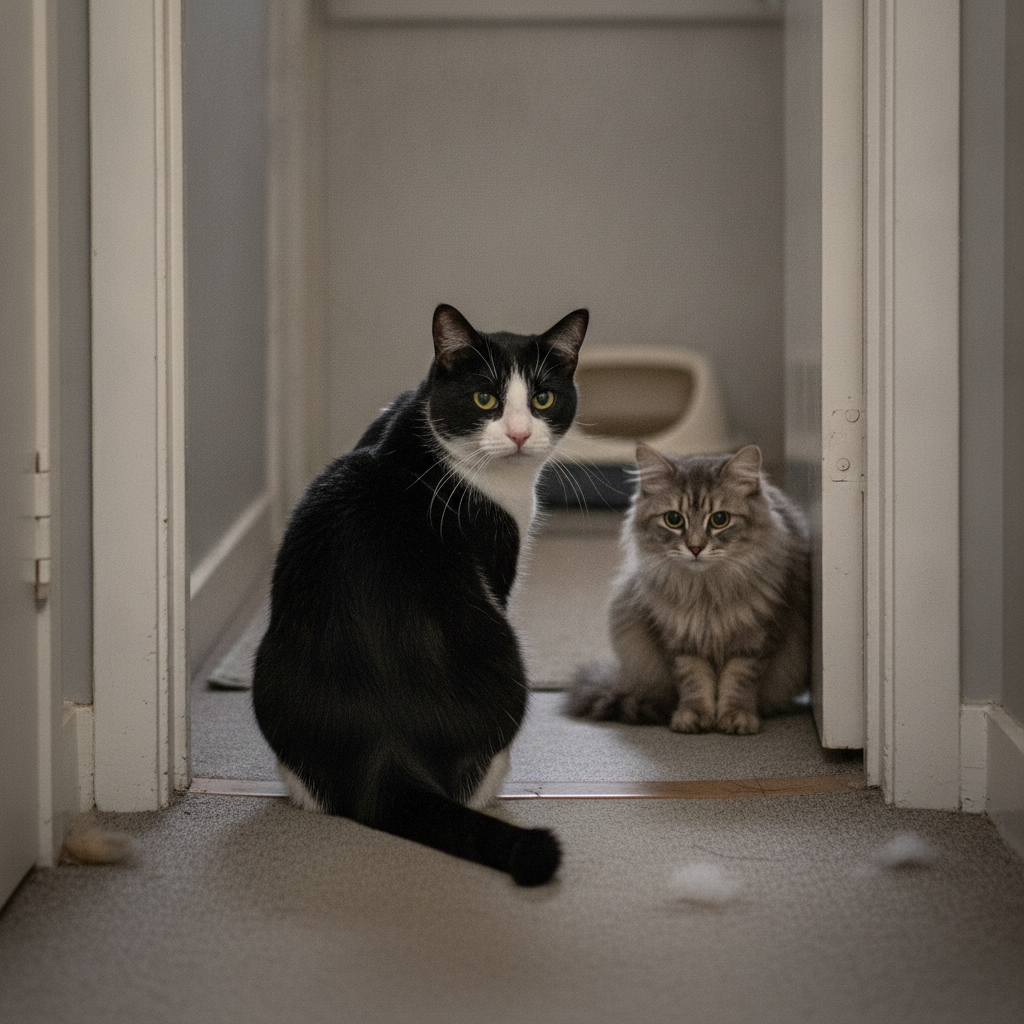
The word people use is “hate.” My cat hates the other cat. It is understandable, and it is the wrong frame, and the wrongness is the thing standing between you and a fix.
Hate implies a judgment: your cat has assessed the other cat and found them unworthy. Cats do not work like that. What is happening in your living room is not a grudge. It is a stranger-recognition problem, and it runs on smell.
Cats in a stable group do not identify each other by face. They identify each other by a shared group scent, built and maintained by rubbing and mutual grooming. A cat that smells like the group is family. A cat that does not is an intruder, with everything that implies: this animal could hurt me, eat my food, take my sleeping spot, drive me out.
Two cats who have never blended scents are, to each other, permanent strangers. In an apartment. With no exit.
That is a solvable problem. Hate is not.
Start by getting the resources right, because this is the part people skip
Before any behavior work, do the arithmetic, because half of what gets diagnosed as aggression is competition.
Go through the list and count: food bowls, water, litter boxes, high perches, hiding spots, scratchers, beds, toys.
The rule is more than one of everything, spread out across the home, not lined up in a row in one room. A single resource in a single place is a chokepoint, and a chokepoint is where a confident cat learns it can control a nervous cat’s access to food, water, or the toilet. That is not a personality clash. That is a floorplan.
Vertical space matters more than people realize. Cats de-escalate by getting away, and in a small home the only available “away” is up. A cat with a high shelf to retreat to does not have to fight over the floor.
The stress multiplier
Here is the piece that reframes everything else: stress raises reactivity, and reactivity is what turns a passing glance between two cats into an incident.
This means stress that has nothing to do with the other cat still makes the relationship worse. Reduce the unrelated stress and the two cats get along better, without you doing a single thing about their relationship directly. It is genuinely a large part of the work.
What loads a cat up:
- Medical issues, pain, or discomfort. Always first. A cat in pain has a short fuse, and pain is the single most under-diagnosed driver of feline aggression. If one of your cats has suddenly changed toward the other, get them examined before you do anything else.
- An environment that does not meet their instinctive needs. A poor litter box setup. Not enough access to food. Nowhere to climb, nowhere to hide.
- Not enough play or enrichment. A cat with no outlet for its predatory drive is a coiled spring, and the nearest moving thing is the other cat.
- Trouble with the other people or animals in the home.
- Routine changes.
- General anxiety, or specific recurring triggers: construction, a loud neighbor, an outdoor cat visible through a window.
“Owners come to me convinced they have a relationship problem, and half the time what they have is a resource problem wearing a costume,” says Dr. Amara Solis. “A cat that cannot reach the litter box without walking past a cat it is afraid of will look aggressive, or will start urinating on your bed, and neither of those is about the other cat’s personality. Fix the floorplan and the pain, and a surprising number of these cases quietly dissolve.”
What is actually going on between them
Territory and resource competition. The instinct is ancient and it does not care that you feed them both. A strange cat is a threat to survival. If a new cat appeared without a proper introduction, or two cats have simply never resolved things, that instinct never got switched off.
Play-aggression, which is the most misread of all. This is extremely common between cats with mismatched energy levels, and it produces a nasty feedback loop.
One cat plays too hard for the other cat’s taste. The target gets defensive to make it stop. The over-playing cat, now met with hostility, gets defensive back. Now both cats have learned that proximity to the other one is unpleasant. Nobody was aggressive to begin with, and now everybody is.
This is the classic kitten-and-senior-cat dynamic, and it is why “he just wants to play!” is not the reassurance people think it is.
Maternal aggression. A mother cat will defend kittens, and some cats will defend a bonded feline companion they think is threatened.
Socialization history. Cats with positive experiences of other cats early in life tend to do better with cats generally. But it is a tendency, not a rule, and it cuts both ways: a poorly socialized cat can absolutely learn to live happily with another cat, given the right environment and a proper introduction.
Energy mismatch, dressed up as personality. It is rarely that one cat dislikes the other’s character. It is usually that one wants to chase and pounce on everything that moves and the other wants to nap in a sunbeam and bat a toy twice. If neither is good at reading and respecting the other’s boundaries, you get conflict.
The fix: build them a group scent
This is the technique the whole article is for, and it is doing the specific thing that is missing.
Cats in a group groom each other and rub on each other, which blends their individual scents into a shared group signature. That signature is how they recognize each other as safe. Your cats have not built one.
So build it for them.
Take a soft-bristled brush or a clean cotton sock. Rub it gently over the cheeks and shoulders of one cat, picking up their scent. Then rub it over the cheeks and shoulders of the other. Then back. You are physically transferring and mixing their scents.
Pair it with a treat every time, so each cat is building a positive association with the other cat’s smell rather than just being confronted with it.
Do this daily for a couple of weeks, then taper off as things improve.
And if a cat does not want to be brushed or rubbed, stop. Forcing it turns the whole exercise into another stressor, which is the opposite of the point.
Reward everything, including nothing
Positive reinforcement here means using something the cat likes, a treat, a pet, a tossed toy, praise, to mark behavior you want more of.
The obvious targets are the good moments: they touch noses, they sit near each other, they play, they sleep on the same bed. Reward all of it, immediately.
But the underrated target is neutral behavior. Reward the moments when nothing happens. Two cats pass in the hallway without incident. One lands on an occupied sofa and there is no reaction from anybody. One does zoomies past the other and the other does not flinch.
Neutral is the actual goal. Two cats who are indifferent to each other are two cats living peacefully. Most owners are waiting to reward friendship and letting the far more achievable outcome go unmarked.
And engineer one good thing a day. Once a day, put both cats in the same room and hand out something each of them likes: treats, a play session, or a lap for one while the other gets a food puzzle. They do not have to interact at all. The only lesson being taught is that the other cat’s presence predicts good things.
The part that actually determines whether this works
Stopping the fights matters more than everything above combined.
You can run the brush protocol perfectly and reward every neutral glance, and if the cats are still having one negative encounter a day, you will make almost no progress. The bad experiences overwrite the good ones.
So: learn the early cues, the stare, the stiffening, the flattened ears, the shifting weight, and intervene before it turns. At that stage, a positive distraction works: toss a toy, call them over for pets, produce a treat.
But once they are already in a negative interaction, do not use a positive distraction, because you will be rewarding the escalation. And never punish, which does not work and makes everything worse.
Instead, use a neutral distraction: something that is neither good nor bad, that simply makes both cats go, what was that?
- Covertly toss something in the opposite direction, casually, not like play.
- Make a gentle sound: a knock on the table, a rattled jar of dry beans.
- Break their line of sight with a piece of cardboard, a pillow, or a blanket.
Then wait a minute or two after they have disengaged, and give each of them something to do: a play session, a food puzzle. That burns off the energy so they do not simply resume.
If they cannot share space at all
Everything above assumes your cats can coexist most of the time with occasional flare-ups. If they genuinely cannot be in a room together without fighting, patching it will not work.
Separate them completely and start over with a slow, careful reintroduction, as though they have never met. Scent first, then sight through a barrier, then supervised time, moving forward only at the pace of the more anxious cat. It takes weeks. It is worth it.
What newer research adds
Two findings are worth carrying with you.
Ohio State’s work on indoor cats produced a result that ought to be better known: healthy cats start behaving like sick cats when their routine is disrupted. Vomiting, appetite loss, house-soiling, hiding. The implication for a multi-cat home is direct. What you are reading as one cat “acting out” against another may be an animal whose environment stopped being predictable, and whose distress is landing on the nearest available target.
The second is the growing evidence that we are bad at reading unhappy cats. People spot a contented cat easily and miss the signs of a stressed or frightened one, which is precisely why the escalation between two cats always seems to come from nowhere. It did not. The staring, the freezing, the blocked doorway, the sustained eye contact were all there, doing their work silently for weeks.
Which brings the whole thing back to where it started. Your cats are not enemies. They are two animals who have not been given a way to become family, in a space with too few exits, being watched by someone who has been taught to look for hostility instead of fear.
Change the smell, change the floorplan, and stop the fights. Most of the rest takes care of itself.
References
- Ohio State University Indoor Pet Initiative. “Conflict between Cats.” https://indoorpet.osu.edu/cats/problemsolving/conflict
- Stella, J. L., Lord, L. K., and Buffington, C. A. T. “Sickness behaviors in response to unusual external events in healthy cats and cats with feline interstitial cystitis.” Journal of the American Veterinary Medical Association, vol. 238, no. 1, 2011. https://avmajournals.avma.org/
- Cornell Feline Health Center. “Feline Behavior Problems: Aggression.” Cornell University College of Veterinary Medicine. https://www.vet.cornell.edu/departments-centers-and-institutes/cornell-feline-health-center/health-information/feline-health-topics/feline-behavior-problems-aggression
- Cornell Feline Health Center. “Feline Behavior Problems: House Soiling.” https://www.vet.cornell.edu/departments-centers-and-institutes/cornell-feline-health-center/health-information/feline-health-topics/feline-behavior-problems-house-soiling
- Texas A&M School of Veterinary Medicine. “When Is Your Cat Hiding Illness or Injury?” https://vetmed.tamu.edu/news/pet-talk/when-is-your-cat-hiding-illness-or-injury/