


Your Carnivore Cat Craves Grass. The Reason Is Older Than You Think.
A cat nibbling greens isn't broken or bored. It's running an instinct millions of years old. Here's what cat grass actually is, why it's safer than your lawn, and how to grow it in under a week.

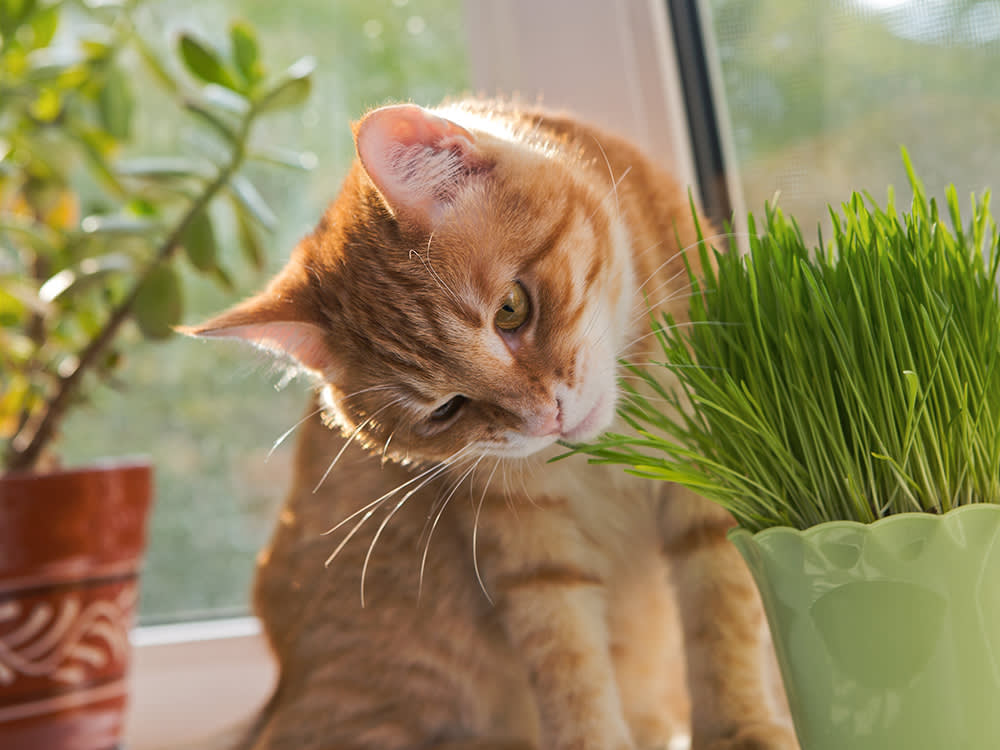
Your cat will stalk a bird feeder before they’ll voluntarily touch a vegetable. They are, by design, strict meat-eaters. So the sight of that same cat solemnly chewing a blade of grass looks like a glitch, or boredom, or a sign something’s off. It’s none of those. Grass-eating in cats is an old, hardwired behavior they inherited from their wild ancestors, and cat grass is simply the safe, indoor way to let them do it. Understanding that flips the whole question. The point isn’t to stop your cat from eating greens. It’s to give them the right greens.
What cat grass actually is
Cat grass isn’t a single plant. It’s a mix of cereal grasses, typically wheat, rye, barley, and oats, grown a few inches tall for a cat to graze on. Despite the shared shelf at the pet store, it has nothing to do with catnip, which is a mint-family herb that changes a cat’s mood rather than something they eat as a snack. (And yes, the wheatgrass in your morning smoothie is essentially the same thing.)
Nobody can say with certainty why an obligate carnivore seeks out grass, and the honest truth is the science here is still thin. But the leading explanations are practical. Grass is a source of moisture, and its fiber may help move things through the gut, including, in theory, hair that would otherwise build into a hairball.
Grass gives a cat a little moisture and a little fiber, and for most cats that’s the whole story, it’s a snack, not a supplement. What I like about it is that it redirects the urge. A cat who has cat grass at home is a cat who’s less tempted by the houseplant or the treated lawn, and those are the things that actually land them in my exam room.
There’s a modest nutrition angle too. Cat grass carries vitamins A and D, folic acid, niacin, and chlorophyll. It isn’t an essential part of a cat’s diet, and no cat needs it to be healthy, but as an occasional fibrous nibble it’s a genuinely good alternative to the risky greens a cat might otherwise go after. It also has a well-known side effect: because it can act as a mild irritant and laxative, cats sometimes use it to bring up something that isn’t sitting right.
Why homegrown beats the lawn
This is the real case for cat grass, and it’s a safety case. Left to their own devices, a cat who wants greens will chew whatever’s available, and “whatever’s available” is often the worst option. Outdoor lawn grass may be treated with herbicides or fertilizers, and it can harbor parasites or bacteria. Many popular houseplants are outright toxic to cats. A pot of clean, homegrown cat grass gives that instinct a target that won’t hurt them.
The rule of thumb is easy: offer cat grass freely as a treat, but pay attention to how they use it. If your cat eats it voraciously, or reaches for it in place of their normal food, that’s worth a conversation with your vet to rule out an underlying problem. And if your cat vomits up grass on the regular, they’re simply eating too much, so scale the portions back.
Growing it yourself, in under a week
Cat grass is famously forgiving, easier to keep alive than a succulent, and it doesn’t ask much of you. You can start from a bag of seed and a little soil or buy a pre-planted grow kit from most nurseries, pet stores, or online. Either way the routine is the same: plant, add water, and keep it somewhere with light. Seeds usually sprout within four to six days, and once the blades are a few inches tall, your cat can start grazing.
A few things to look for when choosing a kit or seed mix: go for organic seed with no added fertilizer or treatment, since your cat is going to eat this; a mix of grasses (wheat, oats, rye, barley) rather than a single type gives a bit of variety; and a stable, tip-resistant pot saves you from a dirt spill when an enthusiastic cat leans in. Keep a second pot coming along so you always have fresh grass ready, because a chewed-down tray gets ragged fast.
What newer research adds
The most interesting recent thinking on this reframes grass-eating as instinct rather than symptom. In a 2021 study of plant-eating in domestic cats, researchers led by Benjamin Hart proposed that the behavior is an inherited holdover from wild ancestors. In the wild, carnivores routinely eat indigestible plant matter to help purge intestinal parasites, and because nearly every wild carnivore carries a parasite load, that grass-eating had a real adaptive job. Domestic cats inherited the drive even though most of them, well-fed and dewormed, no longer need it.
Notably, the same research didn’t find that long-haired, hairball-prone cats ate more grass than short-haired cats, which pushes back gently on the popular “it’s for hairballs” explanation. The reassuring bottom line for owners: a healthy cat nibbling grass is almost always just being a cat, running an ancient program, not signaling that something is wrong.
References
Common questions
Is cat grass safe for cats to eat?
Yes, for most cats. It's a non-toxic fibrous snack and a much safer target than lawn grass, which can carry pesticides, parasites, or bacteria. Offer it as a treat rather than a meal, and check with your vet if your cat eats it voraciously or in place of food.
Why does my cat throw up after eating grass?
Grass can act as a mild irritant and a laxative, so occasional vomiting after eating it is common and usually harmless. If your cat brings up grass regularly, they're likely eating too much, and portions should be limited.
Not a substitute for your vet. Our guidance is educational. For urgent symptoms, contact a vet or emergency clinic right away. Editorial standards
Dr. Solis is a board-certified veterinary dermatologist with over twelve years of clinical experience. She advises on skin conditions, allergies, and grooming practices that affect coat and skin health. All dermatology and allergy content at The Pet Times is reviewed by her team before publication.
Meet our experts ↗Keep reading
 FoodThe Tomato Is Safe for Your Cat. The Plant Can Poison Them.Dr. Priya Nair · 6 min
 FoodPumpkin Is the Rare 'Human Food' Your Cat Might Actually NeedDr. Lena Park · 5 min
 Food'All-Natural' Is Just a Word on the Bag. Read the Ingredients Instead.Dr. Priya Nair · 8 min
 FoodCats Can Eat Pineapple. They Literally Can't Taste the Point.Dr. Ravi Mehta · 3 min
 FoodPeanut Butter Is a Dog Trick. Here's Why It's Riskier for Your CatDr. Mara Chen · 4 min
 FoodYogurt Won't Fix Your Cat's Gut. Here's What Actually Might.Dr. Lena Park · 6 min