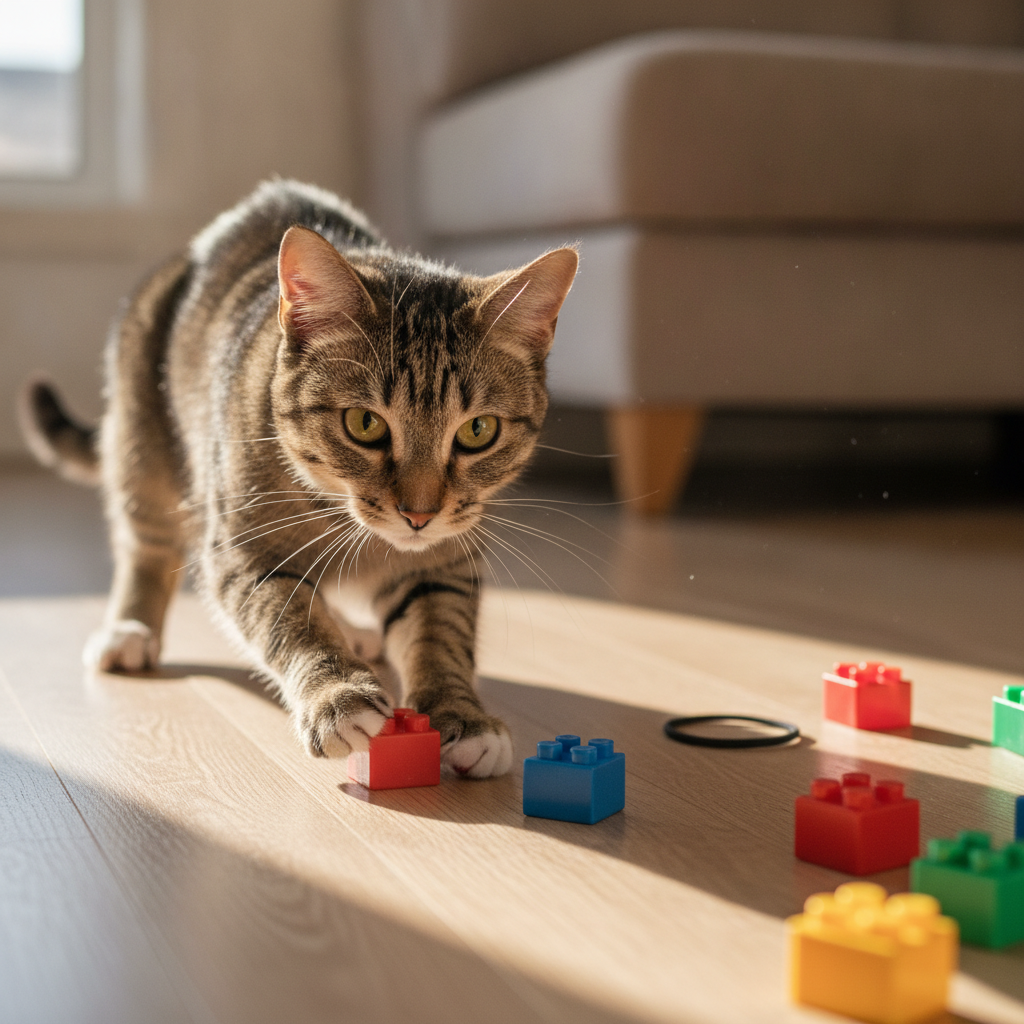
There is a particular kind of panic that comes from watching your cat lunge at something small, hard, and brightly colored, and knowing you are half a second too late.
Most advice about cats eating non-food objects treats every object the same. It shouldn’t. A plastic building brick is a uniquely bad thing for a cat to swallow, and the reason has nothing to do with why they picked it up. It is because if it goes down, your vet may not be able to see it.
The X-ray blind spot
Radiographs work on density. Bone and metal block X-rays and show up bright and obvious. Most household plastics are close in density to soft tissue, which means they are radiolucent: the X-rays pass right through, and the object leaves little or no shadow on the film.
That is the whole problem. A swallowed sewing needle is easy. A swallowed brick can produce a clean-looking X-ray on a cat who is quietly developing an obstruction. Your vet may instead have to work from indirect signs, a contrast study, an ultrasound, or, if the picture is bad enough, exploratory surgery.
So the rule with hard plastic is different from the rule with, say, a hair tie. You do not wait and watch and take reassurance from a normal X-ray. You call, you describe exactly what went in and how big it was, and you follow the plan your vet gives you.
“The sentence I hear most is ‘the X-ray was clear, so we relaxed,’” says Dr. Mara Chen. “With plastic, a clear film is not the same as an empty stomach. Tell your vet the object, the size, and the hour, and let them decide what the imaging is actually worth.”
Signs that a swallowed object has become an obstruction, in rough order of how alarmed to be: repeated vomiting, especially vomiting that keeps coming with nothing in it; refusing food; hiding and going still; a tense or painful belly; straining with no stool; and lethargy. Any one of those with a known swallow is an emergency, not a wait-and-see.
Why bricks, specifically
Cats do not chase toy bricks because they are confused about what food is. They chase them because a brick hits several buttons at once.
It behaves like prey. It is small, it skitters when batted, it makes noise on a hard floor, and it stops when trapped. That is a very good imitation of something worth killing.
The mouthfeel is satisfying. Rigid plastic gives resistance and then releases. Cats who fixate on non-food objects often go for a specific texture, and hard plastic and rubber are recurring favorites.
It smells like you. This is the part owners underestimate. Bricks live in the hands of children and adults all evening. They pick up skin oils, snack residue, and household scent, which is exactly the signal that makes an object worth mouthing rather than ignoring.
Kittens are teething. Between roughly three and seven months, chewing is a comfort behavior. If nothing appropriate is on offer, whatever is on the floor gets the job.
It works on you. If picking up a brick reliably makes you leap off the couch and cross the room, your cat has learned an extremely effective way to start a conversation. Negative attention is still attention, and a bored cat will happily take it.
What pica actually is, and isn’t
Pica is the repeated chewing or swallowing of things that are not food: plastic, fabric, paper, cords, string, plant matter. It is a symptom, not a diagnosis, which is the single most useful thing to understand about it. Something is driving it, and the job is to find out what.
It is also far more common than most owners realize, and it has a clear age curve. In a large UK birth cohort of pet cats, owners reported pica toward at least one material in 42.9% of cats at around six months of age, dropping to 32.0% at twelve months and 30.9% at eighteen months. Most cats targeted a single material type, and plastics were among the most commonly chewed. Chronic pica was more likely in cats whose households moved when they were six to twelve months old, in rented homes, and in homes without a dog when the cat was two to four months old.
Two things fall out of that. First, if you have a five-month-old kitten mouthing plastic, you are looking at the most common phase in the data, not a crisis. Second, the risk factors that predicted the chronic version are all about upheaval and environment, which tells you where to aim.
The medical causes worth ruling out
Before you rearrange your life around enrichment, get the physical causes off the table. A vet visit for persistent pica should be looking at:
- Gastrointestinal disease. Nausea, parasites, and chronic GI inflammation can all push a cat toward chewing and swallowing odd material. This is the most common medical driver and the first thing to check.
- Dental and oral pain. Gum disease, a fractured tooth, or an abscess can make a cat seek out hard objects to press against. Counterintuitive, and real.
- Hyperthyroidism. In older cats, a suddenly ravenous, restless, strangely obsessive cat deserves a thyroid panel. Bloodwork settles it quickly.
- Nutritional shortfalls. Real, but less common than the internet believes. If the food does not meet AAFCO standards for your cat’s life stage, fix that first before adding supplements.
Expect the workup to include a physical exam, bloodwork, a thyroid check in older cats, a dental exam, and imaging if a swallow is suspected. The point is to rule the body out before you blame the mind.
The floor audit that actually prevents this
Once medicine is clear, this becomes a management problem, and management is where the wins are.
Do the audit at cat height. Sit on the floor in each room. Small hard plastic, string, hair ties, rubber bands, twist ties, earbud tips, and bottle caps are what you are hunting. Bricks belong in a lidded bin, not a shallow open tray on the rug.
Give the chewing somewhere to go. Silicone cat chews, rubber toys, and dental treats redirect the urge instead of forbidding it. For a teething kitten, a chilled chew toy is genuinely useful.
Stop the attention payout. When they grab something, do not sprint and shout. Calmly trade: drop a treat away from the object, collect the object while they eat, and move on. You are removing the show, not adding a new one.
Work the boredom. Puzzle feeders, rotating toys on a schedule so they stay novel, vertical space, and a window perch. Two short interactive play sessions a day beat one long one.
Lower the household temperature. Stress is a real driver. Predictable feeding times, safe hiding spots, and pheromone diffusers help. If your cat is genuinely anxious, ask your vet about behavioral therapy or medication rather than trying to out-toy an anxiety problem.
What newer research adds
The biggest shift in how vets think about this is that pica is no longer treated as a bizarre quirk of a few weird cats. The UK birth-cohort data reframed it as a common, largely age-linked behavior that most kittens show at least once, and that a meaningful minority carry into adulthood.
That changes the advice. If your kitten is chewing plastic, the useful response is not alarm, it is a floor audit and a chew toy. If your adult cat is still doing it, or started recently, that is the version worth a workup, because the same study found the chronic form clustered around household disruption rather than simple kitten curiosity.
And the object still matters more than the behavior. A cat who mouths a brick and walks away is a training problem. A cat who swallows one is a phone call, today, no matter how good the X-ray looks.
References
- Owner-Reported Pica in Domestic Cats Enrolled onto a Birth Cohort Study — Animals, 2021
- Factors affecting pica in the domestic cat — Applied Animal Behaviour Science
- Gastrointestinal Obstruction in Small Animals — Merck Veterinary Manual
- Hyperthyroidism in Cats — Cornell Feline Health Center