Most dog training is about getting a dog to do something. Mat training is about giving him somewhere to be, which turns out to be the more useful problem to have solved.
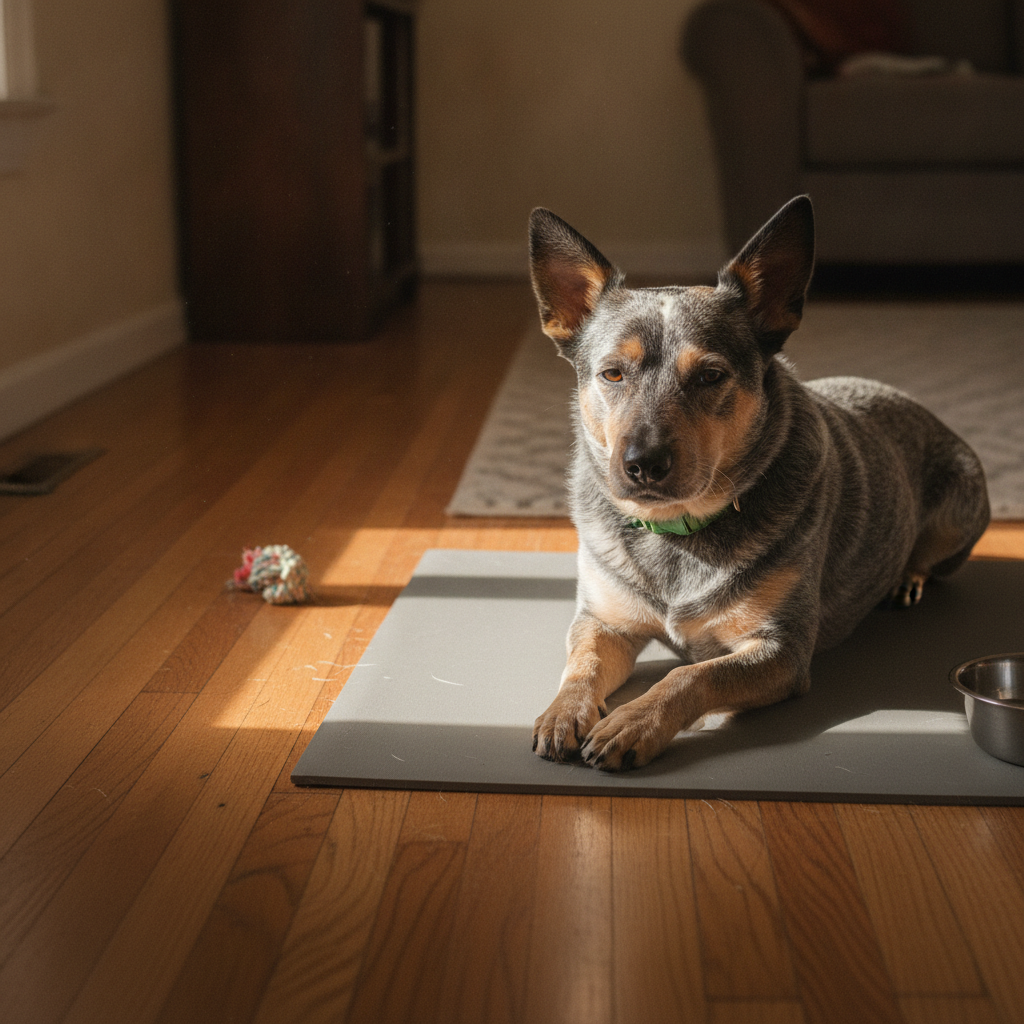
The cue is simple. You say “go to your mat,” and your dog leaves whatever he is doing, crosses the room, lies down on a specific piece of fabric, and stays there until you release him. That is it. And it is, hour for hour, the highest-return thing you will ever teach him, because it converts a dozen separate nuisances into one answer.
What it actually buys you
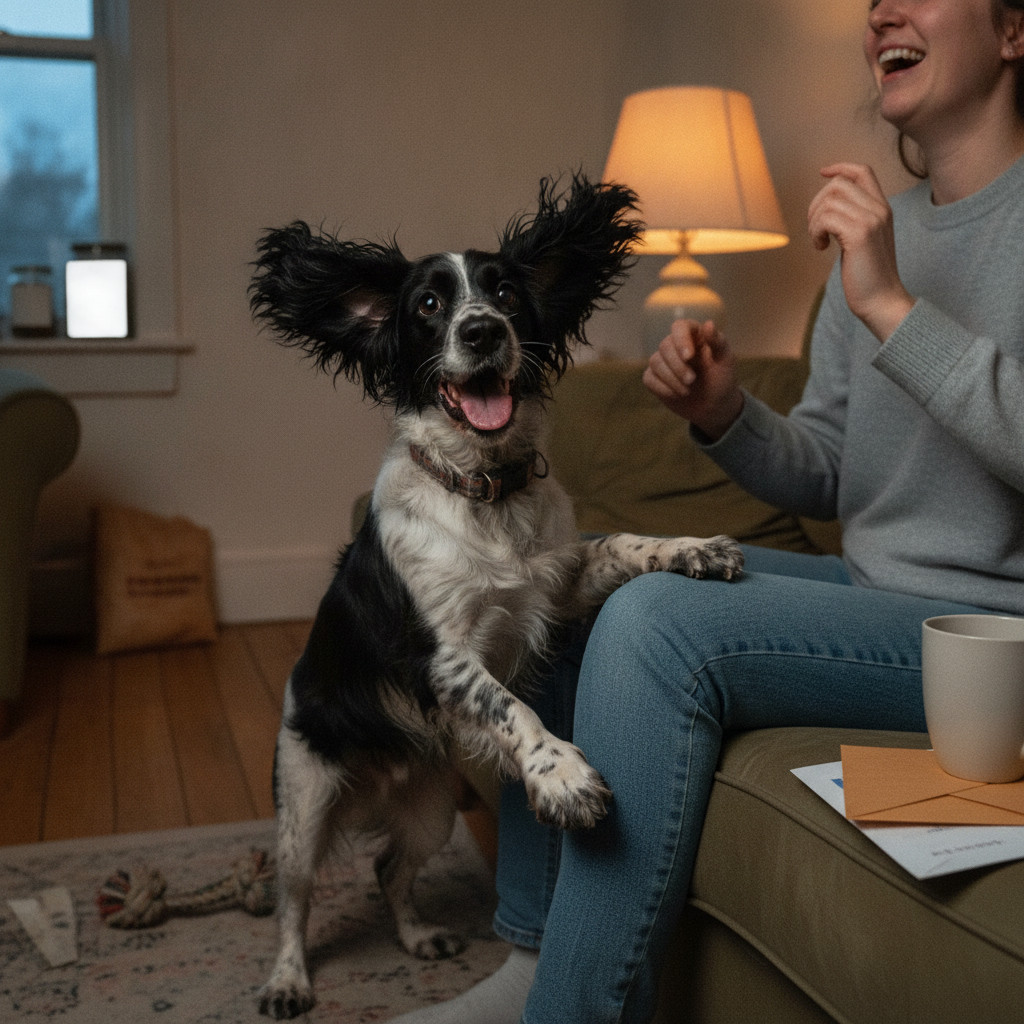
The door. The knock comes, the doorbell goes, and your dog is airborne. A dog who has a mat has a job at the door instead of a problem at the door, and the job is incompatible with launching himself at the delivery driver.
The kitchen. Cooking with a dog underfoot is a hazard for both of you. A mat at the edge of the room ends the negotiation without ending the company.
Guests. A dog who greets a guest by shoving his nose into their handbag is not a bad dog, he is an uninstructed one. Send him to the mat, let him settle, and let him rejoin when the room has calmed down.
The self-soothing part, which is the real prize. A dog who has spent months being paid for lying quietly on a specific mat starts to find that mat genuinely calming. He will begin taking himself there. That is not obedience. That is a dog with a coping strategy.
Everywhere else. This is where mat training beats the crate outright. A crate is a wonderful safe space that weighs thirty pounds and does not come to the cafe. A mat rolls up. It goes in the car, into the hotel room, under the table at the brewery, into your in-laws’ living room, and it brings the same predictable rules with it. Your dog does not have to work out what the etiquette is in a strange place. He already knows: this is my mat, on the mat is where good things happen, and nothing is required of me here.
“The dogs I worry least about in a new environment are the ones with a settle station,” says Dr. Mara Chen. “They aren’t calmer by temperament. They just brought a piece of home with them, and they know exactly what it asks of them.”
Before you start
Your dog needs a working down and a working stay first. Mat training is not a new trick so much as a chain made of old ones, and you cannot chain behaviors you do not have.
Pick the mat deliberately. Flat, portable, washable, and dedicated to this purpose only, so it is not doubling as the nap bed or the chew-toy zone. The whole point is that its arrival on the floor is information.
The six-step build
1. Give the cue and lure. Say “go to your mat,” walk toward it yourself, and draw him onto it with food in your hand. The instant a paw lands on the fabric, mark (“yes”) and pay. Release. Repeat. You are not asking for a down yet. You are only building the idea that this rectangle is where money comes from.
2. Add the down. As soon as he arrives, cue “down” and pay again. Release, reset, repeat. Keep going until you see him start to fold into a down the instant he lands, before you have said anything. That anticipation is the sign the chain is forming.
3. Add distance. Back away from the mat in small increments so that he is running out ahead of you rather than trailing you. Pitching food so it lands on the fabric the instant you cue helps enormously here: it gives him a reason to run ahead and finish the job under his own steam rather than waiting to be escorted.
4. Link the stay. Once he is reliably going out, landing, and downing without prompting, add the last link. Cue “stay” after the down. Build duration in seconds and release him while he is still succeeding. A stay you have to nag him through is not a stay.
5. Reinforce the whole chain. With all the links in place, keep paying for the thing getting harder: more distance, more duration, more distraction. Vary which part you reward so he never knows which piece is the paid one, which keeps all of them strong.
6. Proof it against your actual house. This is the step people skip, and it is the reason mat training so often works beautifully in the living room and collapses at the door. Raise one variable at a time. Knock on the wall from inside the room. Then knock on the door. Then have someone else knock. Then have someone else knock and open it. If he breaks, you jumped too far; go back one rung and pay him for the version he can do.
Where it goes wrong
The stay is too long, too soon. Duration is the hardest variable and people add it first. Two seconds, paid, beats twenty seconds, broken.
The mat is used as a punishment. If the mat is where he goes when he is in trouble, the mat is now a bad place, and you have spent your best training asset on a time-out chair. Never send him there in anger.
He gets released by the exciting thing instead of by you. If the doorbell keeps ending the stay, the doorbell is now the release cue. You end the stay. Every time.
The reward never changes. Once the behavior is solid, a rotating reward, sometimes food, sometimes the door opening, sometimes going out to the yard, keeps it alive far better than the same three kibbles forever.
What newer research adds
The reason this cue works so well is not obedience. It is that you are training an incompatible behavior, which is the most robust technique in the whole behavior-change toolbox: a dog cannot simultaneously lie on a mat and body-check the mail carrier. Reinforcing what you want, rather than suppressing what you do not, is the approach with the strongest support in the current literature and the fewest side effects.
The station idea has also spread well beyond pet homes. Zoo and shelter behavior programs now use mat and station training as a standard cooperative-care tool, because an animal who will voluntarily go to and hold a station can be examined, medicated, or moved without restraint. Veterinary practices are starting to borrow it too. If your dog will settle on a mat at home, ask whether you can bring it into the exam room. A lot of clinics will say yes, and a lot of dogs turn out to be considerably braver on their own rug.
References
- American Veterinary Society of Animal Behavior, “Position Statement on Humane Dog Training.” https://avsab.org/wp-content/uploads/2021/08/AVSAB-Humane-Dog-Training-Position-Statement-2021.pdf
- Vieira de Castro, A. C., et al. “Does training method matter? Evidence for the negative impact of aversive-based methods on companion dog welfare.” PLOS ONE, 2020. https://journals.plos.org/plosone/article?id=10.1371/journal.pone.0225023
- Fear Free Pets, “Cooperative Care and Station Training in Veterinary Practice.” https://fearfreepets.com/