Somewhere around hour three of day one, you will accept that the sound is not going to stop. Not at the state line, not at the truck stop, not after the fourth reassuring sentence you say to a creature who does not speak English. A stressed cat in a moving car will vocalize, and there is no version of this trip where you talk her out of it.
So stop trying to fix the yowling. It is a symptom, and it is the one variable you have the least control over. What you can control, completely, is the four-part infrastructure around it: the carrier she rides in, the pharmacology you have or don’t have on board, the room waiting at the other end of the day, and the microchip record that will decide what happens if she bolts at a rest stop. Get those right and the trip is loud but safe. Get them wrong and the noise becomes the least of your problems.
The carrier is the whole trip
Most people buy the carrier last, in a hurry, based on what fits in the footwell. It should be the first purchase and the biggest decision.
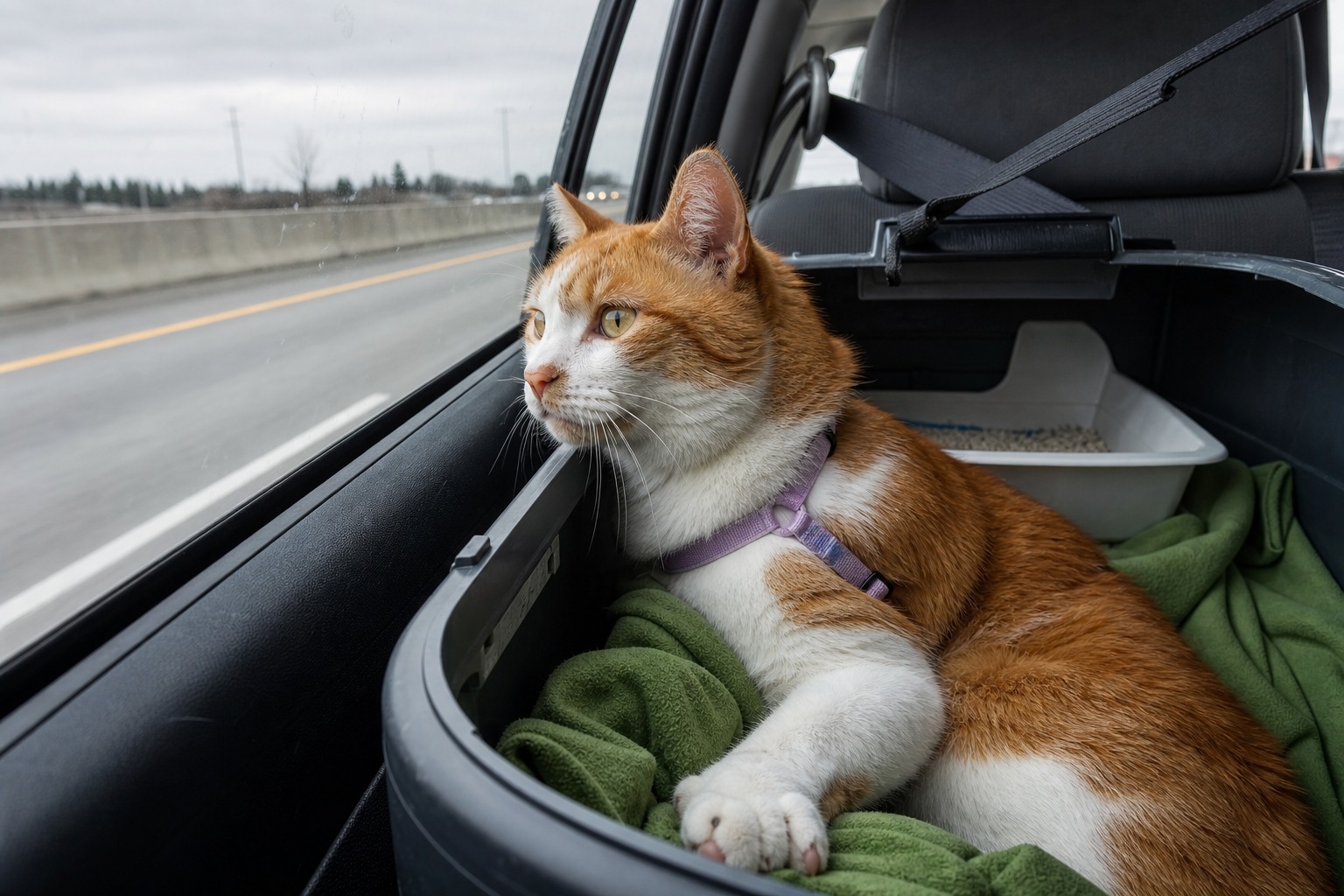
You want hard-sided, because it holds its shape in a sudden stop and because you can strap it down. You want it big enough that she can stand up fully, turn around, and stretch out flat, with space left over for a small litter tray at one end. That last part is the requirement most carriers fail. A cat in a six-day drive needs somewhere to go that is not her own bedding, and a soft backpack with a puppy pad in it is not that place. (Ask anyone who has tried. Roughly one cat in two will use the pad. Once.)
Then buy it weeks early and take the door off. Leave it open in the room where the family lives, with a blanket she already smells like and a few treats appearing inside it at random. The goal is boring. A carrier that only comes out of the closet before a vet visit is a trap, and cats are excellent at recognizing traps.
In the car, the carrier gets belted in. It is not luggage. In a 35 mph collision an unsecured carrier becomes a projectile with your cat inside it.
Ask your vet about the drug that actually has a label for this
This is the part that has genuinely changed, and if your last long-haul move was more than a couple of years ago, your information is out of date.
In December 2023 the FDA approved Bonqat (pregabalin oral solution) for alleviating acute anxiety and fear associated with transportation and veterinary visits in cats. It is the first FDA-approved animal drug containing pregabalin, and it is the first product whose approved label describes exactly the thing you are about to do to your cat. It is given orally about 1.5 hours before travel starts and can be repeated on two consecutive days. In the trial behind the approval, 77 percent of cats given Bonqat improved on fear and anxiety measures across two examinations, against 46 percent on placebo. Reported side effects were mild sedation, wobbliness, and lethargy. It is prescription-only, and it is a controlled substance, so your vet has to write it.
The other common option is gabapentin, used off-label and studied fairly extensively. Work out of UC Davis found that a single dose before a vet visit significantly lowered owner-rated stress scores during both transport and examination. Typical single doses for travel land in the 50 to 100 mg range, but the correct number depends on your cat’s weight and health, and it is your vet’s call, not the internet’s.
Two rules go with either drug. First, rehearse. Give the dose you plan to use before a short practice drive, so you find out how your particular cat responds while you’re still ten minutes from home. Some cats are relaxed. Some are limp and unhappy. You want to know which before you’re in Nebraska.
Second, understand what you’re buying. Neither of these is a mute button.
“People hear ‘anti-anxiety’ and picture a cat who sleeps to Denver,” says Dr. Lena Park. “That is not the goal, and honestly it is not the safe goal either. What we are trying to do is drop her fear low enough that she can settle, eat, and use the box. If she is still complaining but she drinks water and pees, that is a win, and I will take it.”
Calming treats, CBD chews, and pheromone sprays sit in a different tier. A pheromone spray on the bedding an hour before loading is cheap and harmless and may take a small edge off. Do not build the trip around it.
The hotels will lie to you, gently
“Pet friendly” overwhelmingly means dog friendly. Cats get quietly excluded at check-in by properties whose website said pets were welcome, and you find out at 9pm with a screaming carrier on the luggage cart.
Book every night in advance. Call each property, use the word cat explicitly, and get a yes from a human. Expect a pet fee and budget for it. Best Western has historically been one of the more reliably cat-tolerant chains, but policies are set property by property, so the phone call is not optional even within a chain you trust.
Then work the room like a small operation. Before the carrier door opens: litter box out and visible, water down, bathroom door shut, gaps behind the headboard and under the bed dresser blocked if you can. Hotel rooms are full of cat-sized voids, and a frightened cat will find the one you missed within nine seconds. Only when the room is sealed do you open the carrier, and then you leave her alone. She will come out when she’s ready. Most cats decompress dramatically the moment the engine stops, and the animal who spent six hours announcing her grievances will be eating dinner and kneading the comforter by ten.
The microchip is the actual emergency plan
Everything above is comfort and logistics. This one is the thing that gets your cat back.
Cats bolt at rest stops. Not because they are stupid, but because a door opens on an unfamiliar, loud, enormous place while they are already flooded with adrenaline. If it happens, you are a stranger in a state you don’t live in, with no idea where the local shelters are, on a schedule.
So: microchip her if she isn’t chipped. And, far more important, log into the chip registry and update the record before you leave. An enormous share of chipped pets are unrecoverable because the number in the database belongs to a phone the owner stopped using in 2019. Put your cell on it. Put the new address on it. Add a second contact who is not in the car with you. Take a clear photo of each cat on your phone the week before, from the side and from the front, because “grey tabby” is not a useful description at a shelter intake desk.
Harness and leash her at every stop if she’s leash-trained. If she isn’t, she does not leave the carrier at a rest area, full stop. There is nothing out there she needs.
What’s new since this was written
The biggest change is the one above: as of 2023, there is finally a drug approved specifically for this scenario in cats, which means you no longer have to have a vaguely apologetic conversation about “borrowing” something. You can ask a direct question: is Bonqat right for my cat for a six-day drive, and if not, what’s the gabapentin plan?
The second change is in how vets frame the whole problem. The current thinking, reflected in feline-friendly handling guidelines, is that transport stress starts long before the car and is mostly about the carrier and the anticipation. That is why the boring, unglamorous advice, take the door off the carrier and leave it in the living room for a month, keeps outperforming the clever advice. The cat who thinks the box is furniture has already had most of her stress removed before you turn the key.
The part nobody tells you
You are going to feel like a monster. Somewhere in Wyoming, listening to a cat produce the same syllable at the same rhythm for the fifth consecutive hour, you will genuinely wonder whether she can be damaged by this, whether she’ll ever forgive you, whether the whole move was selfish.
She will be fine. Cats are terrible at car travel and remarkably good at recovering from it. The yowling is a protest, not an injury. Barring a real medical problem, a healthy cat who is safely contained, hydrated, and able to use a box will get out of that car at the end, sulk for a day, find the sunniest square of your new floor, and take ownership of the place.
And you will get your quiet back. Just not until you park.
References
- U.S. Food and Drug Administration. “FDA Approves Pregabalin Oral Solution for Alleviating Anxiety Associated with Transportation and Veterinary Visits in Cats.” CVM Updates, December 2023. fda.gov
- American Veterinary Medical Association. “New drug calms cats during transportation, veterinary visits.” JAVMA News, 2024. avma.org
- van Haaften, K. A., Forsythe, L. R. E., Stelow, E. A., Bain, M. J. “Effects of a single preappointment dose of gabapentin on signs of stress in cats during transportation and veterinary examination.” Journal of the American Veterinary Medical Association, vol. 251, no. 10, 2017, pp. 1175–1181. doi.org/10.2460/javma.251.10.1175
- Lamminen, T., Korpivaara, M., Suokko, M., et al. “Efficacy of a Single Dose of Pregabalin on Signs of Anxiety in Cats During Transportation.” Frontiers in Veterinary Science, 2021. pmc.ncbi.nlm.nih.gov/articles/PMC8440915
- American Association of Feline Practitioners. “Feline-Friendly Handling and Transport Guidelines.” catvets.com