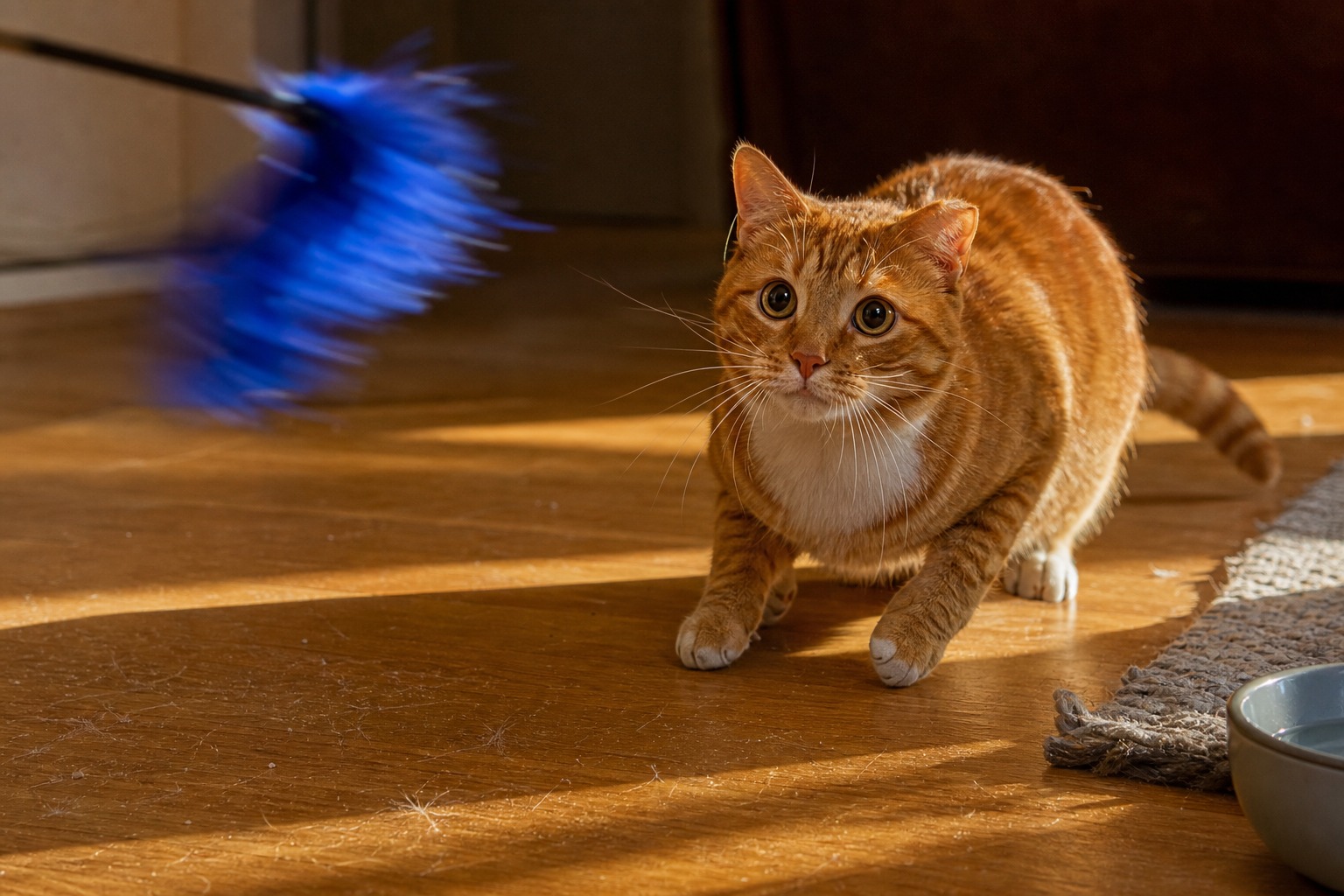
Walk down the cat toy aisle and count the red mice. Then the orange balls. Then the hot pink feather wands.
Almost none of that was designed for a cat. It was designed for the person holding the credit card, whose eyes have three types of cone cell and love a saturated red. Your cat has two.
Here is the correction that actually changes how you shop, though: the answer is not to go buy the same toy in blue. Color is a real limit on what your cat sees, but it was never the variable driving whether they chase a thing. Contrast and motion are. A cat’s visual system was tuned to spot a small, fast, low-contrast thing moving at dusk. Everything else, including the beautiful rainbow of the toy shelf, is decoration.
Let’s take the two pieces in order, because the second one only makes sense once you have the first.
What a cat’s eye is actually built out of
Two cell types do the work. Rods handle low light, peripheral vision, and motion. Cones handle daylight detail and color.
Humans carry three types of cone, each tuned to a different band of wavelengths, and the brain compares them to build the full spectrum. Cats carry two. They are dichromats: one cone type tuned to blue-violet, another tuned to greenish-yellow. There is no cone in a cat’s eye that responds to long, red wavelengths, so red is not a color your cat perceives dimly. It is a color their hardware cannot report at all. It lands as a muddy green or gray.
There is a second, less-quoted number that matters more than the cone count. In the cat retina, only about 10% to 20% of cones are the blue-sensitive type, with the other 80% to 90% being the medium-to-long wavelength kind. Even inside the colors cats can see, the sampling is lopsided. The result is not a rainbow turned down. It is a rainbow flattened toward a narrow band of blues, yellows, and grays, with far less saturation than you are imagining.
So: purple probably reads as another blue. Pink reads greenish. The red laser dot your cat is losing their mind over is not red to them, and that is worth sitting with for a second, because it tells you what they were actually chasing.
The trade, not the deficit
The temptation is to read all this as a loss, as though the cat got a worse version of our eye. That framing is backwards, and it is why people keep buying the wrong toys.
Every eye is a compromise between light sensitivity and detail. Rods gather photons; cones resolve fine information. Retinal space spent on one is not available for the other. Cats spent theirs on rods, plus a reflective layer behind the retina, the tapetum, that bounces light back through the photoreceptors for a second pass. The payoff is enormous: a cat can work in roughly one-sixth the light a human needs, and can resolve small, fast movement at a level we simply cannot.
They did not lose color. They traded it, for the two things that keep a small crepuscular predator fed.
Owners come in worried that their cat’s world is dull, and I have to reframe it. Your cat is not looking at a washed-out version of your living room. They are looking at a room where the moving things glow and the still things barely register. That is not less. That is different.
Which is why toy color is the wrong variable
Follow that logic to the shelf.
The thing your cat is built to detect is a small object moving unpredictably against a background it does not match. Three variables in that sentence, and hue is not one of them. What matters:
- Motion, and specifically erratic motion. Steady back-and-forth dragging reads as machinery. Short darts, pauses, direction changes, and the toy disappearing behind something read as prey. The pause is the part most people skip, and it is the part that triggers the pounce.
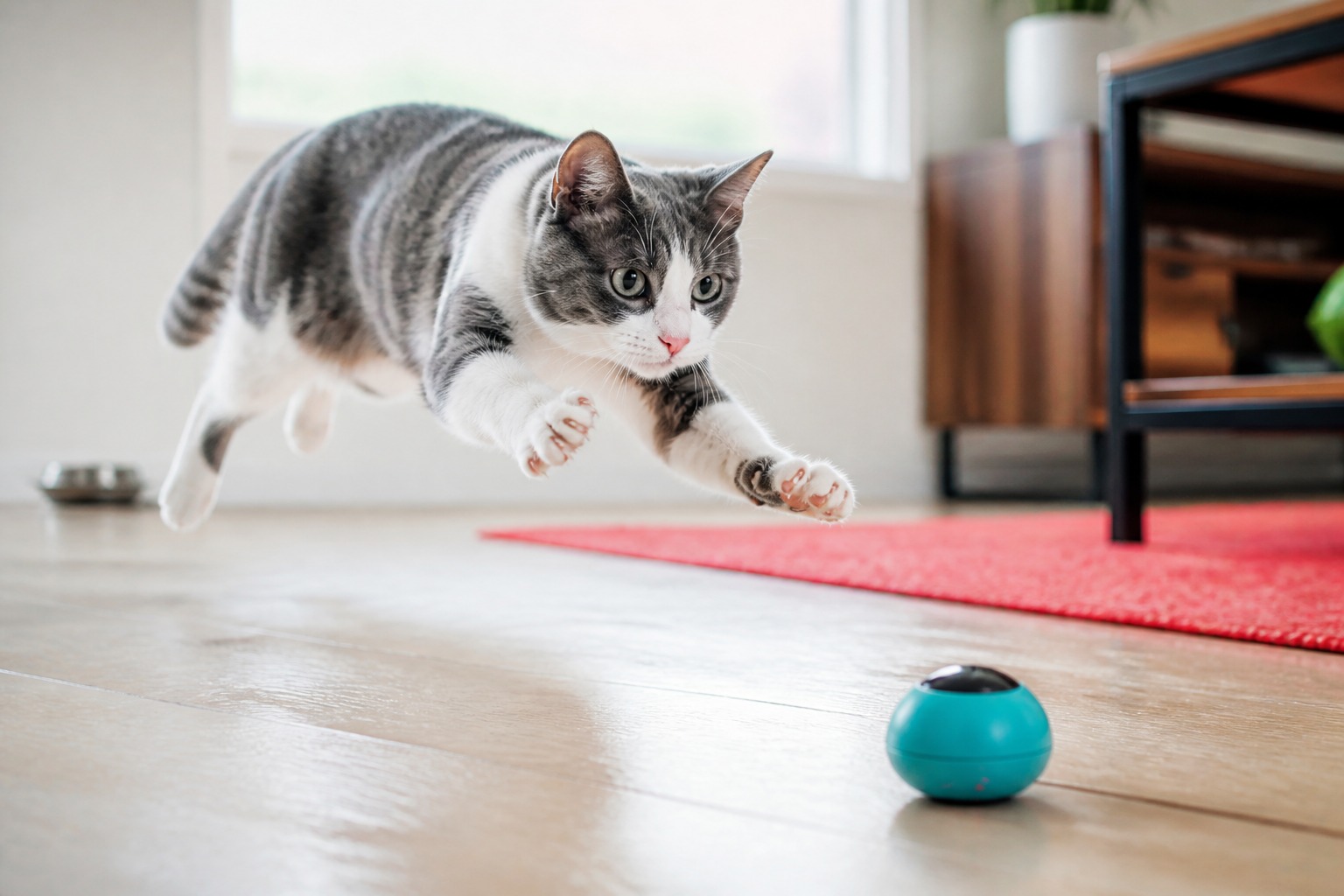
- Contrast against the floor. This is the one nobody thinks about. A dark toy on a dark rug is nearly invisible to a cat even in good light. A pale toy on a dark floor pops. Before you evaluate the toy, look at what it will be moving across.
- Size and sound. Small, roughly prey-sized, with a rustle or a crinkle, beats big and silent.
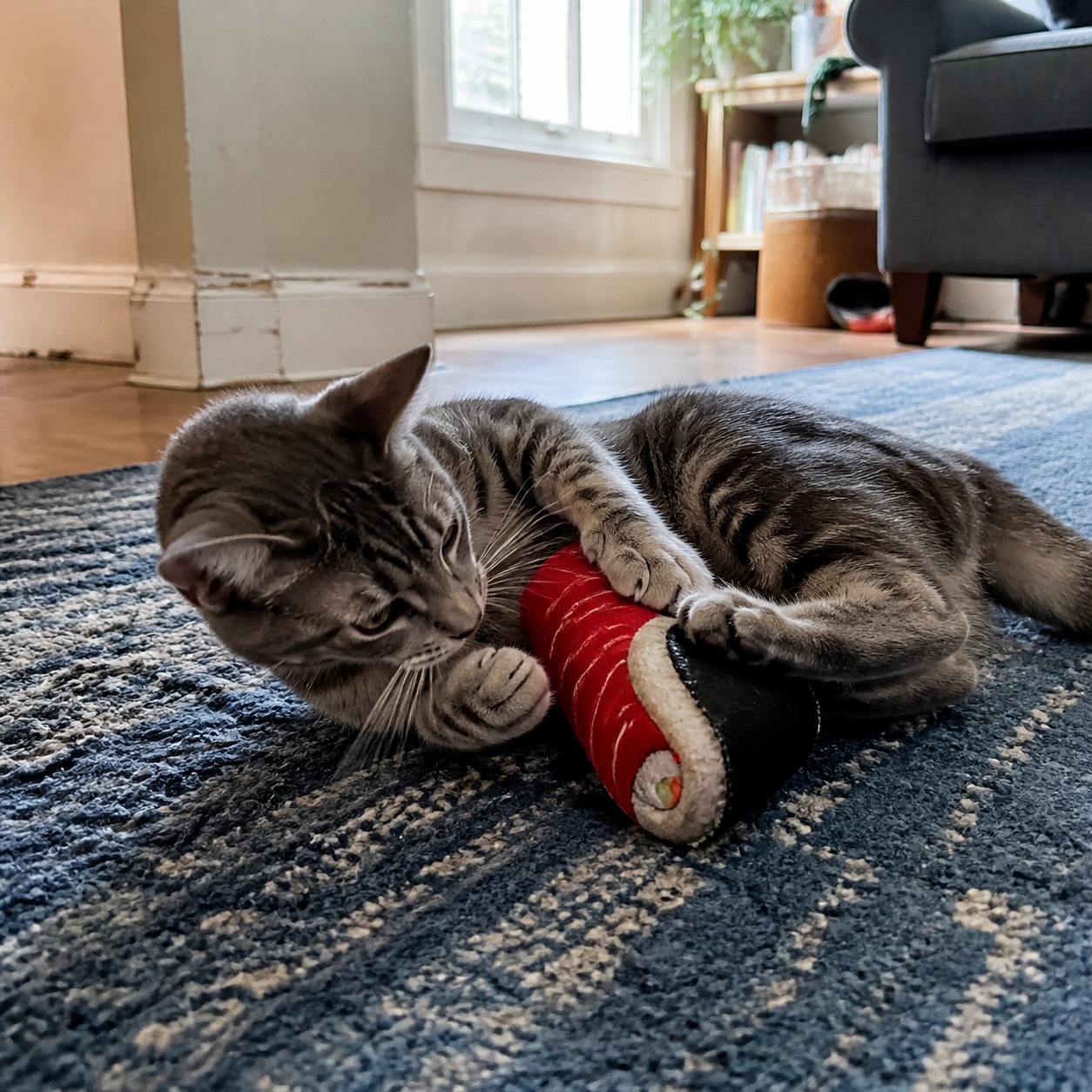
Where color does earn its keep is as a cheap way to buy contrast. If you are choosing between two otherwise identical toys, take the blue or the yellow-green one, because those are the wavelengths your cat’s cones actually sample. Skip red, especially red on a beige carpet, where the toy is doubly invisible to them: wrong hue, low contrast.
That is the whole rule. Buy for movement and contrast. Let color be the tiebreaker.
Does any of this change how a cat lives?
Not much, and that is the honest answer. Cats are not walking around mourning a color they cannot see. Their behavior is organized around movement, scent, and hearing, three channels where they outclass us badly enough that vision is arguably their third-best sense at close range.
The one place it shows up practically is in how a cat finds things. Cats are farsighted, with poor focus inside about a foot, which is why a treat dropped directly under their nose can vanish while a moth across the room does not. If you want your cat’s attention, do not put a colorful object near their face. Move a plain one at a distance.
What newer research adds
Two updates are worth knowing, and one of them is unsettled.
The first is that dichromacy in cats is well-established and not really in dispute. The interesting arguments have moved on to whether cats pick up anything in the ultraviolet range, and here the literature genuinely disagrees with itself. One line of work has measured cat lenses transmitting a substantial share of UVA, which would in principle let UV-reflective patterns register even without a dedicated UV cone. Other measurements of feline ocular media report almost no UVA getting through, and electrophysiological testing has found no retinal response to UV stimuli on their own. So the fair summary is: nobody has closed this, and any product marketed to you on the promise that your cat sees UV is running ahead of the evidence.
The second is that the “cats are colorblind” folk belief has been thoroughly retired, and the practical advice has moved with it. Modern enrichment guidance barely mentions hue. It talks about movement patterns, prey-sized objects, pauses, and letting the cat actually catch the thing at the end. That last point is not about vision at all, and it is still the biggest predictor of whether your cat plays with a toy twice.
References
- Loop, M. S., Millican, C. L., & Thomas, S. R. (1987). Photopic spectral sensitivity of the cat. The Journal of Physiology.
- Linberg, K. A., Lewis, G. P., Shaaw, C., et al. Cat Colour Vision: Evidence for More Than One Cone Process. The Journal of Physiology.
- Douglas, R. H., & Jeffery, G. (2014). The spectral transmission of ocular media suggests ultraviolet sensitivity is widespread among mammals. Proceedings of the Royal Society B.
- Ollivier, F. J., et al. (2004). Comparative morphology of the tapetum lucidum among selected species. Veterinary Ophthalmology.
Common questions
What colors can cats actually see?
Cats are dichromats. They reliably distinguish blue-violet and yellow-green wavelengths. Red, orange, and brown fall outside what their cones can register and read as muddy greens and grays.
Do cats see in black and white?
No. That is a myth. Cats have working color vision, just a narrower version of ours, built from two cone types instead of three.
Do cats and dogs see the same colors?
Close, but not identical. Both are dichromats and both miss red. Cats appear to pick up somewhat more in the green-yellow range, while dogs sit more squarely in blue and yellow.
Does the color of a cat toy matter at all?
Less than you think. Movement and contrast against the floor do most of the work. If you want color to help rather than hurt, choose blue or yellow-green and skip red on a beige rug.