


An AI Box Can Drill Your Dog. It Can't Do the Part That Matters.
A camera-and-treat machine that trains your dog while you're out sounds like a shortcut. Here's what the technology genuinely does well, what it can't replace, and where Companion's device actually landed.

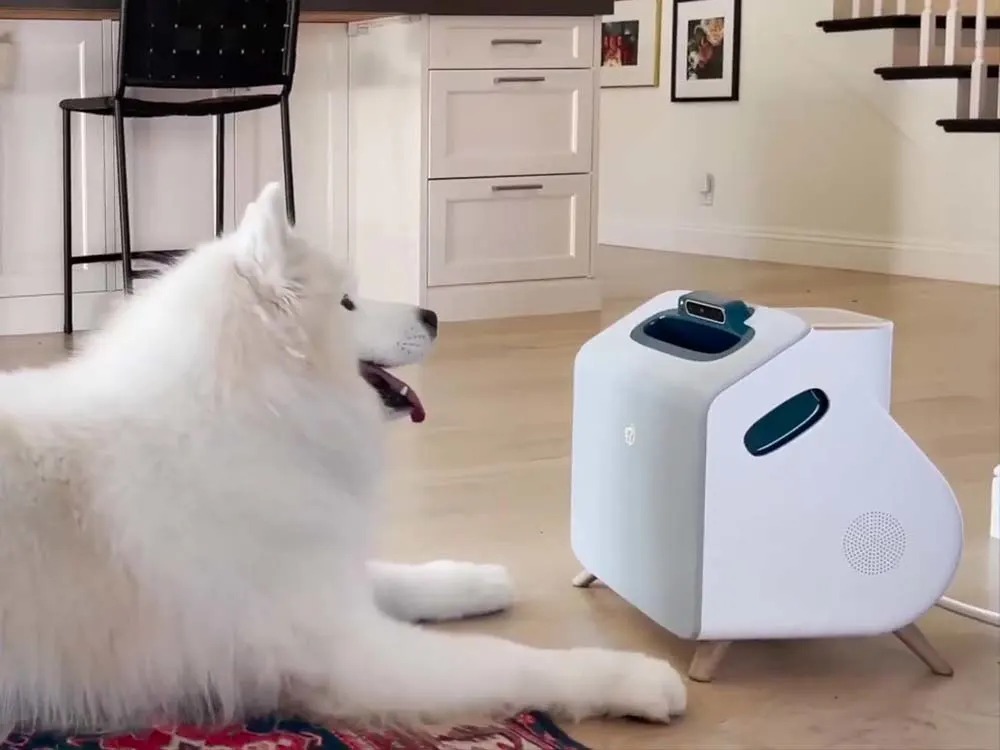
Ask most dog owners what stops them from training more, and the answer is not motivation. It is time. Everyone wants a better-behaved dog; almost nobody has a spare hour a day to drill “sit” a thousand times. That gap is exactly what a company called Companion set out to fill with an AI device that watches your dog, rewards good behavior with a treat, and keeps working whether you are home or not. The obvious question is the interesting one: can a machine actually train your dog, and should it?
The honest answer is that it can do one specific thing extremely well, and it cannot do the thing that matters most. Both halves are worth understanding before you hand any part of the job to a box.
What a machine is genuinely good at
A training device’s superpower is consistency. It never gets impatient, never rewards late, never accidentally reinforces the jumping it is trying to stop, and never gets tired at rep number 300. A human, even a devoted one, drifts. We reward a little inconsistently, we let things slide when we are worn out, and our timing wobbles. A camera-and-treat system paired with behavior-recognition software does not wobble. For the pure repetition phase of building a behavior — the part where a dog needs hundreds of clean, identically-timed reps to lock in something like a reliable “sit” — perfect patience is a real advantage.
Companion’s pitch leans hard on this. The device uses computer vision to read a dog’s behavior in real time and dispenses a treat the instant the dog does the right thing, withholding it otherwise. Crucially, the company built the whole thing around positive reinforcement only, on the logic that consistency is a form of kindness. On that narrow point, the science agrees: reward-based training is both more effective and less risky than aversive methods, and a machine that only ever rewards is a machine that cannot fall back on the shortcuts a frustrated human might.
“Consistency and timing are where most home training quietly falls apart,” says Dr. Amara Solis. “A device that rewards the exact right instant, every single time, removes a huge source of confusion for the dog. That part is legitimately valuable. Where I’d caution owners is in expecting the machine to hand you a trained dog rather than a dog who has practiced a behavior.”
What it can’t replace
Here is the catch, and Companion’s own team is upfront about it: a behavior a dog performs for a machine does not automatically transfer to you, or to the front door, or to the chaos of a real walk. Dogs are famously bad at generalizing. A dog who nails “sit” for the box in the living room may look at you blankly when you ask in the kitchen. Bridging that gap — taking a behavior the machine built and making it work everywhere, with real people, under real distraction — is human work. It is also where the actual relationship gets built.
That is why Companion never sold the device as a standalone robot trainer. It comes bundled with access to human coaches through an app, precisely because someone has to help you transfer the behavior off the machine and into your life. The company also assembled a heavyweight advisory bench, including Fear Free founder Dr. Marty Becker, animal-behavior researcher Erica Feuerbacher, and longtime trainer Ken Ramirez of Karen Pryor Clicker Training. The through-line is that the tech handles reps; humans handle meaning.
Where it actually landed
When this device first made news, its release date had not been announced. Since then the picture has clarified, and it is not quite the mass-market gadget the early buzz implied. Companion moved toward a rent-only model rather than a one-time purchase, with pricing that started around $200 a month, and it leaned into a professional tier, Companion Pro, aimed at working-dog trainers, shelters, and animal-behavior researchers rather than the average living room. The company has said it takes no profit from nonprofit users like rescues, which fits the professional-first direction. Behind it sits roughly $8 million in investment from names including Mars, Central Garden & Pet, and Michelson Found Animals.
The most interesting evidence for the concept is not the hardware but a case report. A study accepted by the Journal of Veterinary Behavior documented a mixed-breed dog with severe separation anxiety whose distress signs dropped significantly within about twelve weeks after an automated, computer-vision-driven positive-reinforcement device was added to the treatment plan. That is a single case, not proof for every dog, and separation anxiety is a serious condition that warrants a real behavior professional. But it points at the honest use case: not “replace training,” but “add machine-grade consistency to a plan a human is still steering.”
So: hand the leash to a machine?
The better framing is that you would not let a robot replace training. You might let one take over the tedious, high-repetition drilling that humans do badly, while you keep the parts that require judgment, context, and a bond. Used that way, an AI device is a power tool, not a substitute. Used the other way — as a set-it-and-forget-it dog-raiser — it will leave you with a dog who is great at pleasing a box and unsure what to do about you.
What’s new since this was written
The device is no longer a “coming soon” teaser. Companion shifted to a subscription and professional-access model, with early availability going to trainers, shelters, and researchers rather than a general consumer launch, and monthly pricing that puts it well outside impulse-buy territory. If you are a pet owner hoping to grab one off a shelf, that is the reality to plan around today. Meanwhile, the broader category of camera-and-treat “smart trainers” has kept growing, so consistency-on-autopilot is increasingly something you can buy in some form — just remember that none of them can do your dog’s generalization or your relationship for you.
Marcus Webb writes about the gear, gadgets, and everyday choices that make life with a pet easier. His coverage runs from product picks to training and the causes worth paying attention to, always with an eye on what actually earns a place in your home.
Meet our experts ↗