Most dogs do not love the vet, and some actively dread it. You see it in the shaking, the drooling, the planted-feet refusal at the door, and occasionally the growl that means a dog has run out of calmer ways to say no. You cannot explain to your dog that the whole ordeal is for their own good, which leaves you with the next best thing: making the experience so predictable and so well-rewarded that there is nothing left to fear.
Here is the reframe that changes everything. A calm vet visit is not something you manage in the lobby on the day. It is something you build at home over the weeks before, so that by the time you arrive, the exam is just a slightly boring version of games your dog already knows. Below are eight ways to get there.
1. Start with a clinic that will meet your dog halfway
Before any training matters, you need a practice that is willing to work with a frightened animal instead of muscling through. Ask directly how they handle anxious dogs. Do they use treats and go slowly? Will they let you send a short video of your dog’s cues ahead of time, or use a back entrance if the lobby is the real problem? A clinic that treats your dog’s fear as your problem alone is telling you something. Shop around until you find one that sees a nervous dog as a challenge worth solving.
2. Do a “happy visit” with no exam attached
One of the most effective things you can do costs almost nothing: call your clinic and book a visit whose only purpose is to have a good time. Your dog walks in, sniffs the lobby, meets the staff, maybe steps on the scale, and eats an outrageous number of treats, then leaves. No shots, no exam, no stress. Do a few of these and you rewrite the story your dog tells themselves about the building. Instead of “this is where scary things happen,” it becomes “this is where the good stuff lives.” These meet-and-greets work for dogs of any age, not just puppies.
3. Turn the exam into tricks your dog already loves
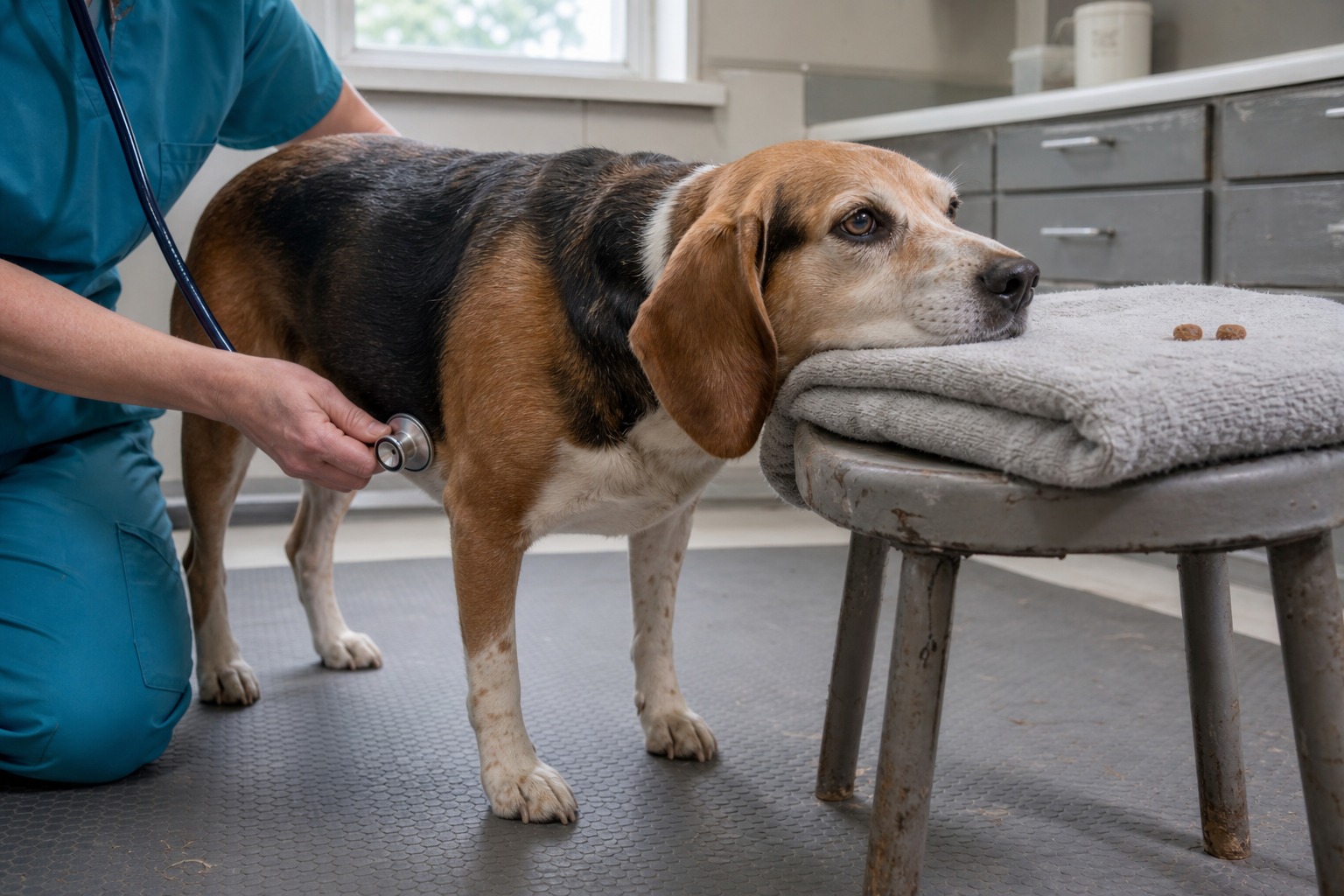
Vets have to do specific things to your dog: weigh them, look in their ears, lift a paw, listen to their chest, hold still for a shot. Every one of those has a trick version you can teach at home as a game. Train a “paws up” onto a low platform and you have a dog who will walk onto the scale willingly. Teach a chin rest, a “shake” for paw handling, and a rock-solid “stay,” and suddenly the exam is a series of familiar cues instead of a series of ambushes. As a bonus, a dog who cooperates gets in and out faster, which means less time to get worked up.
4. Counter-condition the handling before it happens
Counter-conditioning just means teaching your dog that a slightly weird thing predicts something wonderful. At home, gently touch an ear, then treat. Lift a lip to peek at the teeth, then treat. Handle a paw, then treat. Kept short and pressure-free, these reps teach your dog that being poked and prodded is boring at worst and delicious at best. Done consistently, the real exam stops feeling like a violation and starts feeling like the setup to a snack.
5. Bring the good stuff, and do not ration it
“Give treats at the vet” is the oldest advice in the book because it works, but two details make or break it. First, use genuinely high-value food, not dry biscuits. Think real chicken, cheese, or freeze-dried liver, the stuff your dog rarely gets. A cracker will not compete with the anxiety of a strange room; a piece of steak might. Second, be generous. Ask the staff to hand out treats too, so the good feelings come from every direction. Unless your dog’s health rules it out, this is not the moment to count calories.
6. Solve the lobby, not just the exam
For a lot of dogs, the exam itself is fine and the waiting room is the nightmare: strange dogs, slippery floors, tension in the air. If that is your dog, engineer around it. Ask whether you can wait in your car and have someone text or come get you when it is your turn. Ask about a quieter entrance. Removing the pile-up of stressors before the exam even starts can be the single biggest improvement you make.
7. Practice a calming routine you can carry in with you
Teach your dog to settle in response to your touch at home, with a slow, quiet massage or a simple “relax on a mat” routine. Practice it enough that it becomes a reliable off-switch in a familiar setting, then use it in the waiting area and, if the staff allows, during the exam. A cue your dog associates with calm is a portable tool, but only if you have rehearsed it somewhere easy first.
8. Regulate yourself, because your dog is reading you
Your emotions travel straight down the leash. If you are tense, apologizing, and radiating dread, your dog concludes there is something worth dreading. Whatever helps you stay loose (deep breaths, a calmer tone, arriving with time to spare) pays off in your dog’s behavior. This is not just folk wisdom. A study of dogs during veterinary exams found that they were measurably less stressed, by both behavior and physiology, when their owners actively interacted with them through touch and voice rather than standing by passively. Your calm, engaged presence is part of the treatment.
If you want to go deeper, the late Dr. Sophia Yin’s Low Stress Handling, Restraint and Behavior Modification of Dogs & Cats is the reference many low-stress clinics were built on, covering kennel handling, restraint, and reading canine stress signals in far more detail than any single appointment allows.
“The dogs who sail through an exam are almost never the naturally brave ones. They are the ones whose people practiced the boring parts at home first,” says Dr. Lena Park. “Fifteen minutes a week of paw handling and treats will do more than anything that happens in my exam room.”
What’s new since this approach caught on
Low-stress and cooperative care used to be a niche philosophy. It is now mainstream, and it changes what you can ask for. Many clinics are Fear Free certified or offer explicitly low-stress appointments, and it is worth seeking one out. Just as important, vets now routinely prescribe pre-visit anti-anxiety medication (commonly gabapentin or trazodone) for dogs who need extra help, given at home before you leave so your dog arrives already calmer. If home training alone is not enough for your dog, that is not a failure; it is a conversation to have with your vet, and a good one.
References
- Csoltova, E., Martineau, M., Boissy, A., & Gilbert, C. (2017). “Behavioral and physiological reactions in dogs to a veterinary examination: Owner-dog interactions improve canine well-being.” Physiology & Behavior, 177, 270–281. https://doi.org/10.1016/j.physbeh.2017.05.013
- Fear Free Pets. “For Pet Owners: Reducing Fear, Anxiety, and Stress.” https://fearfreepets.com/fear-free-happy-homes/
- Yin, S. (2009). Low Stress Handling, Restraint and Behavior Modification of Dogs & Cats. CattleDog Publishing.