


Your Cat Can Have Broccoli. The Floret Was Never the Problem
Broccoli is nontoxic to cats and safe in tiny amounts. The real risk is everything we cook onto it, plus a fiber load a carnivore's gut isn't built for.

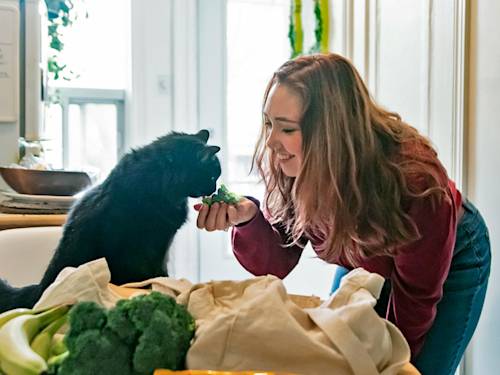
Here is the thing almost every “can cats eat broccoli” answer buries: the floret was never the danger. Plain broccoli is nontoxic to cats, and a small bite now and then is completely fine. What actually lands cats at the vet is everything we tend to put on broccoli, plus the simple fact that a carnivore’s gut is not built to process a pile of fiber. Get those two things right and broccoli is a non-event.
So this is not really a question of “is broccoli poisonous.” It is a question of portion and preparation. Let’s take those in order.
The floret is fine. The sauce is the problem
Broccoli belongs to the Brassica family, alongside cabbage, cauliflower, and Brussels sprouts. Every part of the plant, the crown, the stalk, and the leaves, is nontoxic to cats. Your cat could nibble a raw stem and be no worse for it.
The catch is that we almost never eat broccoli plain. We roast it in olive oil, drown it in cheese sauce, or stir-fry it with garlic and onion. Garlic and onion, and everything else in the Allium family, are genuinely toxic to cats and can damage red blood cells. Add in the butter, the salt, and the heavy dairy, and a “healthy vegetable” becomes a small dose of things a cat should not have.
When someone tells me their cat got into the broccoli, my first question is never about the broccoli. It’s ‘what was on it?’ The plain vegetable I can shrug off. The garlic butter it was swimming in is the part I actually want to hear about.
If you want to share, share it the boring way: a small piece, plain, steamed soft, with nothing added.
Fiber is the real reason to keep it small
Broccoli is genuinely fiber-dense, and that is exactly why a big serving backfires. Fiber does useful things in small amounts, bulking the stool and feeding gut microbes, but a cat’s digestive system is tuned for meat, not roughage. Introduce a lot of fiber suddenly and you get the predictable result: gas, bloating, and loose stool.
This is why “a bite” is the honest serving size, not “a floret.” Offer a small piece the first time and watch how your cat handles it before ever going bigger. Most cats, frankly, sniff it and walk away.
What broccoli actually offers a cat (not much, and that’s okay)
Broccoli carries fiber, antioxidants like sulforaphane and carotenoids, and vitamins K and A. Those are real nutrients. They are also nutrients your cat already gets, in the right amounts, from a complete and balanced cat food.
Cats are obligate carnivores. They need protein, fat, and specific animal-derived nutrients, and a good commercial diet is formulated to deliver all of it. Broccoli is not filling a gap. Treat it as a curiosity your cat is welcome to investigate, not a supplement you are obligated to provide. Keep all treats and snacks under about 10 percent of daily calories.
One family note worth knowing
Broccoli itself is low in glucosinolates, the compounds that cause more serious gut irritation. But other Brassica relatives, like mustard greens, horseradish, and peppergrass, carry far more of them and can cause real digestive upset. So “broccoli is fine” does not mean “the whole cabbage family is fine.” Stick to plain broccoli and skip the sharper cousins.
What newer research adds
The interest in broccoli’s sulforaphane has grown well beyond human nutrition, and it is worth understanding what that does and does not mean for your cat. Sulforaphane is most concentrated in raw or lightly cooked broccoli, and it is the compound behind broccoli’s “superfood” reputation for its anti-inflammatory and cell-protective effects in lab and human studies.
None of that translates into a reason to feed your cat more broccoli. The amounts studied for those effects are far larger than the bite a cat should ever eat, and raw broccoli is both harder on a cat’s stomach and more bitter, so most cats reject it anyway. The current, practical takeaway is unchanged: broccoli is a safe occasional nibble, not a health food you should be working into a carnivore’s diet.
The bottom line
Broccoli is safe for cats in the plain, tiny-portion, occasional-snack sense of the word. It is not good for them in any meaningful nutritional sense, and it turns risky the moment it comes with garlic, onion, butter, salt, or cheese. If your cat is curious, a small steamed piece with nothing on it is a fine thing to offer. If your cat ignores it, that is the more typical, and totally healthy, response.
References
- Anwar, S., et al. “Broccoli: A Multi-Faceted Vegetable for Health: An In-Depth Review of Its Nutritional Attributes, Antimicrobial Abilities, and Anti-Inflammatory Properties.” Antibiotics, 2022.
- ASPCA Animal Poison Control Center. “Toxic and Non-Toxic Plants.”
- Vanduchova, A., et al. “Sulforaphane and Its Anticancer Effects: A Review.” Journal of Oral and Maxillofacial Pathology.
- North Carolina State Extension. “Brassica oleracea (Italica Group).”
Common questions
Is plain broccoli actually safe for cats?
Yes. The whole broccoli plant is nontoxic to cats. Trouble comes from what gets cooked onto it, like garlic, onion, butter, salt, or cheese sauce, not the vegetable itself.
Why does my cat want my broccoli?
Usually the texture or, more often, the seasoning. A cat drawn to your broccoli is frequently drawn to the butter or cheese on it, which is the part to keep away.
Not a substitute for your vet. Our guidance is educational. For urgent symptoms, contact a vet or emergency clinic right away. Editorial standards
Dr. Nair is a veterinarian focused on diet and feeding. She covers everyday nutrition, treats, and the many "can they eat this?" questions owners ask, grounding each answer in what is actually safe and sensible for dogs and cats.
Meet our experts ↗Keep reading
 FoodNever Feed a Cat Grapes. Science Finally Figured Out Why They're So DangerousDr. Amara Solis · 6 min
 Food'Superfood' Means Nothing to Your Cat. Spinach Included.Dr. Nina Kohl · 5 min
 FoodThe Real Problem With Feeding Your Cat Ham Isn't Toxicity. It's MathDr. Ravi Mehta · 4 min
 FoodPlain Bread Is Boring for Cats. Raw Dough Is an EmergencyDr. Amara Solis · 3 min
 FoodThe Real Question About Cats and Cheese Isn't Whether, It's WhichDr. Mara Chen · 6 min
 FoodCats Can Eat Pineapple. They Literally Can't Taste the Point.Dr. Ravi Mehta · 3 min