
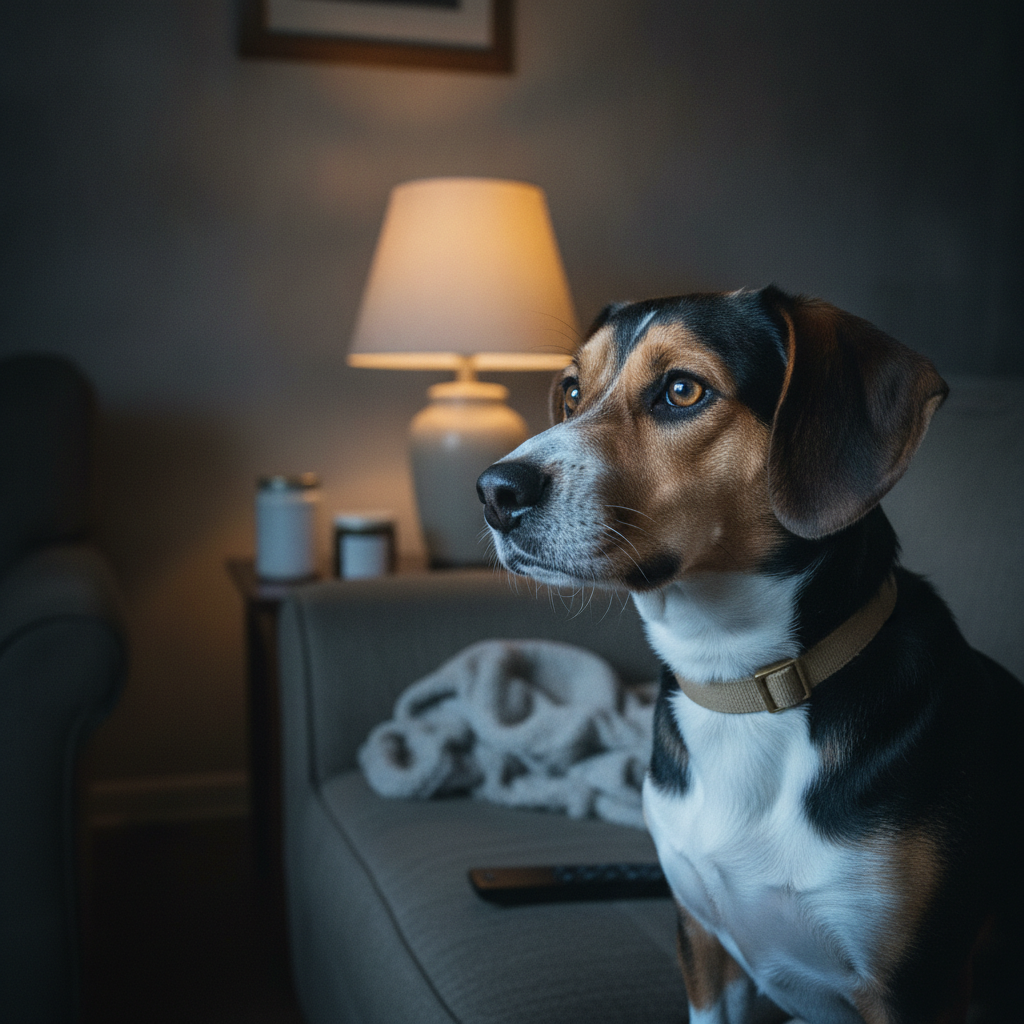
You’ve probably caught your dog watching TV with opinions. Ears up when a nature documentary shows a galloping herd, a bolt off the couch at the sound of an on-screen doorbell, total indifference to your favorite drama. It’s easy to write that off as coincidence. A study published in 2025 suggests it isn’t. What your dog reacts to on screen appears to line up with their personality, and that finding is more useful than it sounds.
The study, in plain terms
Researchers at Auburn University, led by Lane Montgomery, set out to describe how companion dogs actually engage with television. They recruited about 650 dog owners online between February and March of 2024 and built a purpose-made scale to measure viewing habits, then focused their analysis on the 453 dogs whose owners confirmed regularly watch TV. The results were published in the journal Scientific Reports.
The first headline number is simply how common this is: roughly 88 percent of the surveyed dogs actively watched television. Owners rated how often their dogs reacted to different things on screen, both what they saw (other dogs, household pets, unfamiliar animals, people, and inanimate objects) and what they heard (barking, other animal noises, human voices, object sounds, even weather), with reactions counted as barking, tail-wagging, or a shift in body posture.
What the reactions revealed
Across the board, animals stole the show. Dogs were more likely to react to other creatures on screen than to anything else, and about 45 percent consistently responded to canine sounds like barking or howling. That fits what we already knew from earlier work: dogs pay closer attention to footage featuring humans and other dogs, the stimuli that matter in their real lives, and their eyes are drawn to blue and yellow hues and to movement, thanks to how canine vision works.
The new twist is temperament. Dogs rated as excitable were more likely to track objects as if they continued to exist off-screen, following the action past the edge of the TV. Dogs with more fearful or anxious tendencies, on the other hand, reacted more to the non-animal sounds, the doorbells, car horns, and other noises that echo real-world triggers. In other words, an anxious dog and a bold dog can watch the same show and have completely different experiences of it. Notably, the researchers found that breed, sex, and age didn’t predict how a dog responded; personality did.
Why this is more than a fun fact
The authors framed television as a possible welfare tool, and that’s the practical takeaway. If the screen is genuinely part of your dog’s sensory world, it can either soothe them or wind them up, and now you have a clue about which.
“Once you know your dog’s temperament, the TV stops being neutral,” says Dr. Lena Park. “A jumpy, noise-sensitive dog probably doesn’t need a channel full of sirens and doorbells while you’re out. A confident, playful one might genuinely enjoy animal footage as enrichment. Match the screen to the dog, the same way you’d match a walk or a toy.”
That means a fearful dog might do better with calm, quiet content, or with the TV off, rather than a program salted with the exact sounds that spook them. An excitable dog might get real mental stimulation from nature and animal footage. The point isn’t to plop your dog in front of a screen as a babysitter. It’s that the television, which most of us treat as neutral wallpaper, is actually landing differently depending on who your dog is.
What’s new since this was written
This is a young line of research, and it’s worth reading it for what it is: survey data from owners, describing a snapshot, not a controlled experiment proving cause and effect. What it does confirm is that dogs process on-screen content in an individual, personality-driven way, which opens the door to studies that test screen-based content as a real enrichment or calming intervention, especially for dogs who struggle with time alone. Until that work matures, the sensible move is simple and free: notice what your own dog reacts to, and use the remote accordingly.
References
- Montgomery, L.I., et al. “Characterizing TV viewing habits in companion dogs.” Scientific Reports, 2025.
- Auburn University / EurekAlert. Animal behavior: Dog TV viewing habits vary by personality, 2025.