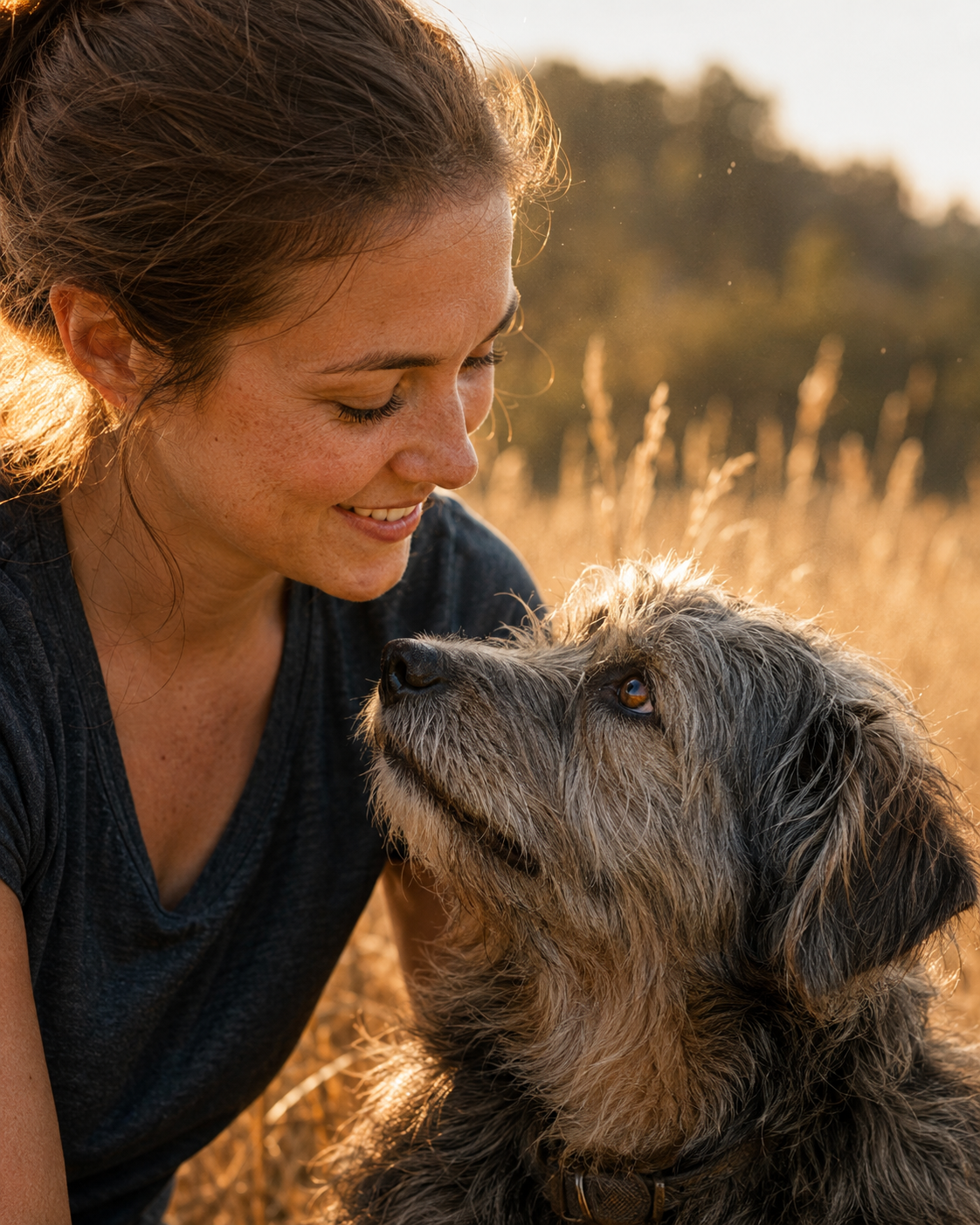
You come home beaming after a good day, and your dog catches the mood and bounces around with you. You come home wrecked, collapse on the couch, and start to cry, and a paw lands gently on your knee. Most of us have felt, in moments like that, like our dogs can read us. It turns out they largely can, and the science behind it is more precise, and more useful, than the warm feeling suggests.
Here is the throughline worth holding onto: your dog is not just soaking up your general vibe. They are actively reading your face, and specific research shows they can tell one human emotion from another. That has a practical consequence most owners never act on, which is that your expressions are training your dog whether you mean them to or not.
Yes, dogs read our faces, and the studies are specific
This is not folk wisdom. In a 2021 experiment, dogs reliably sorted a cheerful human face from a furious one, and they did it by reaching back into what they had already learned about how human faces behave, and they prefer smiling faces to sad ones, which suggests they are reading who might be a friendly presence. Brain-imaging work backs this up at the neural level: researchers who trained dogs to hold still in an MRI scanner found that activity in the dogs’ brains jumped when they saw human faces compared with objects, with responses concentrated in face-processing regions of the temporal cortex. In other words, the dog brain has real estate devoted to us.
Dogs do not read faces the way we might assume, either. Eye-tracking research shows they take in a combination of the eyes, midface, and mouth, but when they look at a positive human face, they spend significantly more time on the eyes. The face is not one blurry signal to a dog; it is a set of features they weigh.
They answer back with their own faces and bodies
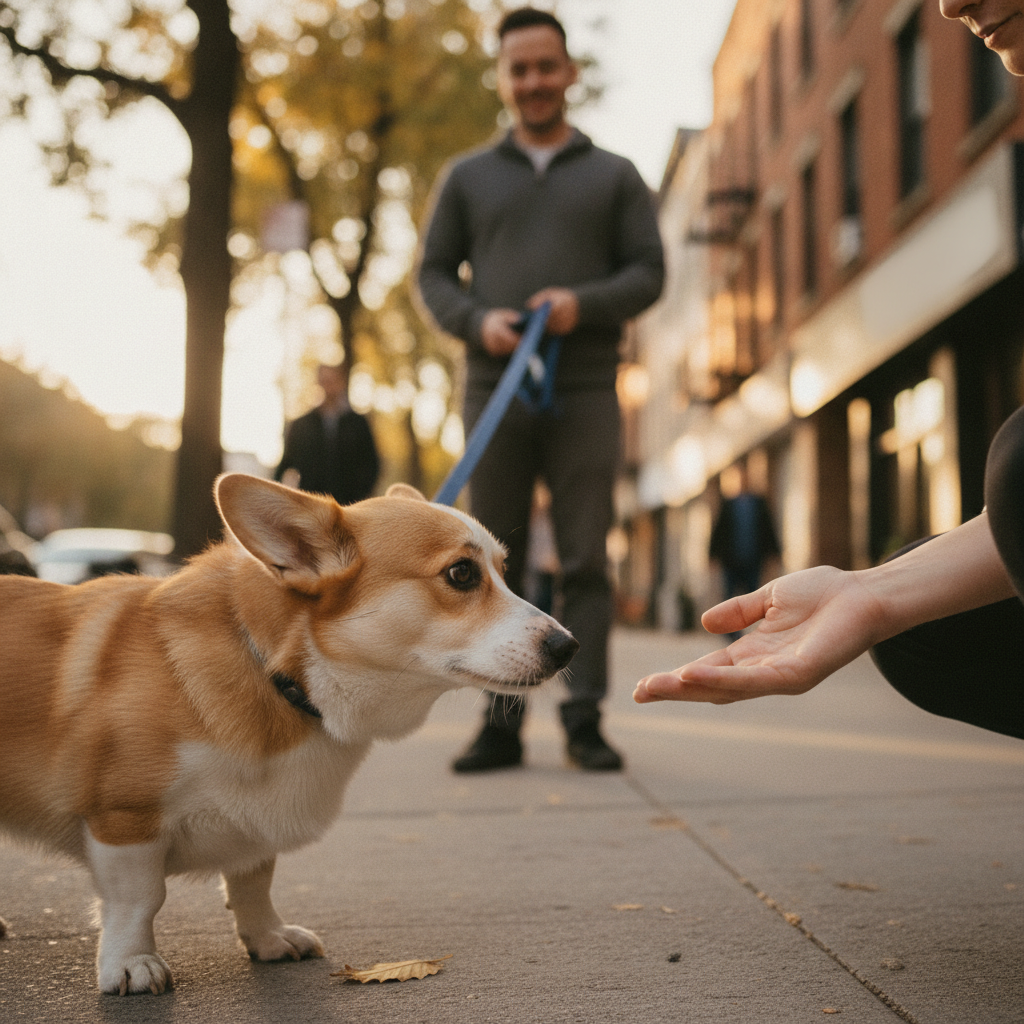
You can tell a dog is processing your expression by how they respond, because they reply in kind. A well-known 2017 study found dogs reacted differently to happy versus angry human faces, licking their mouths when shown angry faces but not when they merely heard an angry voice. Mouth-licking is an appeasement signal in dog-to-dog communication, a way of saying “I come in peace,” so a dog offering it to an angry face is essentially trying to de-escalate you.
Dogs also produce more facial expressions, blinking, nose-licking, and the like, when a person is paying attention to them than when the person is looking away, which implies these expressions are at least partly communicative rather than involuntary. And their bodies carry the rest of the message. Tail-wagging is famously linked to happiness but is not that simple: the position, direction, and speed all matter, with a fast, whole-body wag reading as joyful and a tight, twitchy wag hinting at negative arousal. Raised hackles signal arousal that could be stress or excitement. Posture speaks too, a cowering dog is scared, a play bow is an invitation, and a belly roll can mean relaxed or anxious depending on context. The eyes finish the sentence: soft, squinty eyes suggest calm, a hard stare can signal a warning over a resource, and looking away is often a dog trying to defuse tension. There is even a tender footnote, that a 2022 study linked oxytocin to increased tear production when dogs reunite with their people. Read that against everything else and it is hard not to call it happy tears.
Why they’re so good at this
The leading explanation is co-evolution. Dogs and humans have shared a long, intimate history through domestication, and that partnership appears to have selected for dogs who are unusually tuned to human emotion. Living alongside us has made dogs sensitive to subtle shifts in our behavior, and among social animals they are considered some of the sharpest at understanding people specifically. They are also relentless observers, noticing small noises and shifts in position even while dozing, and that attention gets aimed squarely at our faces, gestures, and even our scent, which adds up to genuine social-emotional awareness.
“What the research keeps confirming is that this is a two-way channel, not a party trick,” says Dr. Amara Solis. “Your dog is constantly sampling your face and body for information about whether the moment is safe or tense. The most useful thing an owner can take from that is simple: your expression is data to your dog, so in a stressful moment, a calm face genuinely helps them settle.”
What newer research adds
The picture has kept sharpening. A 2024 study in the journal Animal Cognition found that dogs can distinguish authentic human emotional expressions, and notably concluded they do so without necessarily being “empathic” in the human sense, meaning they read the emotional signal reliably even if they are not feeling the emotion themselves. That is an important nuance: your dog genuinely perceives that you are upset, which is remarkable on its own, without our needing to romanticize it into full human empathy. Either way, the takeaway for daily life is the same, and it is bigger than a fun fact.
Use it: the relationship is built on your face
Since your dog reads your expressions all day, you can put that to work. Be conscious of your emotional state and your face during high-stakes moments, training, vet visits, meeting new places or new dogs. A calm, happy demeanor can genuinely soothe an anxious dog, and clear positive feedback, a real smile when your dog nails a cue, does more to cement the behavior than any amount of praise delivered with a flat face. It cuts the other way too. If you are frustrated right before a walk, your dog may pick that up and even start associating the walk with tension, so taking a beat to reset before you clip the leash is not silly, it is communication.
The deeper move is reciprocity. Your dog is working hard to understand you; the relationship gets better when you return the effort, watching their signals, respecting when they are scared or want space, and, as one researcher put it, simply acknowledging them, by name, when they walk into the room. Your dog can read your face without a single word. The least we can do is learn to read theirs.
This article covers canine behavior and cognition and is for general information.
References
- Barber, A. L. A., et al. “Dogs Distinguish Authentic Human Emotions Without Being Empathic.” Animal Cognition, 2024.
- Müller, C. A., et al. “Dogs Can Discriminate Emotional Expressions of Human Faces.” Current Biology, 2015.
- Albuquerque, N., et al. “Mouth-Licking by Dogs as a Response to Emotional Stimuli.” Behavioural Processes, 2018.
- Dinets, V., and A. M. Kwan-Wong. “Increase of Tear Volume in Dogs After Reunion With Owners Is Mediated by Oxytocin.” Current Biology, 2022.