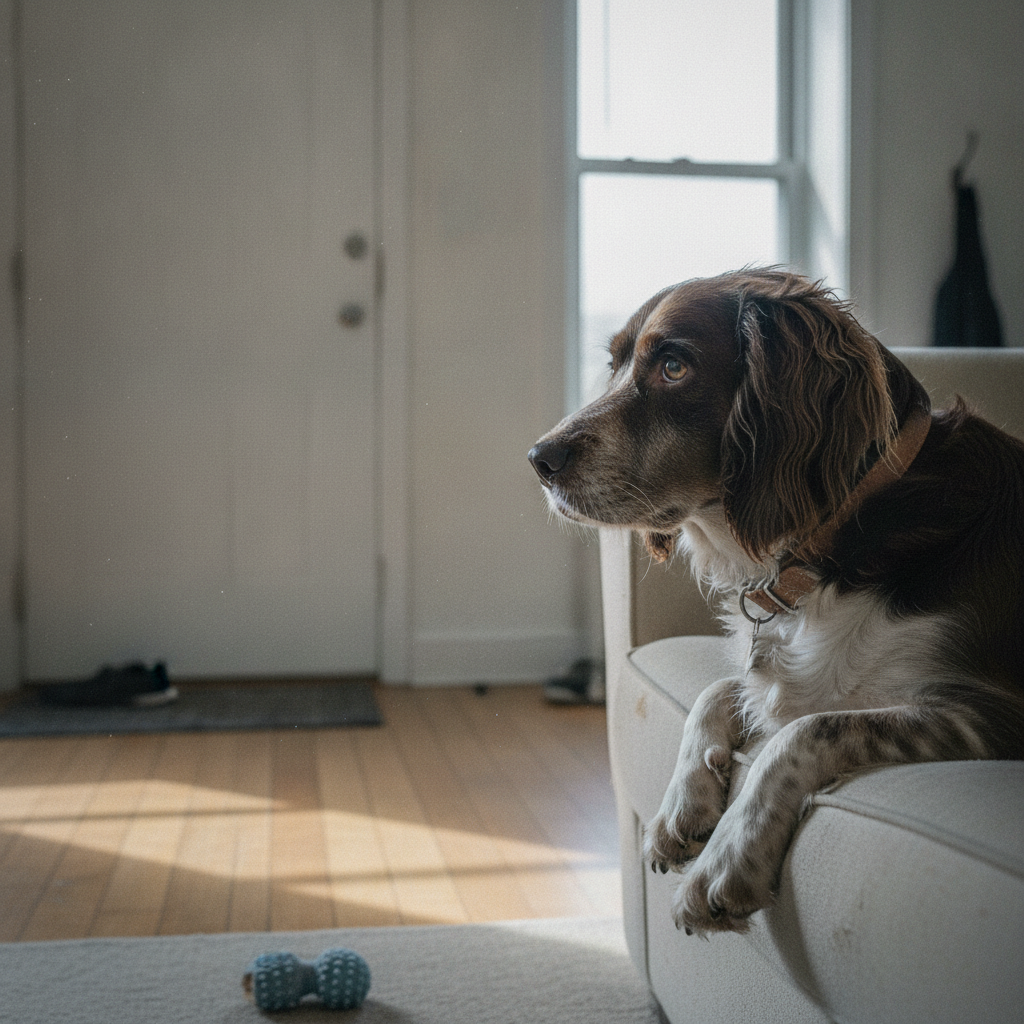
The story everyone tells about this is a sad one. You were home for years, the two of you were inseparable, and now you’re gone all day and he’s heartbroken, and the guilt sits on your chest through the whole commute.
The story is wrong in a useful way. Your dog is not sitting on the rug processing an absence. Dogs are prediction machines, and what actually broke is his ability to know what happens next. For three or four years, “human puts on shoes” predicted nothing much. Now it predicts nine hours of silence, and the shoes have turned into a threat.
That reframe changes everything about what you should be doing this week. You are not comforting a grieving dog. You are rebuilding a forecast. And a forecast is fixed with routine and cues, not with apologies.
The scale of what just happened to him
This is not a niche problem, and the pressure on it is still climbing. Somewhere north of 23 million American households brought home a dog between early 2020 and the start of 2022. A huge number of those dogs have never known a version of life where the house empties out.
Meanwhile the office keeps pulling harder. Recent tracking puts 54 percent of Fortune 100 employees under five-day, in-office requirements, up from just 11 percent a year earlier, and roughly 27 percent of companies overall had gone fully in-person by the end of 2025. Whatever your feelings about that, your dog is going to feel it through you.
He is also not alone in struggling. Even before all this, separation-related problems were estimated to affect somewhere around 20 percent of dogs. The pandemic cohort has almost certainly pushed that number up.
Step one: move the schedule before you move yourself
Dogs are not clock-readers, they are pattern-readers, and the single kindest thing you can do is make sure the pattern doesn’t change on the same day the house does.
Sit down and answer four questions. What time will you actually be getting up once you’re commuting? When does breakfast land? When does dinner land? Where, honestly, do the walks fit, before the commute or after?
Then run that schedule now, while you’re still home. Do it for a week, two if you have them. If the wake-up, the meals, and the walks are already in their new slots, then day one at the office subtracts one thing, your presence, instead of detonating his entire day at once. From his point of view, most of the world stays where he left it.
Step two: break your own cues, because he’s been reading them for years
You do a small anxious dance before you leave. Keys, phone, wallet, back for the phone, coat, bag, door. You do not experience this as a ritual, but he has memorized it in the way you have memorized a song you never chose to learn. And every note of it now predicts abandonment. By the time you reach the door, he has been escalating for four minutes.
So dismantle it. Pick up the keys and go sit on the sofa with them. Put your coat on and stay in it while you unload the dishwasher. Sling the bag over your shoulder and wander back into the kitchen to make tea. Do it at random, several times a day, until the cues stop meaning anything at all.
This is the least glamorous advice in this article and by a wide margin the most effective. You are not doing anything for the dog directly. You are stripping the meaning out of a sequence you didn’t know you were performing.
Step three: make the morning mentally expensive
Trainers repeat this until they’re hoarse and people still hear it as a suggestion to jog further. It isn’t. A physically tired dog is a dog who will recover in an hour and then have eight hours of nothing. A mentally worked dog decompresses and sleeps.
The mechanics are simple and cheap. Stuff a rubber food toy with something sticky the night before, peanut butter, wet food, whatever he’ll work for, and freeze it. Hand it over as you leave. A frozen toy takes real effort, and licking and chewing are self-soothing behaviors, meaning they actively lower arousal rather than just occupying time. A lick mat does the same job with less mess.
Done right, your departure stops being a loss and becomes a cue for the best thing that happens all morning. That is not a trick. That is the entire mechanism of counter-conditioning, running in your hallway.
Step four: look at the footage, not your imagination
You will spend the first week at your desk quietly convinced he is screaming. Get a camera and find out.
A cheap pet camera, ideally one that flags barking and movement, will show you the twenty minutes after the door closes, which is the only part that really matters. And here is what most people discover: the dog barks for ninety seconds, circles once, and then goes to sleep in a patch of sun for six hours. That footage is worth more than any reassurance anyone can give you.
But it cuts both ways, and that is the point of watching. Because sometimes it shows the other thing.
When it’s not adjustment, it’s a clinical problem
There is a line here and it matters enormously.
Boredom and mild adjustment look like: a bit of vocalizing, restlessness, a chewed shoe, an accident, a dog who settles once he understands nothing terrible is happening. Everything above will fix this.
Separation anxiety looks like: distress inside the first few minutes, every time. Refusing the frozen toy entirely, because a truly panicked dog cannot eat. Drooling enough to soak the bed. Relentless pacing. Scratching, chewing, or digging at the door or window frame, sometimes to the point of broken nails or bloodied paws. Frantic escape attempts.
That second list is not a training gap and you cannot walk it off. It is a panic disorder, and every month it runs untreated it gets more entrenched. If your camera shows that, the next call is your vet or a veterinary behaviorist, not the pet store. There are real treatment protocols, and they often combine behavior modification with medication, and they work.
“The frozen food toy is a diagnostic, not just a distraction,” says Dr. Ravi Mehta. “A dog who’s merely bored will eat it the second you’re gone. A dog who’s panicking won’t touch it, and will still be standing over it, untouched, three hours later. If you find that toy full when you get home, stop reading articles and call someone.”
Step five: buy the midday, if the day is long
If the workday is long, or it’s the kind of job where 5:30 becomes 8:00 without warning, a dog walker two or three times a week or a spot in daycare is a reasonable purchase. It is not cheap; more than 20 percent of workers now use daycare on workdays, spending an average of around $148 a month, and walkers cost more than that in most cities.
Be honest about what you’re buying, though. A midday walk solves a bladder and a boredom problem. It does not treat separation anxiety, and for some anxious dogs a stranger entering the house mid-panic makes the day worse rather than better. Match the tool to the problem.
Give it more time than feels reasonable
The last thing, and the one people skip: this takes weeks, not days. You will do everything right and he will still have a bad Tuesday. That is not failure, it is a dog updating a model of the world that took three years to build.
He does not need you to feel guilty. He needs you to be boring, predictable, and consistent, so that the shoes stop meaning anything, the frozen toy means something excellent, and the sound of the door closing eventually predicts nothing at all except a nap.
References
- American Veterinary Medical Association. “U.S. Pet Ownership Statistics.” avma.org
- American College of Veterinary Behaviorists. “Separation Anxiety: owner resources and treatment approaches.” dacvb.org
- Founder Reports. “Essential Return-to-Office Statistics and Trends (2026).” founderreports.com
- de Assis, L. S., Matos, R., Pike, T. W., et al. “Developing Diagnostic Frameworks in Veterinary Behavioral Medicine: Disambiguating Separation Related Problems in Dogs.” Frontiers in Veterinary Science, vol. 6, 2020. doi.org/10.3389/fvets.2019.00499
- VCA Animal Hospitals. “Preventing Separation Distress During and After the COVID-19 Pandemic.” vcahospitals.com