There’s an invisible world riding around on your dog: roughly a hundred trillion microbes, bacteria, viruses, and fungi, living across their coat and skin, tucked behind their ears, even along the rims of their eyelids. Most of them are the good guys, the gut microbiota clustered in the digestive tract, where they train the immune system, manufacture vitamins, and break food down into usable energy.
Here’s the part that turns a biology lesson into a genuinely strange idea: those microbes don’t stay put on the dog. If you live with a dog, you’re trading them back and forth, all day, every day. You and your dog are, in a very real sense, sharing an ecosystem.
A delicate balance, in both of you
A healthy microbiome is a balancing act. Tip it too far in either direction, too many of the wrong microbes or too few of the right ones, and a whole range of inflammatory and autoimmune problems can follow. It’s a striking parallel across species: researchers find markedly lower bacterial diversity in both people and dogs living with chronic inflammatory bowel disease. Mapping the microbiome, mostly through stool and tissue samples, is one of the hottest frontiers in both human and veterinary medicine, and the canine side is catching up fast.
“We used to think of the microbiome as a private thing, sealed inside one body,” says Dr. Mara Chen. “It isn’t. In a household with a dog, the humans and the dog are constantly seeding each other. That shared microbial cloud is turning out to be one of the more interesting things about living with an animal.”
The proof is in your mouth
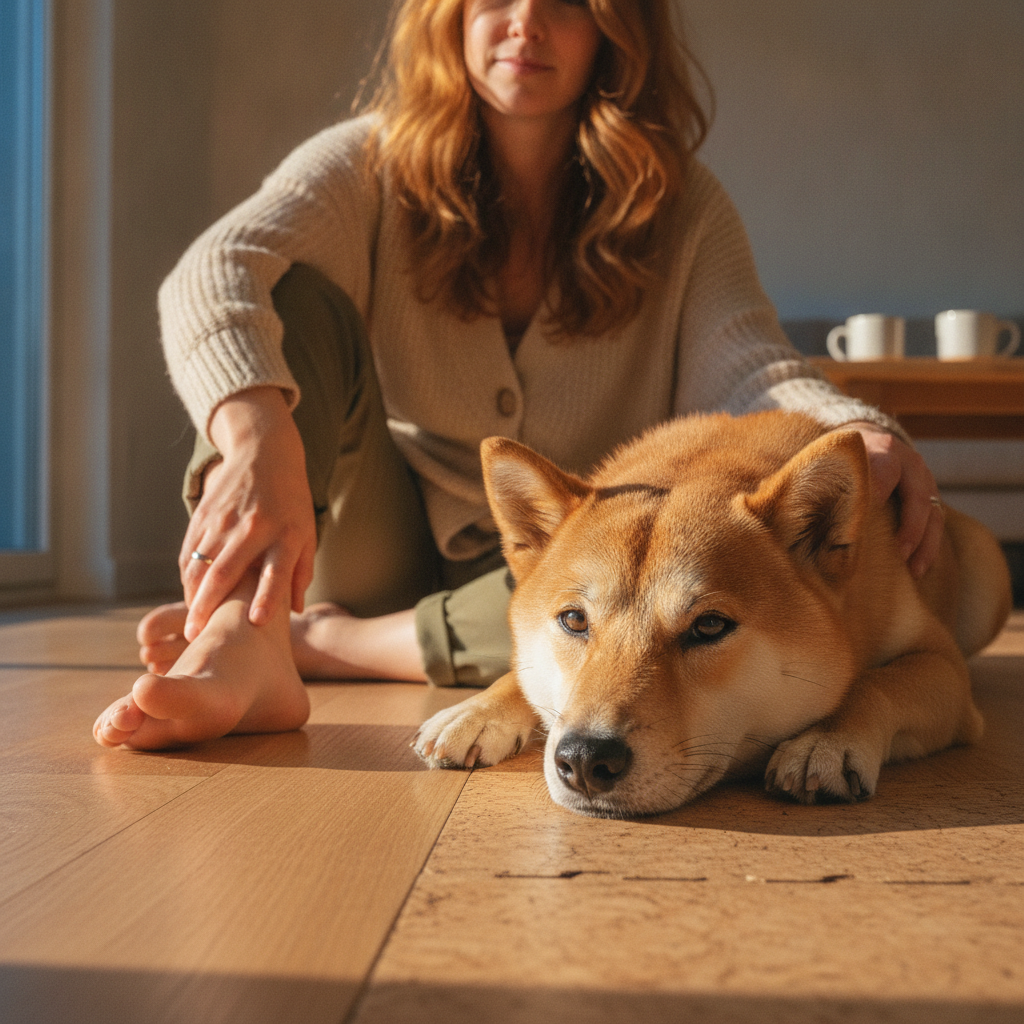
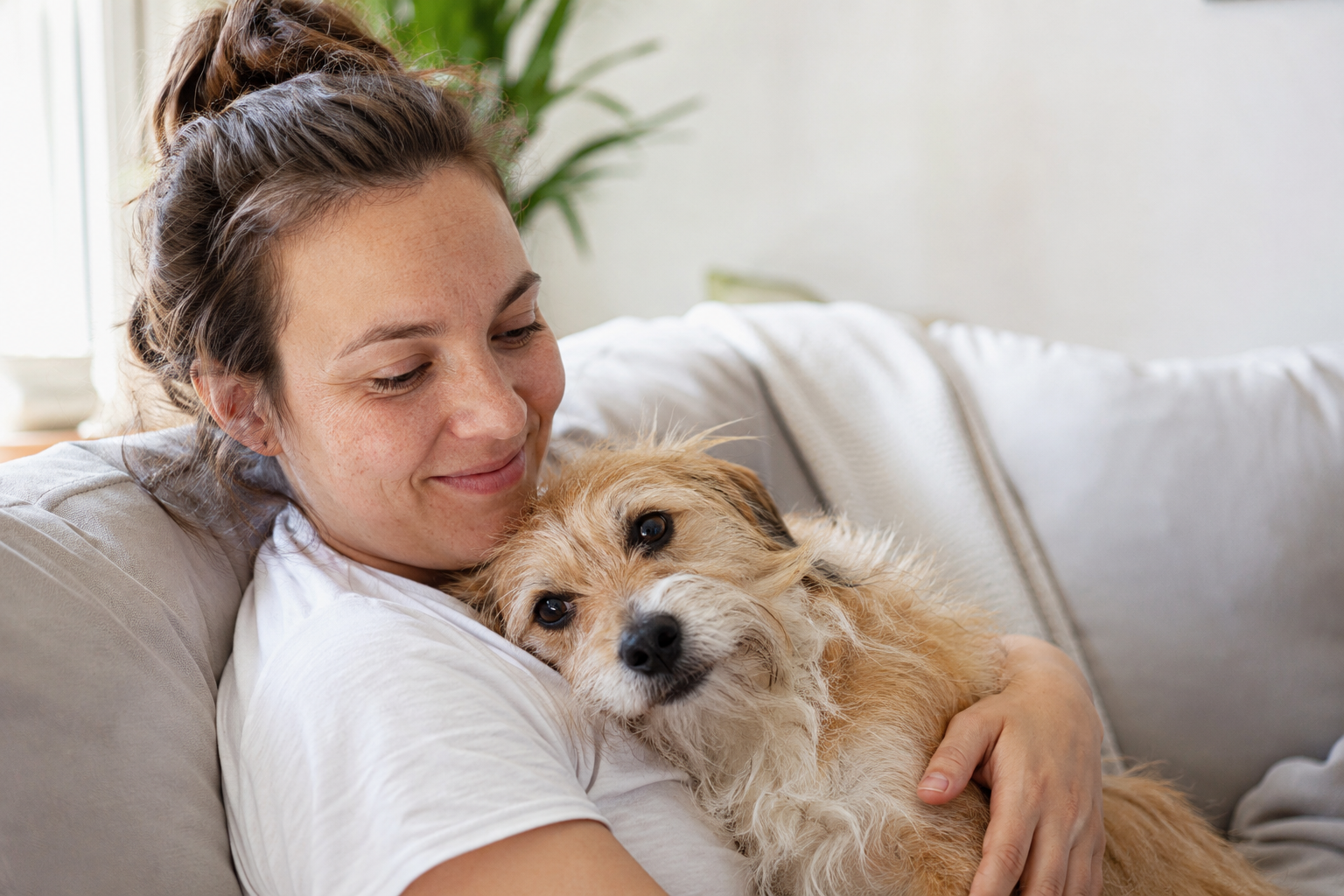
If you kiss and hug your dog and let them sleep on the bed, you’ve got more in common with them than you’d ever guess. Researchers at the University of Colorado, Boulder found several patterns that only make sense if microbes are moving between species. Two adults who live with the same dog end up with more alike oral microbes than two who don’t. Households with dogs carry more diverse and distinct microbial communities than dogless ones. Parents, oddly, have more types of mouth bacteria in common with the family dog than with their own kids. And children who grow up alongside a dog develop a wider variety of microbes than those raised without one.
Whether every one of those swapped microbes does something, or is just passing through, isn’t fully settled. But the downstream signal is hard to ignore: kids who grow up with a dog develop eczema and asthma at lower rates. The leading explanation is that early, varied microbial exposure helps calibrate a developing immune system, teaching it what to react to and what to leave alone.
Dogs are more like us than pigs or mice
The reason any of this crosses species so easily is that a dog’s gut is startlingly similar to ours. When scientists compared gut genes against the human catalog, they found the microbiome gene overlap was about 20 percent for mice and 33 percent for pigs, but a remarkable 63 percent for dogs. In other words, of the common lab and farm animals, the dog’s gut is the closest match to a human’s.
Diet drives it, too. What a dog eats has a large and reproducible effect on their microbiome, independent of breed or sex, and those shifts closely track what researchers see when people change how they eat. That similarity is exactly why dogs keep turning up as a useful model for understanding the human gut, and why the two fields increasingly borrow from each other.
What’s new since this was written
Two threads have advanced quickly. The first is direct evidence of sharing: newer work confirms that simply spending time together leads to measurable microbial transfer between people and their dogs, nudging their gut communities toward each other the longer they cohabit. Living together doesn’t just correlate with similar microbiomes, it appears to cause them.
The second is treatment. Veterinary researchers have been testing fecal microbiota transplants, transferring stool microbes from a healthy donor dog, for dogs with chronic gut disease that hasn’t responded to standard care. Studies through the mid-2020s report encouraging results in dogs with chronic enteropathy, including rises in beneficial short-chain-fatty-acid-producing bacteria after treatment, though the diet and antibiotic history of each dog clearly shapes the outcome. It’s still an emerging tool, not a routine one, but it’s a sign of how seriously the gut is now taken as an organ worth repairing rather than ignoring.
The takeaway for the rest of us is gentler and stranger at once: the dog on your bed isn’t just company. They’re a member of your microbial household, and the exchange runs both ways.
References
- Similarity of the Dog and Human Gut Microbiomes in Gene Content and Response to Diet, Microbiome
- Cohabiting Family Members Share Microbiota With One Another and With Their Dogs, eLife
- Exposure to Environmental Microorganisms and Childhood Asthma, New England Journal of Medicine
- Effect of a Single Rectal Fecal Microbiota Transplantation in Dogs With Chronic Inflammatory Enteropathy, Journal of Veterinary Internal Medicine