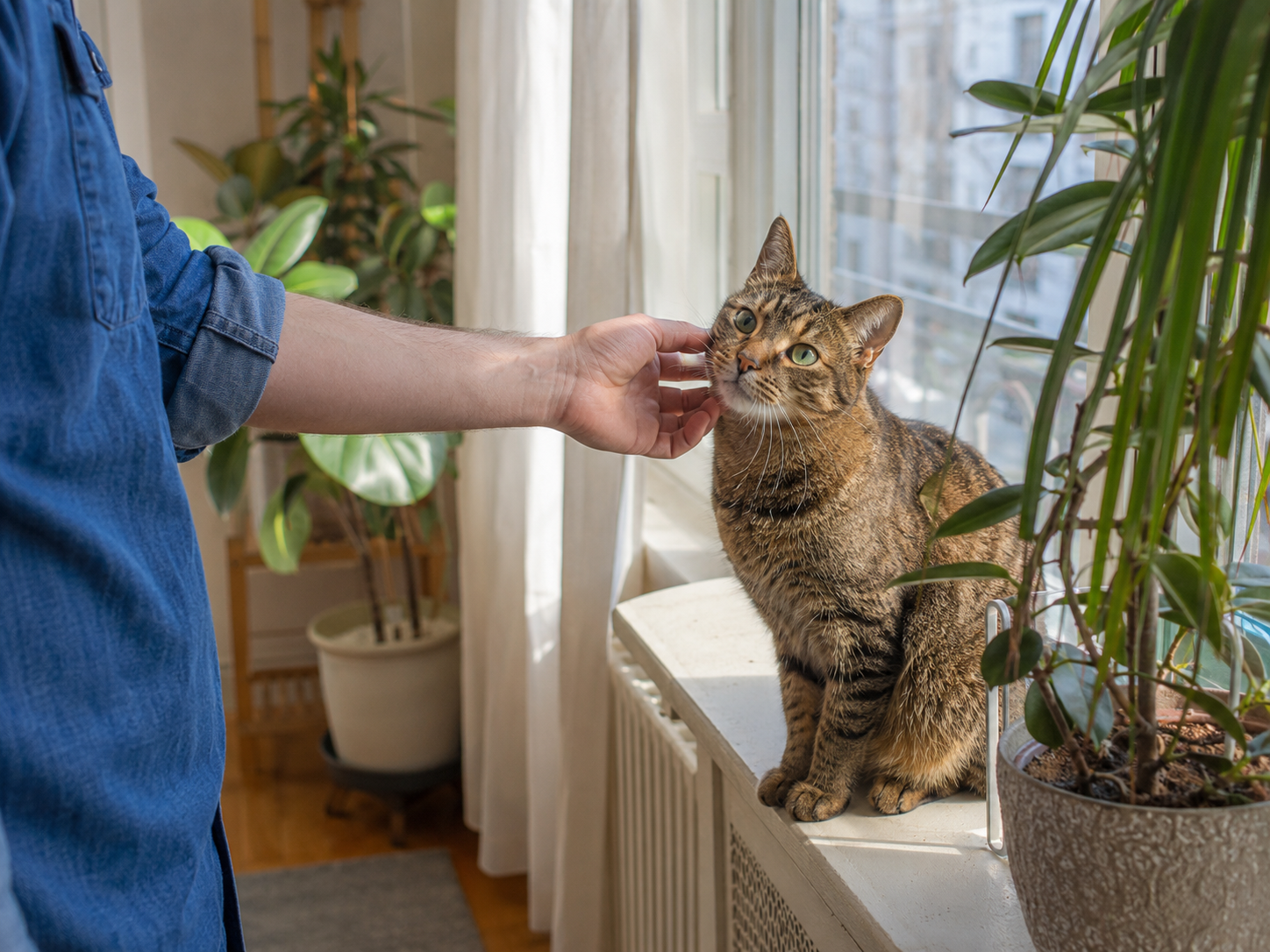
You come home wrung out by a brutal day, ready to fuse with the couch cushions and let bad TV wash over you. Then your pet trots over, leans into your leg, and something in your chemistry shifts. It feels like magic. It’s actually endocrinology.
That warm rush has a name: oxytocin, the so-called love hormone that lowers stress, raises your tolerance for pain, and nudges you toward connection. Interacting with a pet reliably bumps it up, which turns a few minutes of cuddling into a genuine, measurable dose of well-being. And here’s the deeper part: we appear to be built for this. Dogs and cats co-evolved alongside us, and as mammals we share the ancient machinery of social bonding, the brain structures, the hormones like oxytocin, all of it. That shared wiring is why bonding with them comes so easily, and why the bond does real things for our health.
“People sometimes treat the pet-health connection as a nice sentiment, but the biology underneath it is sturdy,” says Dr. Amara Solis. “We didn’t just decide to like animals. We’re running on the same bonding chemistry they are, and that overlap is exactly why a pet can move the needle on stress, blood pressure, and even how much we move in a day.”
So no, it isn’t only about the warm fuzzies. Here are seven research-backed ways your animal is quietly working as medicine for your mind and body.
1. You move more, almost without noticing
Exercise is a pillar of health, and also the thing most of us skip. Pets, especially dogs, smuggle it into your day. Guidelines call for kids aged six to 17 to get about 60 minutes of moderate-to-vigorous activity daily, and adults to aim for 150 to 300 minutes a week. Dog owners get a head start: a 2008 study found they were a striking 55 to 77 percent more likely to hit their recommended activity levels than non-owners. The effect holds up with age, too, a 2021 Swedish study showed dog owners in their seventies were twice as likely to meet their activity targets. Every walk counts for both of you.
2. Your blood pressure drops
Those daily good-dog scratches do more than earn tail wags. Research testing whether visual, verbal, or physical interaction had the biggest effect found that people’s blood pressure and heart rate hit their lowest while actually touching a dog. And it’s not just a lower resting number: a 2002 study of 240 married couples, half of them pet owners, found the pet owners had smaller spikes in blood pressure and heart rate under stress, plus a quicker return to baseline afterward.
3. Your heart gets healthier
Loving a pet doesn’t just fill your heart metaphorically. In a study of 4,435 people, cat owners showed a reduced risk of dying from cardiovascular disease and stroke, and even former cat owners retained some benefit compared with people who’d never had a pet. Dogs pull their weight here too: a large Swedish study with a 12-year follow-up linked dog ownership to a lower risk of heart attack, ischemic stroke, and heart failure.
4. Your immune system gets a workout
When it comes to immunity, the science says start them young. Early exposure to dogs and cats may reduce the odds of allergies and asthma in children and help build a more robust immune system. The germs a pet tracks in from outside sound alarming to parents, but they help diversify a family’s microbiome, giving a child’s immune system a blueprint for handling future invaders. There’s a direct effect in adults, too: one study found that a solid 18-minute stretch of dog-petting raised levels of immunoglobulin A (IgA) in participants’ saliva, an antibody that guards the body’s mucous membranes and helps flag and clear germs. And a 2015 study in JAMA Pediatrics tied exposure to dogs in the first year of life to a lower risk of childhood asthma.
5. Stress and anxiety ease off
The antidote to a ball of stress may be a ball of fluff. Stress fires up the fight-or-flight response, and while that’s useful when you’re being chased by a predator, chronic stress corrodes your health, feeding high blood pressure, stroke risk, and digestive trouble, largely by keeping the stress hormone cortisol elevated. Pets push back. In a study of famously frazzled college students, hands-on time with a dog or cat significantly lowered cortisol. The kicker: you don’t even need to own the animal. As little as a 10-minute session with a borrowed pet delivered the benefit.
6. Your brain stays sharper
Bringing a pet home may literally be a smart move. In the “Alabama Brain Study on Risk for Dementia,” which included participants aged 20 to 74, about half of them pet owners, researchers tied pet ownership to sharper cognition and larger brain structures. Pet owners showed better processing speed, stronger episodic memory, and sharper attention, with dog owners showing the most pronounced effects. The study even associated pet ownership with a brain age up to 15 years younger. Anti-aging benefits were not on your adoption paperwork, but here we are.
7. You’re less lonely, which is its own medicine
This is the one the original science-backed lists often left off, and it may be the most important. Loneliness isn’t just an unpleasant feeling; it’s a bona fide health risk. In 2023, the U.S. Surgeon General issued a formal advisory calling loneliness and isolation a public health crisis, noting that a lack of social connection can be as damaging as smoking a stack of cigarettes a day, raising the risk of heart disease, stroke, dementia, and early death.
Pets are quietly powerful here. A dog who needs a walk gets you outside and into casual conversations with neighbors and other owners. An animal at home means you’re never entirely alone, and caring for another living creature provides structure, purpose, and routine, the very scaffolding that isolation strips away. The companionship is real medicine, not a consolation prize, and it braids together with everything above: the pet who gets you moving, lowers your stress, and steadies your heart is often the same one keeping loneliness at bay.
Add it up, and the animal snoozing at your feet is doing more for you than you probably realize, no prescription required.
References
- Surgeon General of the United States. “Our Epidemic of Loneliness and Isolation: The U.S. Surgeon General’s Advisory on the Healing Effects of Social Connection and Community.” 2023. Link
- Mubanga, Mwenya, et al. “Dog Ownership and the Risk of Cardiovascular Disease and Death: A Nationwide Cohort Study.” Scientific Reports, 2017. Link
- Pendry, Patricia, and Jaymie L. Vandagriff. “Animal Visitation Program (AVP) Reduces Cortisol Levels of University Students.” AERA Open, 2019. Link
- Fall, Tove, et al. “Early Exposure to Dogs and Farm Animals and the Risk of Childhood Asthma.” JAMA Pediatrics, 2015. Link