Let’s be careful about the word “feelings,” because the sloppy version of this article does real harm.
Your dog does not sulk. Your dog does not hold a grudge about Tuesday. Dogs are not keeping a ledger of slights, and the idea that they are is the same anthropomorphic error that produces the “guilty look” myth.
What dogs do have is something more consequential: a running assessment of whether you are safe, predictable, and worth communicating with. That assessment is built out of hundreds of small interactions, and it can be degraded. Not by hurting their feelings in the greeting-card sense, but by teaching them, repeatedly, that talking to you does not work.
Here is what that degradation looks like from the outside: a loss of interest in things they used to enjoy, changes in sleep or appetite, hiding, and subtle body language — ears back, tail tucked, avoiding eye contact. Some dogs go clingy instead. Some just seem, in the word owners always reach for, off.
And here are six ordinary things that produce it. The last one does the most damage, and it is the one people do most confidently.
1. Their needs are negotiable and yours are not
Dogs need daily exercise and daily enrichment. Not “when things calm down at work.” Daily.
The amount varies enormously by breed and mix, and the single most useful thing you can do is find out what your dog was actually built for. A Border Collie and a Basset are not running the same software, and treating them as interchangeable pets who both get a twenty-minute walk is how you end up with a dog who is chewing the wall.
Routine matters as much as volume. A dog that knows roughly when things happen is a dog that can relax in between. A dog whose day is improvised has to stay vigilant.
2. “In a minute”
Count how many times a day you say some version of not now to your dog. Most people are startled by the number.
Dogs are extremely sensitive to tone and body language, so they know perfectly well when you are annoyed, and they know when they are being brushed off. Persistently ignored dogs escalate, which is where the destructive behavior comes from: stealing something they are not allowed to have, chewing the furniture. Those are not acts of revenge. They are a communication channel that got upgraded because the polite ones were not working.
The fix is not to be constantly available. It is to acknowledge and then redirect. A word, a look, a hand on the head, and then something for them to do. Fifteen seconds of genuine acknowledgement beats forty minutes of “in a minute.”
3. Scolding a dog for trying to talk to you
Your dog paws at you, nudges you, brings you a toy, or stares at you until you look up. So you snap at them.
Here is what you have to sit with: that was the dog’s best attempt at communication. They do not have language. They have a very short list of ways to reach you, and pawing is near the top of it.
Punish the attempt often enough and the dog stops attempting, which people sometimes mistake for progress. It is not. It is a dog that has learned that reaching out to you has a cost. The channel closes, and closed channels do not reopen easily.
Even a quiet acknowledgement, a look, a touch, is enough to keep it open.
4. You do not respect their space
Dogs sleep a lot, and they need to. Waking a sleeping dog because they look cute is an intrusion, and if you do it constantly, you are teaching them that rest is never secure.
The bigger one is hugging. Most dogs do not enjoy being hugged. It is a primate gesture. To a dog, being wrapped and pinned by a much larger animal is restraint, not affection, and a lot of tolerated hugs are exactly that: tolerated. The photos are lovely. The dog in them is often signalling discomfort that nobody in the room is reading.
5. You override their choices
This is the one that most people would deny and most people do.
You drag them off a patch of grass they were reading. You throw out the disintegrating toy and replace it with a nicer one they did not ask for. You push them into meeting a stranger, or another dog, when they have made it clear they do not want to.
That last one matters most. Pushing a dog into interactions they are not ready for is not socialization, it is a betrayal of the one job you have, which is to be the thing standing between your dog and the world when your dog is frightened. If your dog is scared of other dogs, your role is advocate, not organizer.
The general principle is worth stating plainly: so much of a dog’s life is decided by us that the small number of choices we can hand back are disproportionately valuable. Let them pick the direction at the corner. Let them sniff the thing for as long as they want. Let them decline the stranger. Choice is not indulgence; it measurably improves quality of life, and it is one of the strongest deposits you can make in the account.
6. Punishment, and specifically the crate
Punishment does not work. It is worth saying without hedging: an animal being punished does not understand why you are angry. They learn that you are sometimes frightening and that the connection between their behavior and your anger is unpredictable. That is a recipe for a distressed dog, not a trained one.
And then there is the crate.
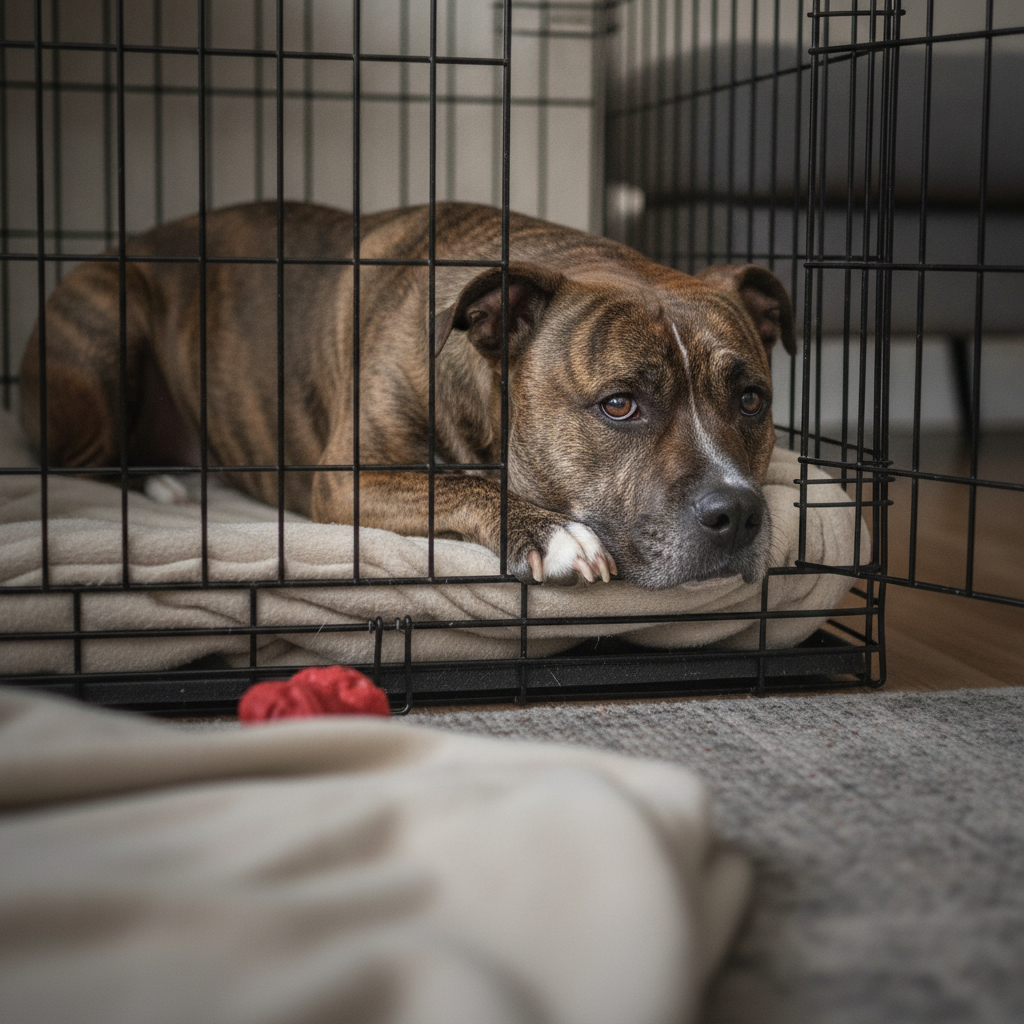
If you have ever shouted “GO TO YOUR CRATE” at a dog that has just done something infuriating, you have taken the single place in the house that belongs to the dog and turned it into a punishment cell.
Think about the geometry of it. The rest of your home is yours. The sofa is yours, on loan. The bed is yours, on sufferance. The crate, or the bed in the corner, is the one square metre in the world that is unambiguously the dog’s, and its entire value comes from the fact that nothing bad happens there.
Poison that, and you have not just made crate training harder. You have removed the only place your dog could go to feel safe, at the exact moment they most needed one. It is difficult to think of a more direct way to teach a dog that there is nowhere in your house where they can stop bracing.
“The crate is the one thing in the house a dog can genuinely call theirs, and people burn it down without realising,” says Dr. Amara Solis. “Once a dog associates that space with your anger, you have not just lost a training tool, you have taken away their off switch. I would rather someone shouted at their dog in the kitchen every day for a year than sent them to their crate in anger once a month.”
How to repair it
The good news, and it is real, is that dogs are not keeping score in the way people fear. They are not owed an apology and they will not accept one. What they respond to is evidence, accumulated over time, that you are listening.
- Give them space when they ask for it. Do not follow a dog that has removed itself.
- Give them choices wherever you can. Direction, pace, whether to greet, which toy.
- Offer comfort when they seek it out rather than when you feel like giving it.
- Add quality time that is actually about them: a sniffari, a walk where the dog picks the route and you follow, a real play session, a training game.
- Let them set the pace. All of it.
Put something on the calendar if that is what it takes. It is not silly. Your relationship with your dog is a relationship, and the reason it usually works so well is that one of the two parties is trying extremely hard, all the time, to understand the other.
The least we can do is close the gap from our side.
What newer research adds
The direction of travel in behavior science is firmly toward agency as a welfare variable in its own right.
The finding that keeps replicating, across species, is that animals given meaningful control over their own environment, even small control, do measurably better than animals whose needs are met but whose choices are not. It is not merely that the choice is pleasant. The absence of it is itself a stressor.
That reframes most of this list. Ignoring a dog, overriding a dog, hugging a dog that does not want to be hugged, and confiscating the one space a dog controls are not six separate mistakes. They are the same mistake, made six ways: removing the dog’s ability to influence what happens to it.
Give some of that back, and most of the rest sorts itself out.
References
- American Veterinary Society of Animal Behavior. “Position Statement on the Use of Punishment for Behavior Modification in Animals.” https://avsab.org/resources/position-statements/
- Ziv, G. “The effects of using aversive training methods in dogs — A review.” Journal of Veterinary Behavior, vol. 19, 2017. https://www.sciencedirect.com/science/article/abs/pii/S1558787816301198
- Vieira de Castro, A. C., et al. “Does training method matter? Evidence for the negative impact of aversive-based methods on companion dog welfare.” PLOS ONE, vol. 15, no. 12, 2020. https://journals.plos.org/plosone/article?id=10.1371/journal.pone.0225023
- Hecht, J., Miklósi, Á., and Gácsi, M. “Behavioral assessment and owner perceptions of behaviors associated with guilt in dogs.” Applied Animal Behaviour Science, vol. 139, 2012. https://www.sciencedirect.com/science/article/abs/pii/S0168159112000937
- Cornell Richard P. Riney Canine Health Center. “Anxious behavior: How to help your dog cope with unsettling situations.” https://www.vet.cornell.edu/departments-centers-and-institutes/riney-canine-health-center/canine-health-information