Every so often, someone tells me their dog would be a perfect therapy dog. One client said it about a pathologically shy dog with a bite history. He meant it sincerely, which is what made it hard to answer. He loved his dog, and he had watched that dog light up at home, and he assumed the leap from “adores me” to “would comfort strangers in a hospital” was a short one. It is not a short leap. For most dogs it is not a leap they should be asked to make at all, and understanding why is the difference between a beautiful volunteer experience and a slow-motion problem waiting to hurt someone.
The health benefits of dogs are real and well documented, and therapy dog work delivers them to people who need them badly: patients in hospitals, residents in senior centers, children in crisis. Certification runs through outfits such as Pet Partners and Therapy Dogs International, and the teams they’ve credentialed number in the tens of thousands. The good those teams do is not in dispute. But the bar for the dog is much higher than “friendly,” and the bar for the human is higher still. This is a piece about both bars, because clearing them is what makes the work safe, genuinely helpful, and, crucially, enjoyable for the dog.
What therapy dogs actually do
Two different kinds of work hide under the word “therapy,” and it helps to keep them straight. The more clinical version is Animal-Assisted Therapy (AAT), where dogs participate in structured programs designed by healthcare professionals with specific goals. These teams can help decrease patients’ pain, improve mobility, speed post-surgery healing, and calm autistic children while increasing their social interaction. That is a serious résumé, and it is only the short list.
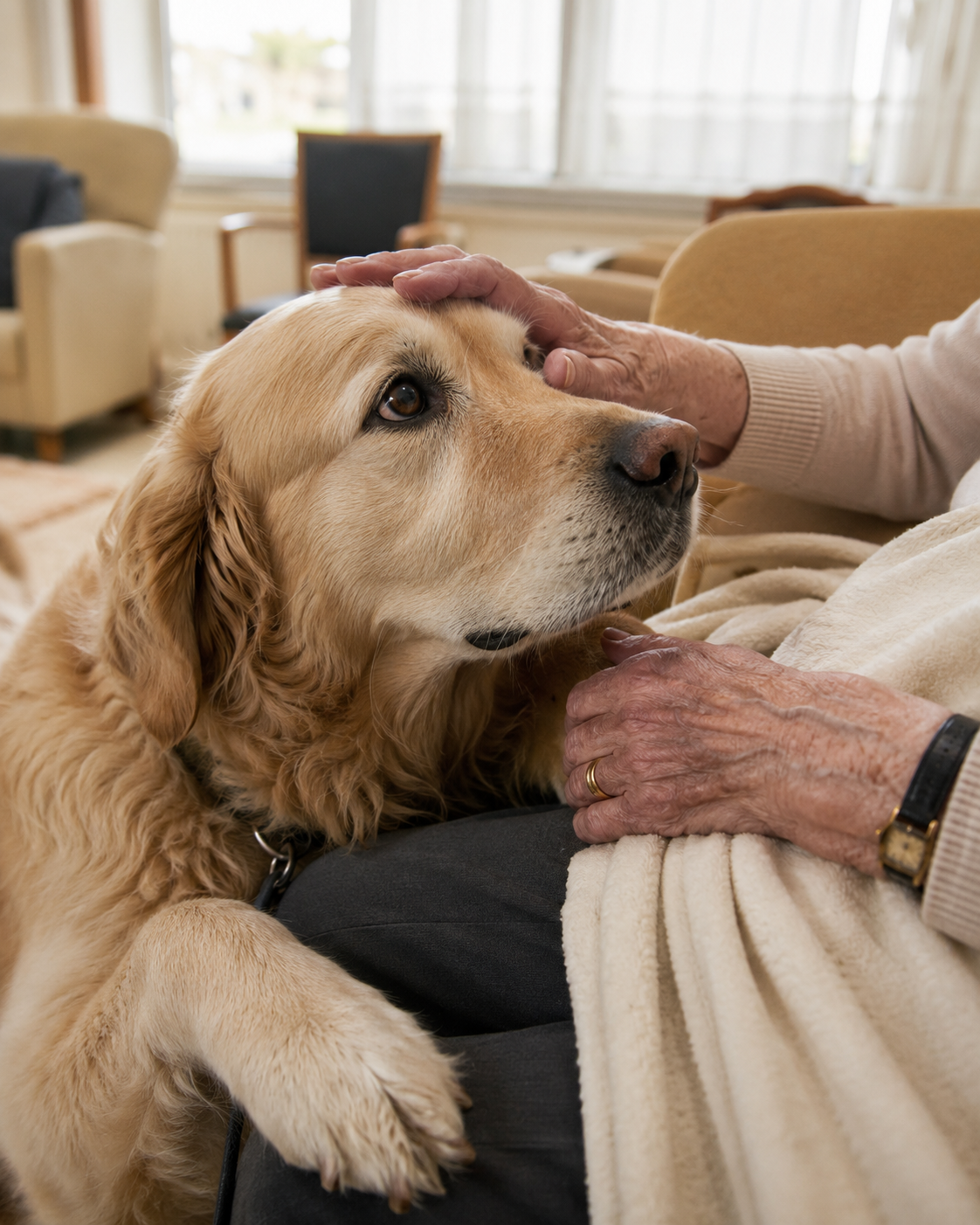
The far more common version is Animal-Assisted Activities (AAA): a team turns up on a pediatric ward or in the day room of a senior facility, and what’s on offer is company, a dog to put your hands on, maybe a trick or two. It sounds casual, but the effect is chemical: the contact triggers the release of oxytocin, the bonding neurohormone, in the people being visited. That is the warm glow you have felt petting your own dog, delivered to someone who may not have felt it in a while.
Here is the part people skip. That glow flows to the handler too, and it can blind you. Watching a senior citizen beam while stroking your dog is genuinely intoxicating, and it can leave you so wrapped in your own oxytocin haze that you stop seeing your dog clearly. Loving your dog does not mean everyone in a nursing home wants to meet them, and it does not mean your dog is enjoying this, no matter how good you feel. There is even a physical risk in the other direction: your dog can pick up antibiotic-resistant bacteria like MRSA, which circulates in healthcare settings. In short, this work is wonderful and it is not simple, and doing it well means leaving the rose-colored glasses at home.
What actually makes a good therapy dog
So which dogs are suited to this? Honestly, not many, and that is not an insult to your dog. The work drains a dog, and for some it is outright stressful. Plenty of thoroughly lovely animals are disqualified by their own temperament, and the cruelty of it is that many of them would badly like to come along anyway. There are three real criteria, and a dog needs all three, not two out of three.
They have to truly love people, not tolerate them. This is the headline qualification, and it is stricter than it sounds. It does not mean your dog is happy to see you and puts up with visitors. It means your dog voluntarily approaches strangers, seeks eye contact, and makes an effort to get close to people they have never met. I have known many dogs in training who adored their own person but had no real interest in strangers, and I have watched a “therapy” session that was really just a handler petting their own dog while others looked on. That is not therapy; that is a pet parent enjoying their dog in a nursing home. There is a world of difference between a dog who genuinely wants strangers and a dog who merely endures them.
They have to be physically calm with real manners. And here we have to separate manners from personality, because they are not the same thing. A dog can be beautifully trained, greet people politely, keep four feet on the floor, and still be wrong for this work if their underlying energy is too big. The people who benefit most from a dog’s visit are often frail or physically compromised, recovering from surgery, protecting a new hip, guarding a fragile shoulder. A dog who quivers and thrashes with joyful enthusiasm, even a well-mannered one, can hurt them by accident. This is exactly why so many dogs make far better therapy dogs as calm seniors than as exuberant adolescents. A dog dismissed as “too much” at three may be perfect at eight or ten, after life has mellowed them. If your young dog flunks, it is often a “not yet,” not a “never.”
They have to be emotionally unshakable. Beyond physical calm, a therapy dog needs to be a genuine zen master. They cannot come unglued when a child hugs them too hard before you can intervene, when a patient with dementia grabs at their ears, or when a metal tray clatters to the floor behind them. They need to behave in ways most dogs simply do not: unbothered, unreactive, unfazed by the small chaos of a room full of people who are not going to handle them gently. Because people will not be gentle, guaranteed. Children will be desperate to hug a dog like the one they miss at home, and will not understand why they cannot squeeze the breath out of yours. Some seniors will get a firm grip on the sides of your dog’s head and kiss their face before you can move. A dog who “tolerates” this may be fine the first time or two, and not fine the third or fourth. And forcing a dog to endure treatment they hate is not only risky, it is arguably unkind. You want a dog who honestly does not mind being hugged or having their tail pulled. Those dogs exist. They are rarer than we like to believe.
“The word I always push back on is ‘tolerates,’” says Dr. Nina Kohl. “A dog who tolerates being grabbed is a dog running down a countdown you can’t see. The dogs who belong in this work aren’t gritting their teeth through it. They genuinely don’t care, and that indifference to being handled is a specific temperament, not something you can train into a dog who finds it stressful.”
Your job is harder than the dog’s
If the dog’s criteria are demanding, the handler’s are the part people underestimate entirely. You are half of the team, and your responsibilities are real: be your dog’s advocate, become fluent in your dog’s body language, and stay objective when everything in you wants to melt.
You are your dog’s advocate. A therapy dog fields a lot of clumsy, pushy handling, and your role is to strip away every bit of stress you possibly can. You won’t catch all of it, which is exactly why temperament and training carry so much weight, but the protector’s job is yours. That starts long before you arrive anywhere, and it starts with an honest read on your own animal: which rooms will suit this dog, and which will undo them. A dog who would be swamped by a pediatric ward can be perfect in a senior facility. A dog who adores children can still find wheelchairs and walkers alarming. So the first task is fitting the dog to the program rather than the reverse, and a certifying organization (Pet Partners, Therapy Dogs International, whichever you go through) will help place a newly credentialed team somewhere it fits.
You have to read your dog expertly, in real time. The job on site is a strange two-step: offer the dog up, then get out of the way far enough that something real can pass between the dog and the person, all while watching closely enough to catch the interaction that is quietly going wrong. This is where most well-meaning handlers fail, and they fail in a specific way. If I had a dollar for every stiff-bodied, closed-mouthed, wrinkle-browed dog whose person told me “oh, they’re fine,” I could fund a shelter. I once watched a video a woman sent me of her dog doing hospital visits. The children were ecstatic, petting and chattering over the dog, and she was beaming, telling me how much her dog loved it. Except the dog’s body said the opposite: stiff, mouth clamped shut, head turned away from the kids. She was so flooded with her own oxytocin that she could not see her dog was miserable.
You have to escape the oxytocin and stay objective. That is the hardest skill of all, and it is the whole game. Handlers have to become brilliant at spotting signs of discomfort in their dog and acting on them immediately, which is not easy when you are enjoying yourself and when “but they’ve always loved coming here” is right there as an excuse. Maybe they did love it, and maybe that was then. For some dogs a visit is the best part of the week; for the same dog on a different day it can be draining, and there’s nothing unusual about a dog loving the work for a few years and then signaling they’re ready to hang it up. Your job is to read your dog objectively, every minute of every interaction, tracking three things at once: the person being visited, the room around you, and the animal on the end of your leash. Here is the test. Drive home from a visit feeling fresh and unbothered, and you almost certainly weren’t doing the job.
I know that is a lot to carry. Done properly, it is. But many handlers call it the most rewarding thing they have ever done with their dog, and I do not want any of these cautions to scare off the right teams. When the match is right, it’s meaningful, lovely work that pays off three ways at once, for you, for your dog, and for people craving precisely the comfort a dog is built to offer. The whole thing just has to be approached with eyes open and a plan, so that it truly benefits everyone present, the dog first among them.
What newer research adds
Two developments are worth folding into how you think about this work. The first is about safety, and it is genuinely reassuring. That MRSA risk in healthcare settings has been studied directly, and researchers have found that it can be sharply reduced with a simple decolonization protocol: bathing therapy dogs with a chlorhexidine (antiseptic) shampoo before visits and wiping them with chlorhexidine wipes periodically during a visit. In one study of an outpatient cancer center, children who interacted closely with the dogs were several times more likely to pick up MRSA, but once the dogs were decolonized, the risk for the close-contact group dropped to match everyone else’s. The broader lesson is that reputable programs increasingly run on written infection-control policies, formal training and evaluation of teams, and hand hygiene before and after contact, so if you volunteer, expect and welcome those rules rather than seeing them as red tape.
The second development gently widens the field. For years the assumption was that this work was essentially a dog’s domain, and that cats could not do it. Newer thinking suggests we were often screening cats for the wrong traits rather than proving they lacked the temperament, and some calm, people-seeking cats do participate in animal-assisted programs. The point is not that your cat should suit up, but that the real qualification was never species. It was always the same rare combination this whole article is about: a genuine love of strangers, unshakable calm, and a human paying honest attention. That is the bar, whatever the animal, and it is worth clearing precisely because the work matters so much when it is done right.
References
- Dalton, K. R., et al. “Effectiveness of a decolonization protocol for reducing MRSA transmission between therapy dogs and pediatric patients.” Infection Control & Hospital Epidemiology / Johns Hopkins research. dvm360.com
- Pet Partners. “Therapy Animal Program.” petpartners.org
- Alliance of Therapy Dogs / Therapy Dogs International. Handler and dog eligibility standards. tdi-dog.org