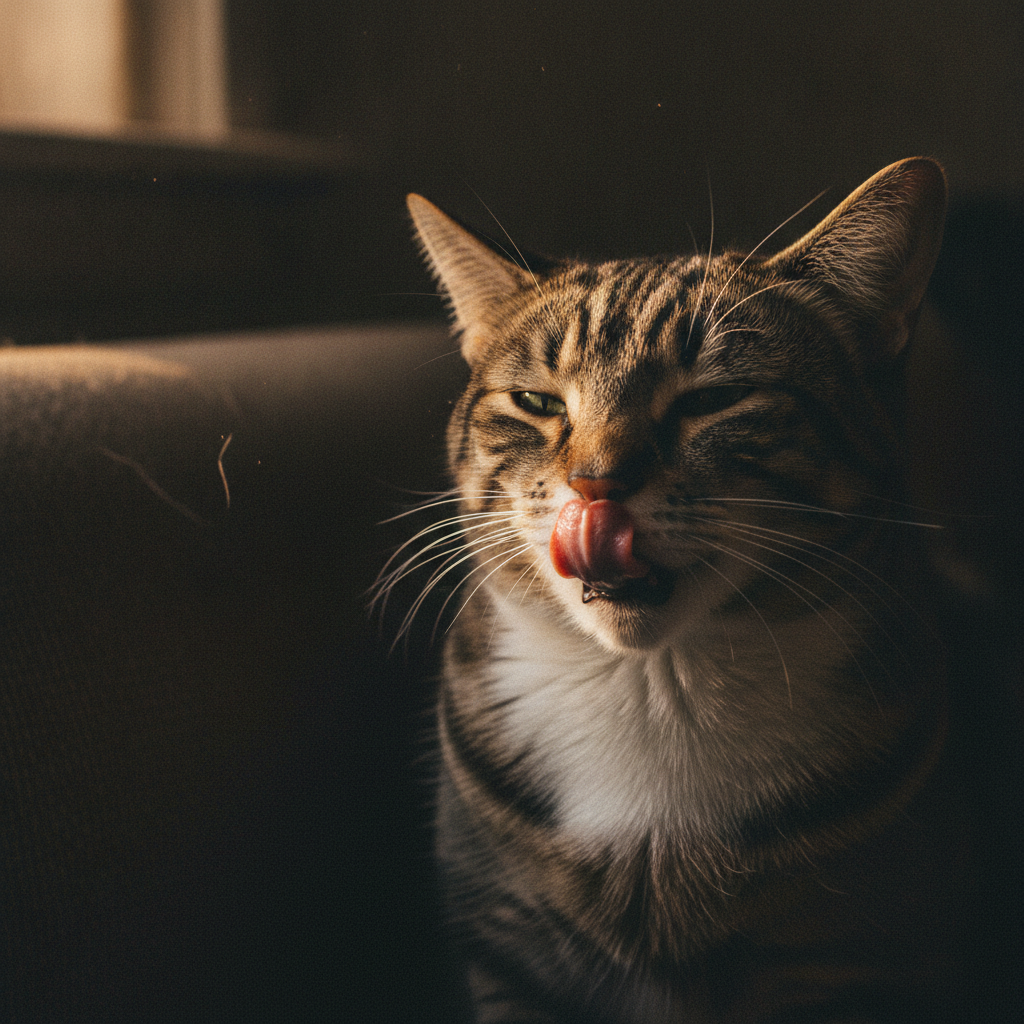
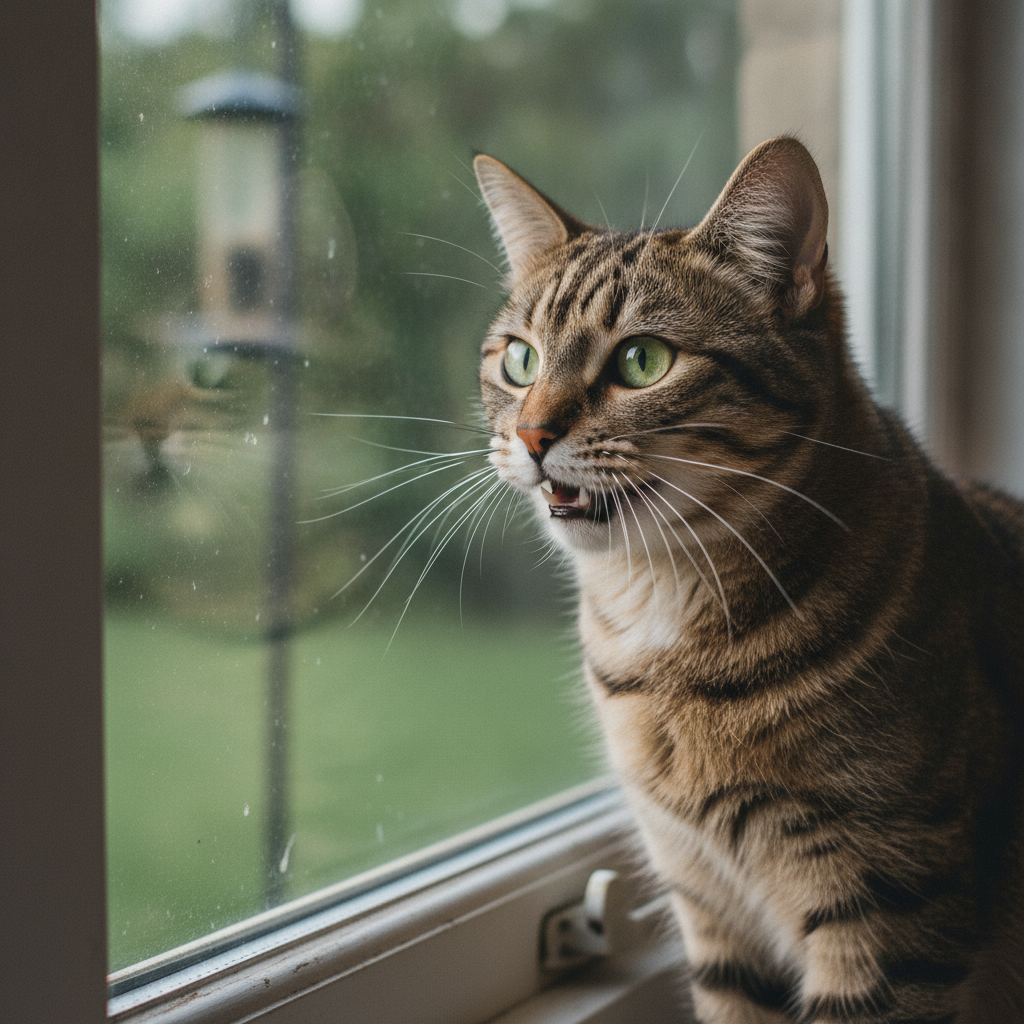
You know the sound if you’ve lived with a cat and a window. Your cat locks onto a bird or a squirrel outside, freezes into total stillness, and then the jaw starts going, a fast, stuttering clack-clack-clack, mouth half open, whole body wound tight. It can look like they’re shivering, the way our teeth chatter when we’re cold. They’re not cold. They’re hunting, and the hunt is happening almost entirely in their head.
This behavior goes by a few names, chattering, chittering, twittering, and even the experts don’t fully agree on what drives it. But the throughline is clear: it’s wired into your cat’s identity as a predator, and it shows up at the precise moment a hunt becomes impossible. There’s a target, right there, and a pane of glass making it unreachable. What you’re watching is instinct with nowhere to go.
What the jitter actually is
The leading theories all circle the same idea. One holds that the rapid jaw movement rehearses the “killing bite,” the fast, precise clamp a cat uses on prey’s neck, firing off as a kind of muscle-memory reflex the moment the cat sees something worth catching. Another ties it to a surge of adrenaline: the sight of prey floods the system, the body revs for a chase that can’t happen, and the jitter is the overflow. And a third reads it as pure frustration, the animal equivalent of a groan at a target you can’t reach.
There’s also a stranger possibility, drawn from the wild. Researchers observing a small wildcat called the margay in the Amazon documented it mimicking the calls of baby monkeys to lure the adults closer, a hunting con job. That has fed the idea that a house cat’s chatter might carry a faint echo of prey-imitation, a leftover instinct to sound like the thing you’re trying to catch. It’s unproven for domestic cats, but it fits the pattern: everything about chattering points back to the hunt.
“I think of chatter as a hunt with the volume turned all the way up and nowhere for it to land,” says Dr. Lena Park. “The cat has locked on, the body has committed, and the glass makes the whole thing impossible. That tension has to go somewhere, and for a lot of cats it comes out through the jaw.”
Chatter versus chirp: not the same sound
It’s worth separating two things cats do at the window, because they mean slightly different things. A chirp is a voiced sound, a short, high, birdlike note the cat produces on purpose when it’s excited. A chatter is nearly voiceless, made without vibrating the vocal cords, and it’s more reflex than choice. Cats often do both in the same session when a squirrel shows up, but the chirp is closer to an excited exclamation and the chatter closer to a body reacting on its own.
Chirping also shows up in gentler contexts that have nothing to do with prey. A mother cat chirps to round up her kittens, and plenty of house cats chirp at their humans, usually as a pointed reminder that a food bowl is emptier than they’d like.
When the window becomes a problem
For most cats, window-hunting is enrichment, a genuinely good time. But the same setup can tip into stress. A cat teased all day by birds it can never reach can move from excited to overstimulated, frustrated, or anxious, because the instinct keeps firing with no payoff. In some cats that frustration spills over into redirected aggression, where the pent-up energy gets aimed at whatever’s nearby, another pet, or your ankle. It’s worth giving a wound-up, chattering cat some space rather than reaching in to pet them mid-fixation.
Learn to read the body. A cat with ears and tail up is engaged and open to interaction. A cat crouched low with ears flattened is highly aroused and should be left alone. If your cat seems to be tipping from fun into frustration, the fix is simple: break the sightline, a curtain over the window will do it, and redirect that predator drive somewhere it can actually finish. Wand toys, puzzle feeders, and food-dispensing toys let a cat stalk, pounce, and “catch,” giving the hunt the ending the window never will.
The one time to take it seriously
Chattering at prey is normal. Chattering at nothing is the exception worth watching. If your cat makes that jaw-jitter with no bird, squirrel, or bug in view, it can occasionally signal mouth pain rather than a phantom hunt. Cats don’t get cavities the way we do, but they’re prone to tooth resorption, a painful condition that erodes the tooth and exposes the sensitive layer beneath.
So the tell isn’t the chatter itself, it’s the context. Random jaw movement paired with other mouth-trouble signs, a foul odor, extra drool, food falling out mid-bite, or a shrinking appetite, is a reason to book a dental check. In that pairing, the jitter may be your cat telling you their mouth hurts, and that’s the one version of this behavior you don’t want to file under “just a cat being a cat.”