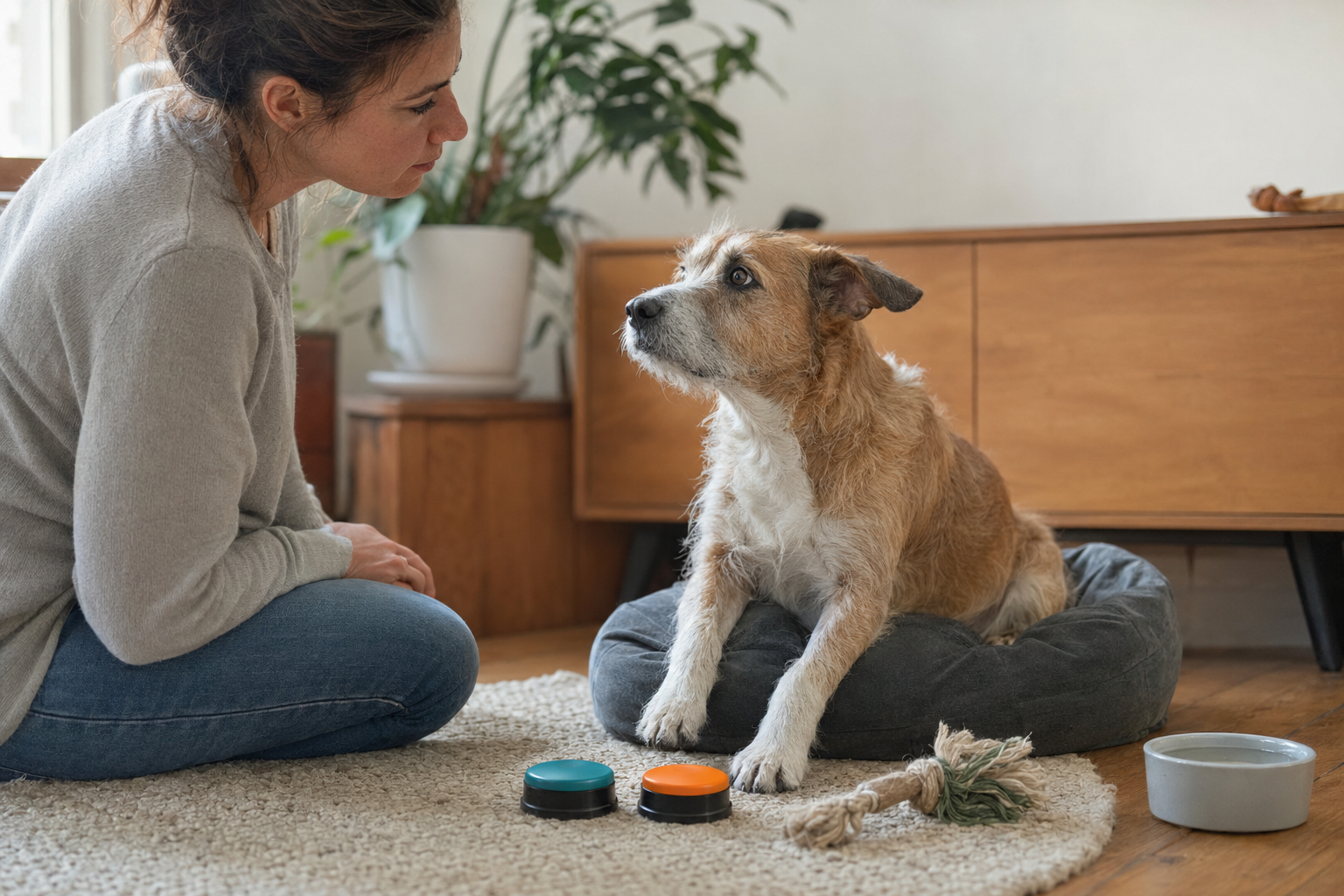
Spend two minutes on a pet feed and you will meet a dog who presses plastic buttons to “say” outside, play, or food. The videos rack up millions of views, and the comments underneath them tend to split into two camps. One camp is charmed. The other is convinced the whole thing is a trick, and that the dog is not responding to any word at all but to a twitch of the owner’s shoulder, a glance toward the door, a hopeful lean. That second camp has a real point, and for years nobody had cleanly answered it. A study in the journal PLOS One set out to, and the buttons came out looking a lot more legitimate than the skeptics expected.
The objection worth taking seriously
The doubt has a name in animal science: the Clever Hans effect, after a horse who appeared to do arithmetic but was actually reading tiny, unconscious signals from the people around him. Any claim that an animal understands language has to rule this out first. If a dog only hits the door after its owner has already drifted toward the door, the dog has learned to read a person, not a word. That is still clever, but it is not comprehension.
So the useful question is not “do soundboard dogs seem to understand words.” It is “can they respond correctly to a word when every human tell has been stripped out of the room.” That is the version of the question the researchers built their experiment around.
Designing the tells out of the room
The work came out of the lab of Federico Rossano at the University of California San Diego, and it ran in the one place a dog is most relaxed and least performing: its own home. Fifty-nine dogs already trained on buttons took part.
In the first setup, a researcher who could not hear the recording pressed a button whose printed word was hidden under tape. Neither the person pressing nor, in effect, anyone in the room knew which cue had just played, which means nobody could leak the answer through posture or expression. The buttons covered three categories a dog cares about: play (the words “play” or “toy”), going out (“out” or “outside”), and eating (“food,” “eat,” “dinner,” or “hungry”). The team then watched what the dog did, looking for the giveaway behaviors, a dog fetching a toy after “play,” or turning toward its bowl after “food.”
A second round used a fresh set of dogs and had the owners themselves either press the button or simply say the word out loud, with each dog experiencing both.
What the dogs actually did
Two of the three categories landed clearly. After a play button, dogs produced play behavior about seven times more often than they did on average across all the buttons. Going-out cues pulled the same kind of jump in door-and-leash behavior. It did not matter whether a stranger or the owner delivered the cue, and it did not matter whether the word was pressed or spoken, which is exactly the pattern you would expect if the dog is tracking the word rather than the human holding it.
The food buttons were the exception. Dogs did not reliably ramp up food behavior after hearing “dinner” or “hungry.” That is an honest wrinkle rather than a hole, and there are ordinary explanations, a well-fed house dog may simply care less about a food announcement than about the promise of a walk or a game.
Rossano has been refreshingly measured about the whole thing. He has called the finding a necessary first step rather than a bombshell, and noted that it was already well established that dogs learn plenty of spoken words. What this study adds is the control the viral videos can never provide: it shows the dogs were acting on the words themselves, independent of who produced them and independent of the scene around them.
What newer research adds
The bigger development came a few months later. In December 2024, the same group published work in Scientific Reports that moved past single words to combinations. Instead of a staged lab task, they mined a mountain of real-world data logged through the FluentPet app, more than 260,000 button presses gathered over 21 months, with roughly 195,000 of those made by the dogs themselves. From that pool they focused on 152 dogs with long press histories and asked a sharper question: when a dog hits two buttons in a row, is that random, imitated from the owner, or aimed at something.
Using simulations to model what pure chance would look like, they found the real two-button sequences did not match chance. Pairings such as “outside” plus “potty,” or “food” plus “water,” showed up more often than random pressing would produce. That does not prove dogs are building sentences with grammar, and the researchers are careful not to claim it. But it is a meaningful step up from “the dog learned one word” toward “the dog is combining words on purpose.” For an owner deciding whether a soundboard is a gimmick or a genuine channel, that is the encouraging part.
“The thing I tell clients is that the buttons are a listening tool as much as a talking tool,” says Dr. Ravi Mehta. “Your dog was already communicating in body language before the first button arrived. What the board does is give you a shared vocabulary and, just as importantly, a reason to slow down and actually watch what they are asking for.”
If you want to try it at home
None of this means every dog will become a chatterbox, and it is worth keeping expectations grounded. Start with one or two buttons tied to things your dog genuinely wants, press the button yourself every single time that thing happens so the association is airtight, and resist the urge to test or quiz your dog. The dogs in this research succeeded because their words were consistent and meaningful, not because anyone drilled them. If a button never seems to click for your dog, that is fine too. The talking is a bonus. The paying attention is the real point.
References
- Bastos, A. P. M., et al. “How do soundboard-trained dogs respond to human button presses? An investigation into word comprehension.” PLOS One, 2024. https://journals.plos.org/plosone/article?id=10.1371/journal.pone.0307189
- Bastos, A. P. M., et al. “Soundboard-trained dogs produce non-random, two-button combinations.” Scientific Reports, 2024. https://www.nature.com/srep/
- University of California San Diego. “Dogs Use Two-Word Button Combos to Communicate, Study Shows.” 2024. https://today.ucsd.edu/story/dogs-use-two-word-button-combos-to-communicate-study-shows