The question gets posed as a personality test. Are you the helicopter type who trails their dog into the exam room, or the type who trusts the professionals and waits with a magazine?
It is the wrong question. Framed that way, both answers are defensible, everyone shrugs, and you end up making the call based on which vet asked you last. The better question is what actually happens to the animal on the table, and on that, there is more evidence than the “it’s a personal choice” framing suggests.
What the research actually found
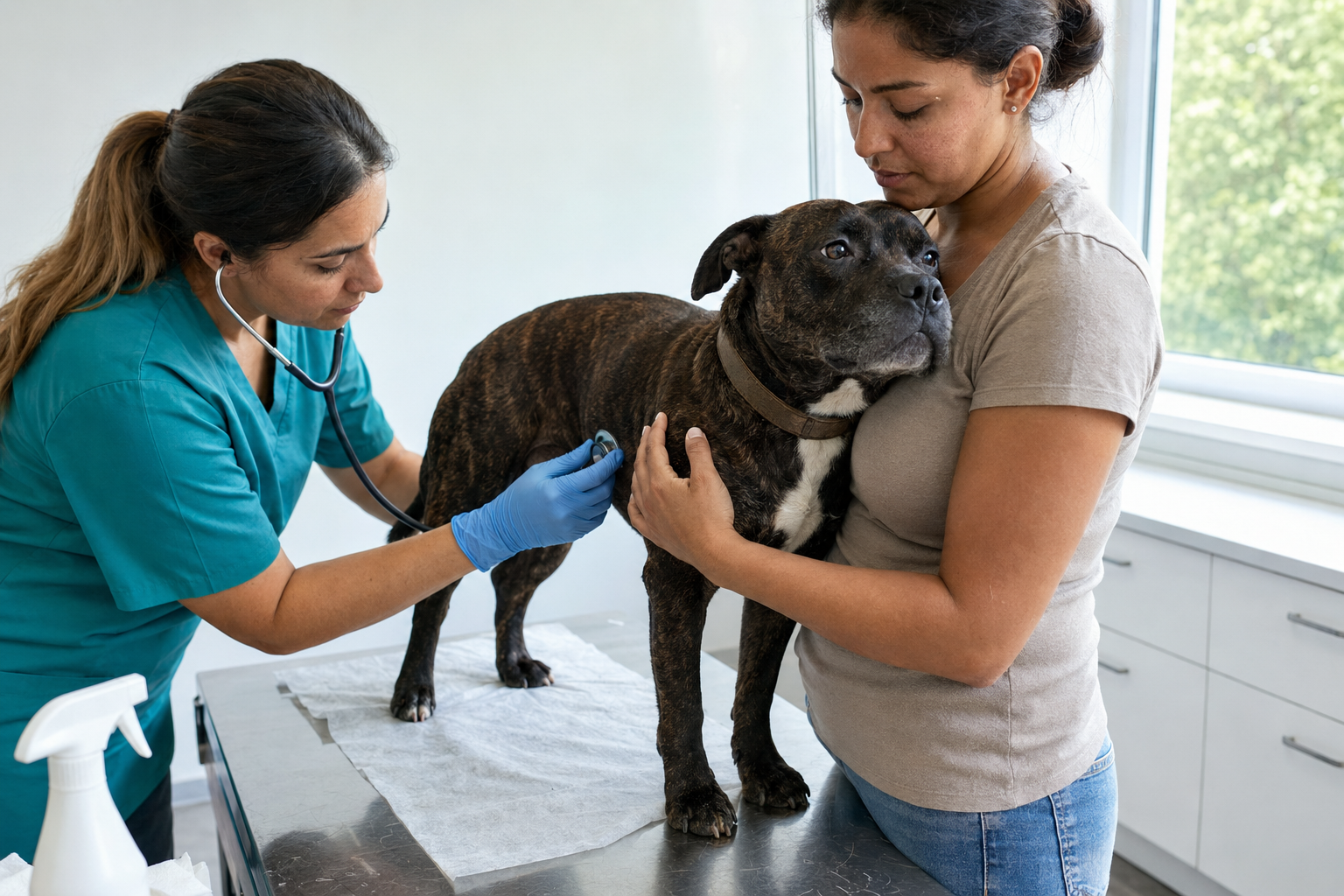
Studies of fearful and anxious veterinary patients have consistently found reduced signs of stress and anxiety when owners were actively present in the exam room. Not merely standing in the corner. Present, and participating: petting the dog, talking to them, staying in contact.
When owners do that, the measurable results in dogs include lower heart rates, lower body temperatures, less vocalizing, and less yawning, which is a stress signal in dogs rather than a sleepy one.
Environment matters in the same direction. Dogs who waited twenty minutes outside in a garden with their owners had lower heart rates and lower cortisol than dogs who spent that time in the waiting room. Dogs also showed fewer stress signs waiting in an empty exam room than in a busy lobby.
Put those together and the picture is not “in or out.” It is that the busy, loud, dog-dense waiting room is a bad place to be, and that a calm, engaged human touching their dog is a good thing to have nearby.
“The variable people argue about is whether the owner is in the room,” says Dr. Lena Park. “The variable that changes the numbers is whether the owner is doing something useful once they are in it.”
The case for sending your dog in alone, taken seriously
It is not a fringe view, and it is not lazy. Vets who prefer solo exams have real reasons.
The pandemic proved the workflow. When curbside care forced owners to wait outside, plenty of clinics found that exams ran smoothly, pets settled, and appointments finished on time. Some practices kept the policy afterward because they liked the results.
Undivided attention. A vet examining a patient while also managing a worried human is doing two jobs. During procedures that require stillness, like a blood draw, the second job can cost you the first.
Some dogs are worse with you there. A dog who feels responsible for you may spend the exam guarding you from the vet instead of tolerating the vet. That is a real phenomenon, and it is not a character flaw in the dog.
Independence has value. A dog who learns they can be handled by a stranger and come out fine has learned something durable, and a dog who never leaves your side never gets to learn it.
The clinics that do this well replace your presence with a thorough conversation before the exam, so nothing about the visit’s purpose is lost. If your vet takes your dog to the back without that conversation, the model is not being run properly.
Where solo exams break down
The strongest argument against them is not about the dog at all. It is about the black box.
When your dog disappears into “the back,” you cannot see what was done, why, or how your dog reacted. You get a summary and an invoice. That gap breeds exactly the thing that makes people distrust their vet: confusion about the diagnosis, uncertainty about the recommendations, and a bill that arrives with no visible relationship to the twenty minutes you spent staring at a wall.
In emergency medicine, that gap is worse. You have just rushed in terrified, and the first thing that happens is that your animal is taken away from you. Clinics that keep owners with their pets through the process tend to find that owners are calmer, ask better questions, and are less likely to feel blindsided by the cost, because they watched every step that generated it.
And the dog, per the research above, is generally not paying a price for your presence. They are usually benefiting from it.
The actual answer: be in the room, and be useful
Presence is not the same as help. A person who stands rigid, radiating dread, or who leans over the table apologizing to the dog in a high, thin voice, is not lowering anyone’s heart rate.
Here is what being useful looks like.
Stay in contact. Hands on your dog, calm and steady. Scratch the chest, hold the shoulders. This is the specific behavior the research ties to lower heart rates.
Keep your voice boring. Low, slow, unremarkable. Cheerful is fine. Frantic reassurance is not, because “it’s okay, it’s okay, it’s OKAY” tells your dog that something is very much not okay.
Take the job you are given. If the tech asks you to hold a leg, hold the leg exactly as shown. If they ask you to step back, step back. You are part of the handling team now, not a spectator with opinions.
Bring the good stuff. A licking mat with something soft on it, or a fistful of chicken, converts an exam from a thing done to your dog into a thing they are being paid for. Ask ahead of time whether treats are okay, since fasting is required for some tests.
Have the conversation up front. Say what you noticed, when it started, and what you are worried about, before anyone touches the dog. This is the part solo-exam clinics get right and everyone should copy.
Step out for the hard minute if you need to. A blood draw on a wriggling, protective dog may genuinely go faster without you. Leaving for ninety seconds is not abandonment. What the evidence supports is not clinging to your dog through every procedure; it is being with them for the waiting, the exam, and the recovery, which is most of the visit.
Know your own dog
None of the above overrides the animal in front of you.
A dog who has repeatedly done better in the back is telling you something. A dog who is protective, who has a bite history, or who escalates when you enter the room is telling you something. So is a person who genuinely cannot keep it together at the vet, and there is no shame in that; a distressed owner is a stressor the dog can smell.
Past visits are data. Use them. The default should be that you go in, because that is where the evidence points and it is where the transparency lives. Deviate from the default when your specific dog gives you a reason to.
What newer research adds
The wider shift here is the Fear Free and low-stress-handling movement, which has reorganized how a lot of clinics think about the visit. The goal is no longer just to get the exam done. It is to get it done without teaching the animal that the clinic is a place where frightening things happen, because a dog who learns that becomes harder to treat every year for the rest of their life.
Practically, that has produced things worth asking your clinic about: pre-visit anti-anxiety medication given at home, appointments scheduled at quiet hours, exams done on the floor instead of a slick steel table, and a policy of not restraining a panicking animal by force when the visit can be rescheduled.
That last one surprises people. A modern, well-run practice would often rather abort a visit than win a wrestling match, because the wrestling match is what makes the next four visits worse. If your clinic thinks that way, the question of whether you stand in the room mostly answers itself.
References
- AAHA. “A Look Inside Fear-Free Practices.” Trends Magazine, March 2024. aaha.org/trends-magazine/march-2024/a-look-inside-fear-free-practices/
- AAHA. “Canine and Feline Behavior Management Guidelines: Tips for Reducing Patient Fear in the Veterinary Clinic.” aaha.org/resources/2015-aaha-canine-and-feline-behavior-management-guidelines/reducing-patient-fear/
- “A Review on Mitigating Fear and Aggression in Dogs and Cats in a Veterinary Setting.” PubMed Central. pmc.ncbi.nlm.nih.gov/articles/PMC7826566/
- AAHA. “How Can My Pet Have Stress-Free Veterinary Visits?” aaha.org/resources/how-can-my-pet-have-stress-free-veterinary-visits/