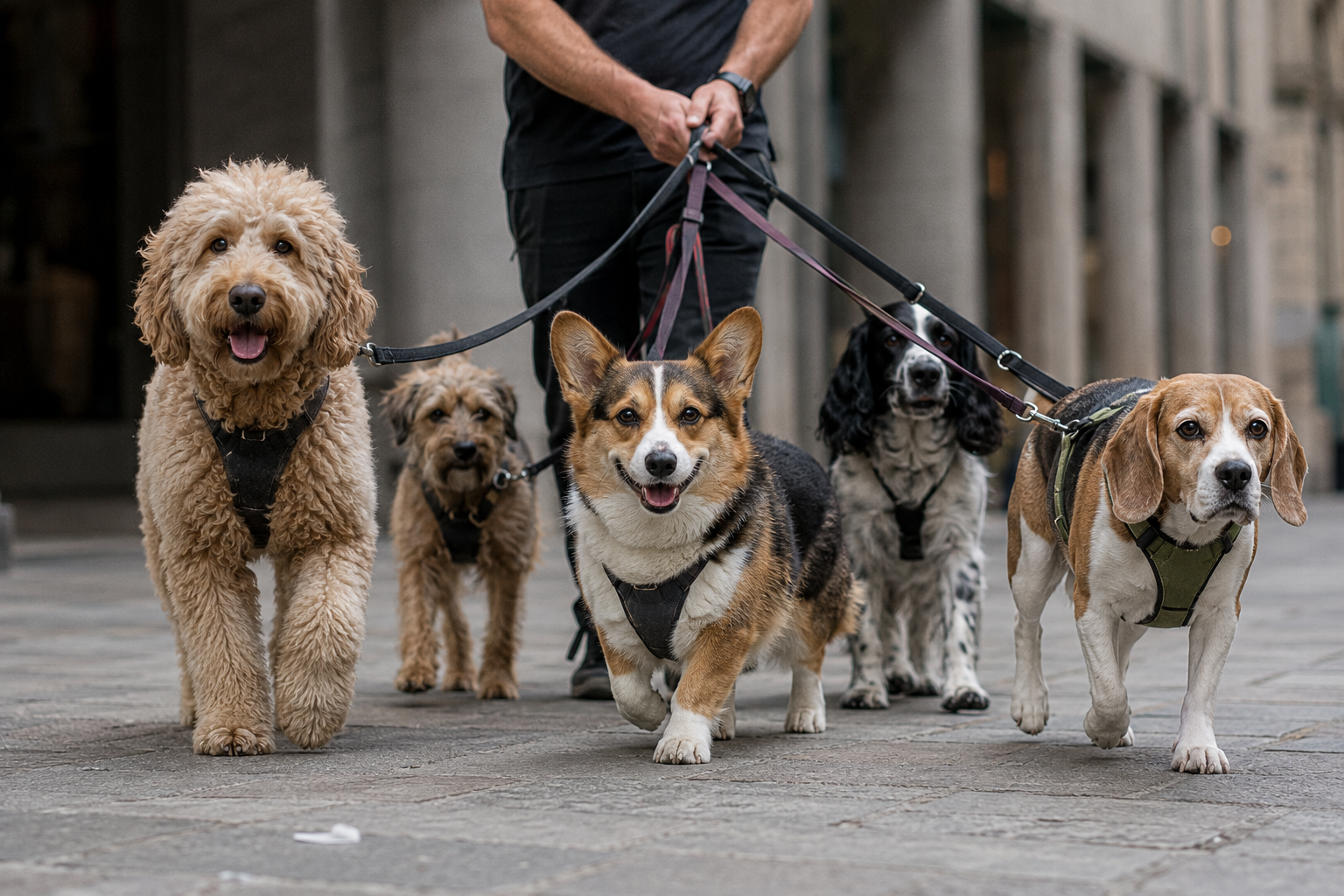
The dream is easy to picture: you, your own boss, out on a trail or a beach with a handful of well-behaved dogs, making your own hours and getting paid to be around animals all day. It’s a genuinely good life, and plenty of people build it. But the parts of dog walking that decide whether you make it aren’t the sunny-trail parts. They’re the unglamorous ones, pricing, contracts, insurance, and the right vehicle, and the walkers who take those seriously are the ones still in business a year later.
So if you secretly harbor the dog-walking dream, here’s how to start it as an actual business, with the boring essentials given the weight they deserve.
Do your research first
Before anything else, investigate the dog-walking services already operating in your area. What do they offer, and just as important, what’s missing? Maybe nobody runs an off-leash adventure service, or midday visits for work-from-office households, or weekend hikes. Find the gap between what local owners need and what’s currently available, and build your service to fill it. That’s your opening.
Write a business plan
Get specific on paper before you take a single client. How many dogs can you safely handle in one group? How many shifts a day, and how long is each walk? What will you charge, and which neighborhoods will you serve? Resist the urge to cover the whole map. Pick a zone close to home, and weigh its stability, clients whose routines and budgets hold steady will keep you employed through ups and downs. A tight, realistic plan beats a sprawling ambition every time.
Choose your business structure
Most dog-walking businesses launch as one of two things, a sole proprietorship or an LLC, and the difference matters. A sole proprietorship is simplest, but your personal and business finances sit in the same pot, so you’re personally on the hook for any debts. An LLC separates personal and business assets, which protects your home and savings if something goes wrong. Incorporation is another option with similar protection. Many walkers begin as a sole proprietorship and switch to an LLC once they hire employees or simply want that layer of protection.
Set your pricing, and don’t undervalue yourself
Check your competitors’ rates and services, then price to your value. A common mistake for new walkers is charging rock-bottom fees to build a client list, then realizing they’ve undersold a service that delivered longer outings and more out-of-house time than rivals did. These days a per-walk rate generally lands between $10 and $35, varying by region. Got the skills? You can layer on obedience training or pet-sitting for extra income. Whatever you set, make sure it reflects the real work and time you’re putting in.
Draw up a contract
Have every client sign a contract, and don’t skip this because it feels formal. At minimum it should cover the dog’s information, any training or behavioral issues, an emergency contact, and the family vet’s details. Crucially, include a liability release and written permission to seek veterinary care if it’s ever needed, along with an agreement to be reimbursed for that care. A clear contract protects you, the client, and the dog.
Build a website and social presence
You’ll eventually get most of your business by word of mouth, but early on you need to be findable. Platforms like WordPress, Squarespace, and Shopify make it straightforward to build a professional site, and a presence on Facebook, Instagram, and other social channels is fundamental to growth. Show your services, your rates, and your availability, and let happy clients help you tell the story.
Get your licenses, insurance, and permits
Patience-testing but non-negotiable. Sort out the paperwork before you start walking dogs professionally.
- Business license. Your city government issues it.
- Liability insurance. Choose a plan built for pet-care work; providers like Pet Sitters Associates offer affordable coverage designed for exactly this.
- Permits. Some public parks and dog parks require a permit to walk multiple dogs at once, so check the rules for the spaces you plan to use.
Consider getting certified
Online and in-person courses cover dog behavior, safety and first aid, and business and client management, and completing one earns you a certification that’s a genuine selling point with prospective clients. It signals that you take the work seriously, and it makes you better at it.
Market your services
In the beginning, marketing is a numbers game: networking, flyers, and handing out cards, in volume. A few of the most effective channels:
- Mailboxes and cars in the neighborhoods you want to draw clients from.
- Dog parks, ideally in the early evening when they’re busy, for handing out cards.
- Coffee shops, restaurants, and bars, many of which keep a corkboard for flyers (always ask first).
- Groomers and vets. Introduce yourself to nearby groomers and clinics, and consider a referral incentive; a friendly relationship with a local groomer or a vet’s front desk can send you a steady stream of clients.
Don’t be surprised if it takes a stack of flyers to land a couple of clients, and those clients to refer a few more. If self-promotion makes you squirm, recruit a friend to help you get the word out.
Invest in the right equipment
The basics are simple but essential: sturdy six-foot leashes, long lead lines for new dogs still getting to know you, poop bags, treats, and, above all, a dependable vehicle that fits dogs comfortably. A four-door car can work when you’re starting out, but something roomier, a minivan, or a pickup with a camper shell, is a better long-term option once your pack grows.
What’s new since the old playbook
The bones of this business haven’t changed, but the on-ramp has. Gig platforms like Rover and Wag now let new walkers pick up clients and build reviews before they’ve built a brand, which is a faster start than flyers alone, though the platforms take a cut and set some of the terms. Pet-care-specific insurance is easier to buy than it used to be, and many walkers use scheduling and GPS-tracking apps that send clients live updates and route maps mid-walk, a professional touch that helps justify a higher rate. The fundamentals still win, but the tools to launch are more accessible than ever.
The trait that actually carries you
Beyond the business mechanics, one quality does more than any of them: patience. Patience building the business, patience with the dogs (there’s no such thing as a perfect one), and patience with clients. Add a real love of dogs and a sense of humor for the days you end up face-first in the sand, and you’ll be well on your way.