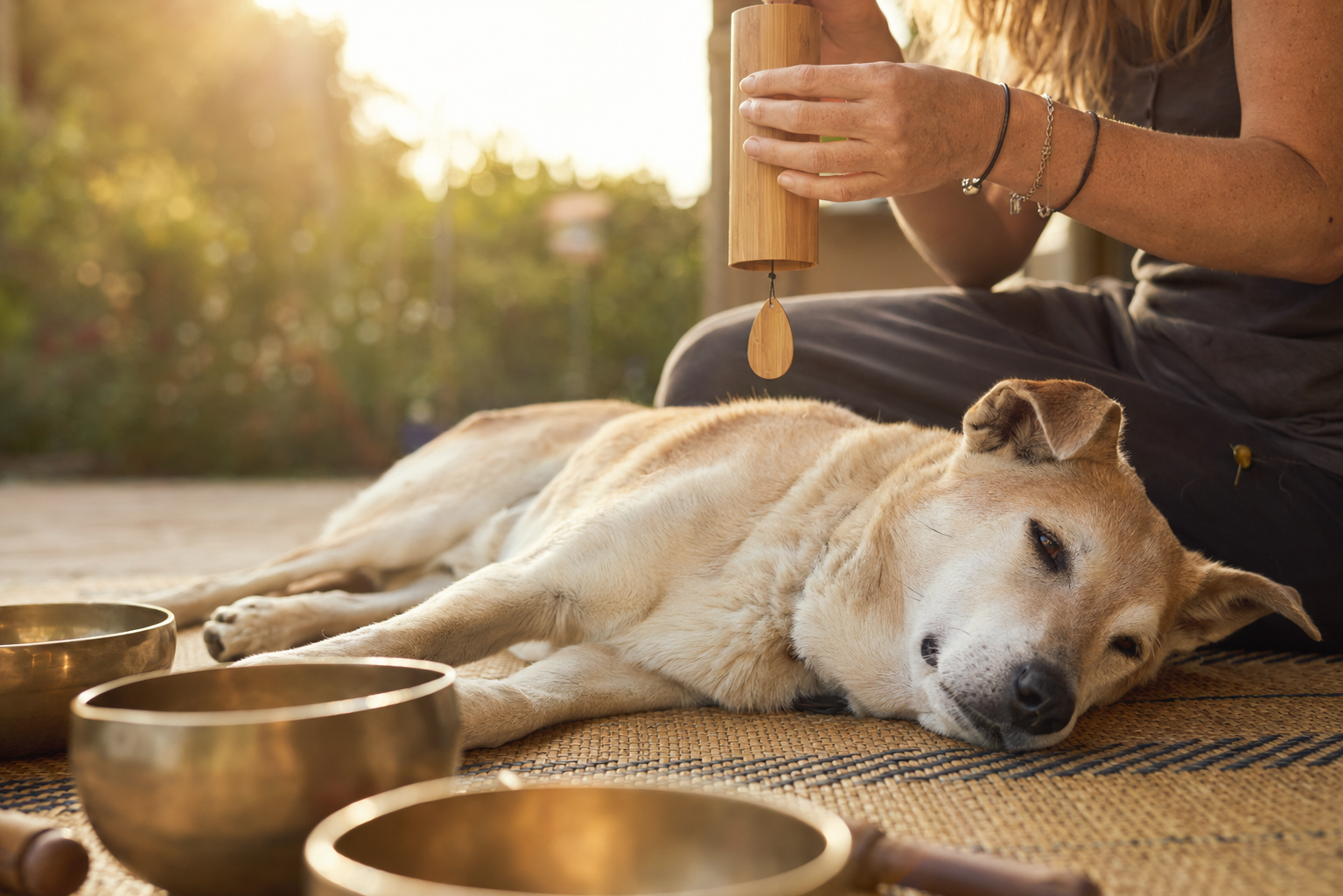
There’s a version of this story that gets an eye-roll: a person in white linen kneeling in the grass, waving a tuning fork over a dog while brass bowls hum. It looks like wellness theater aimed at owners, not pets. But strip away the aesthetics and there’s a real question underneath, one with actual research behind it: can sound change how a dog feels? The short answer is yes, modestly, and in ways that are worth knowing before you dismiss the whole thing or, on the flip side, expect it to fix a genuinely anxious dog.
Where the idea comes from
Sound healing (you’ll also see it labeled a sound bath or sound meditation) uses instruments that produce deep, sustained, reverberating tones, think gongs, singing bowls, and tuning forks, to nudge the listener toward a calmer brain state. In people, a full session runs 60 to 90 minutes and layers in drums and other instruments. Practitioners who adapt it for dogs strip it back, dropping anything with a sharp or startling sound (rain sticks, for example, tend to put dogs on edge rather than settle them) and shortening the whole thing.
One Los Angeles practitioner came to it by accident. Letizia Silvestri adopted a young Terrier named Zen during the pandemic, a dog the shelter warned would be a handful. He was: wound up around the clock, so reactive he’d lose control of his bladder if a hand came near his face, and immune to every calming trick she tried, from positive-reinforcement training to wearing him out during the day. Trainers floated medication or rehoming. On a hunch, she reached for something that helped her own stress, a small singing bowl, and played it near him. He softened. He started sleeping during the day. The trust between them grew from there, and that experience eventually became her pet-and-human sound-healing practice, Altha.
That’s one dog and one anecdote, which is exactly the kind of story that should make you skeptical. So it helps that the underlying claim, that sound can move a nervous system, has been measured.
What the science actually shows
Start with people, since that’s where most sound-healing research lives. One study found adults reported meaningfully less tension, fatigue, and anger after a singing-bowl session. Another concluded that sound meditation lifted a low mood about as well as silent meditation did. Useful, but humans can tell you they feel better; a dog can’t.
For dogs, the strongest evidence doesn’t come from sound baths at all. It comes from shelters. Researchers with the Scottish SPCA piped five music genres into kennels and tracked the dogs’ physiology, and the standout finding was heart-rate variability: it rose, a marker of lower stress, most clearly when soft rock and reggae played, with classical, Motown, and pop having a gentler effect. Across the board, dogs spent more time lying down and less time standing when any music played compared with silence. The takeaway isn’t “put on reggae.” It’s that audio is not neutral to a dog. The right sound measurably shifts them toward calm, and silence isn’t automatically the restful default we assume it is.
A live sound bath leans on the same mechanism. A dog on high alert is scanning for the next thing to react to. Steady, low, repetitive tones give that scanning brain a single predictable input to settle onto, which is why a curious dog who perks up at the first ring of a bowl often ends up with their ears dropped, body loose, sometimes asleep, a few minutes later.
“Sound works on a dog the way a metronome works on a racing mind, it gives an over-aroused nervous system one slow, predictable thing to organize around instead of a hundred fast ones,” says Dr. Lena Park. “I tell owners to treat it as one calm ingredient in the day, not a switch that turns anxiety off. It lowers the baseline; it doesn’t rewrite the behavior.”
How to try it at home
You don’t need a practitioner for the everyday version. A few low-effort options:
Learn a singing bowl. The basics take minutes and plenty of free tutorials walk you through it. Play a few soft minutes and let your dog choose whether to stay in the room.
Stream it. A recorded sound bath or a dog-specific calming playlist won’t carry the physical vibration of a live session, but it’s a genuinely useful stand-in, and the shelter research suggests recorded audio alone can move the needle.
Sit with them. Dogs are porous to our state; when you deliberately slow down, some dogs borrow the calm. You don’t need your dog to hold a perfect down-stay through your meditation. Sharing the quiet room is the point.
Keep every session short and read the dog, not the clock. Drowsy, loose, lying down: good. Pacing, panting, trying to leave: stop. More sound is not more calm.
Where sound stops being enough
Here’s the honest limit. Sound is a supportive input for ordinary, low-grade stress. It is not a treatment for separation anxiety, noise phobia, or reactivity, and reaching for a singing bowl instead of a real plan can cost a struggling dog weeks. Zen’s turnaround wasn’t a bowl alone; it rode on top of trust, routine, and time. If your dog’s anxiety is the kind that empties their bladder, shreds a crate, or hijacks a walk, the sound bath is a nice-to-have around the edges of a behavior plan built with your vet or a qualified behaviorist, not a substitute for one.
What’s new since this idea took off
The wellness-for-pets market has kept expanding, and the most useful development is that we no longer have to argue about whether audio affects dogs. The shelter-music work settled that: measured on the dogs’ own physiology, the right sound lowers stress and silence doesn’t automatically soothe. Newer enrichment guidance for kennels and clinics now treats calming audio as a standard, low-cost tool rather than a fringe one, often defaulting to soft rock, reggae, or purpose-built dog playlists.
What the evidence still hasn’t done is validate the specific claims around bowls, forks, and “frequencies,” which remain the marketing end of the spectrum. So the reasonable position sits in the middle: sound is a real, cheap, low-risk way to help an ordinary dog settle, worth trying and easy to do yourself, as long as you don’t ask it to carry weight it was never built to hold.
This is a sensitive area for owners of genuinely anxious dogs. If your dog is struggling, a calming tool is a supplement to professional help, not a replacement, and it’s always worth looping in your vet.
References
- Bowman, A., et al. “The effect of different genres of music on the stress levels of kennelled dogs.” Physiology & Behavior, 2017. sciencedirect.com
- Goldsby, T. L., et al. “Effects of Singing Bowl Sound Meditation on Mood, Tension, and Well-being.” Journal of Evidence-Based Complementary & Alternative Medicine, 2017. pubmed.ncbi.nlm.nih.gov/27694559
- Goldsby, T. L., et al. “Sound Meditation and mood.” 2019. pubmed.ncbi.nlm.nih.gov/31632840