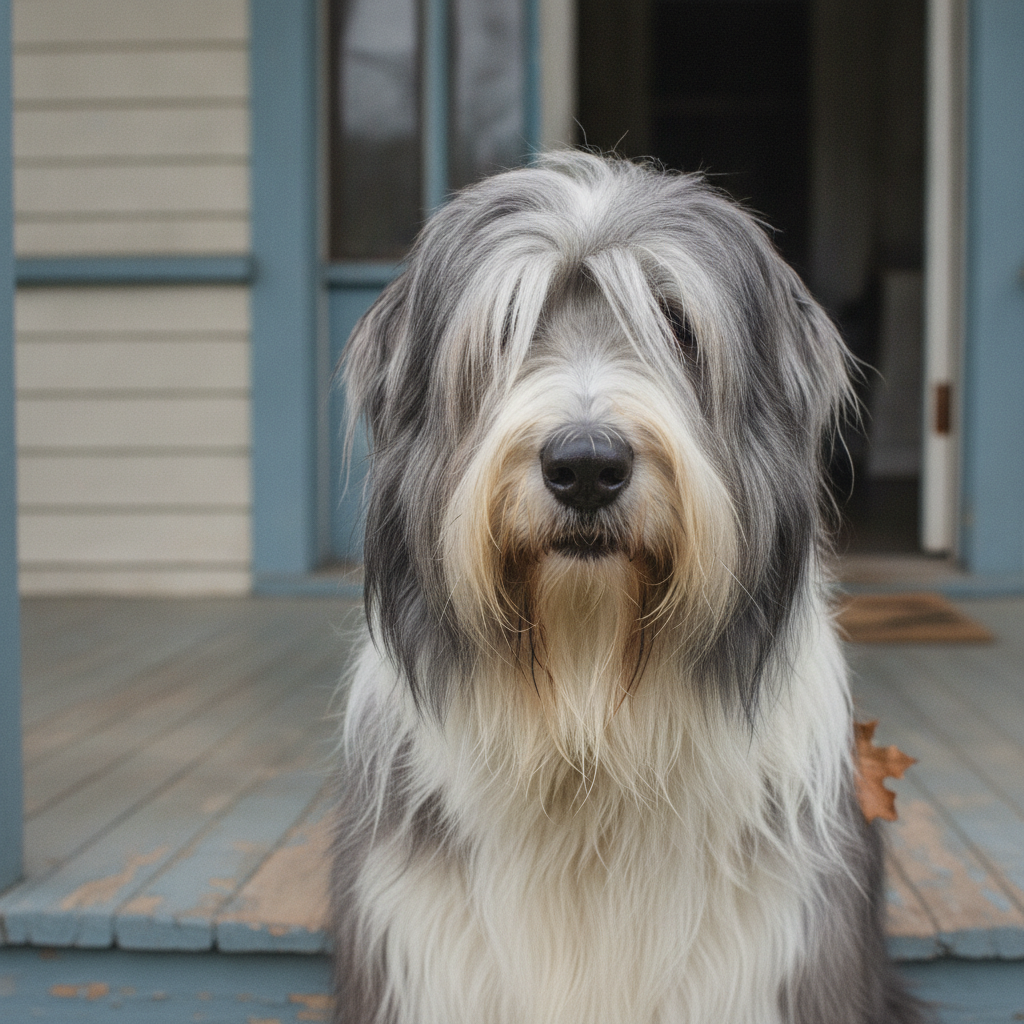
Nobody consults the dog. That is the uncomfortable truth behind the beloved sheepdog mop, the Lhasa’s curtain, the Puli’s cords swinging over the face. The shaggy-bangs look is a human preference, written into some breed standards, the Old English Sheepdog’s calls for a skull well covered with hair, and reinforced every time someone coos over a dog who appears to have no eyes at all.
The dog, meanwhile, is navigating the world through a keyhole.
If you share your home with an Afghan Hound, Bearded Collie, Old English Sheepdog, Havanese, Komondor, Lhasa Apso, Poodle, Puli, or Skye Terrier, the case for trimming the fur that hangs over their eyes is stronger than the case against, and the case against is mostly “but it’s cute.” Here is what the bangs actually cost.
Vision is not optional equipment
A dog’s nose and ears are extraordinary, and it is tempting to assume they simply route around a blocked view. They cannot, not fully. Vision carries information the other senses never will: the flick of another dog’s tail across the park, the hand signal you trained all winter, the skateboard entering stage left. A dog with fur over their eyes is working with a persistent blind spot in every direction, which means more surprises, more startles, and more collisions with the coffee table.
There is a social cost, too, and it is bigger than most people realize. Dog-to-dog communication is heavily visual, a running exchange of posture, eye contact, and facial signals. A dog who cannot see those signals clearly is like a person in a loud bar catching every third word: they miss cues, respond late or wrong, and other dogs notice. For anxious or fearful dogs especially, the world gets scarier when things seem to appear out of nowhere. Clear sightlines are a cheap, permanent anxiety reduction.
“I think of eye fur as a welfare issue wearing a hairstyle costume. When we trim it, people tell me their dog seems younger, more confident, even better behaved, and nothing changed except that the dog can finally see what’s coming,” says Dr. Nina Kohl, a Pet Times veterinary expert.
The physical problems pile up quietly
Beyond the sensory tax, the fur itself is a slow-motion irritant. Long facial hair wicks into the eyes, carrying dust and debris with it. At best that means chronic low-grade discomfort and tear staining. At worst, hairs abrade the cornea or trap moisture and grime that set up an infection, which is painful and can do lasting damage. A dog squinting, pawing at their face, or sporting goopy discharge under the bangs is not having a style moment. They need a trim and, if the eye looks angry, a vet.
Trim the bangs. Spare the whiskers.
Here is the nuance the “just cut it all off” crowd misses: not all facial hair is decoration. The stiff, deep-rooted whiskers on the muzzle, above the eyes, and on the cheeks are sensory instruments, wired to detect air currents and nearby objects, and they feed a dog real information, especially up close and in dim light. Your target is the soft coat hair flopping over the eyes, not the vibrissae. Trim the curtain, keep the antennae.
The practical rules for a DIY trim are short: use blunt-tipped scissors, never pointed ones, near a face. Work with a calm, well-anchored dog, ideally with a second person steadying the head. Comb the fur forward, trim conservatively, and stop the moment your dog gets squirmy; you can always finish tomorrow. If your dog will not hold still, or the mats near the eyes have gotten dense, hand the job to a professional groomer rather than gambling with scissors at eyeball range. And if scissors anywhere near the face are a nonstarter, a topknot or soft band that lifts the hair away does the job without a single snip.
For show dogs, the breed standard is the breed standard, and handlers manage around it. For the other 99 percent of shaggy dogs, whose only judging panel is the neighborhood squirrels, there is no ribbon on the line. There is just a dog who would like to see the ball you keep pretending to throw.
What newer research adds
The foundational science here has held up well: veterinary ophthalmology’s classic account of canine vision established that dogs, while built for motion detection and dim light rather than fine detail, depend on sight far more than the “dogs just smell everything” folklore suggests, particularly for reading movement and body language at a distance. More recent attention in veterinary behavior circles has focused on the flip side, how sensory restriction feeds reactivity: a dog who is repeatedly startled by things they could not see coming rehearses a startle-first response. Groomers and behavior professionals increasingly treat face trims on drop-coated breeds as a standard welfare recommendation rather than a style choice, right alongside nail length and mat prevention.
None of this requires new equipment or money. It requires scissors, five calm minutes, and the willingness to prioritize your dog’s eyesight over your Instagram grid.