Does your dog fall apart when you leave? The crying, the shaking, the shredded couch cushion or the puddle by the door? Now here’s the part that surprises people: watch closely and you’ll notice the meltdown often starts before you leave. Before you even touch the doorknob. It kicks in while you’re brushing your teeth, lacing your shoes, or rummaging for your keys.
That’s not a coincidence, and it’s the key to fixing the whole thing. Dogs are relentless observers, and their favorite subject is you, which makes sense given that you control when they eat, when they go out, and for how long. Over time, an anxious dog notices the small rituals that reliably come right before you disappear. Those rituals become pre-departure cues, and to a dog with separation distress, each one is a rung on a ladder of dread. The leaving isn’t the trigger. The countdown to it is.
Why the ritual matters more than the exit
Almost anything can become a pre-departure cue if you do it consistently before heading out. Gathering your things, organizing what you’re taking, a specific jingle of keys, all of it can quietly tip your dog off, including the stuff you do on autopilot without noticing.
These cues only become a problem when they set off stress behavior: salivating, panting, pacing, whining, barking, trembling. It’s tempting to wave those off as minor when you first spot them, but think of your dog as a wind-up toy. The longer they stew in those stress behaviors before you go, the tighter the spring gets. Then the door clicks shut, the key releases, and all that pent-up anxiety explodes across your house as nonstop barking or a demolished sofa.
And it compounds. If your dog had a single pre-departure cue, they’d wind up a little. But you probably run through a whole sequence of them, so your dog may be tracking five, or even ten. Each one stacks more tension onto the next, and the actual moment you walk out lands that much harder. In the worst cases, dogs hurt themselves trying to escape the feeling, chewing at doors or throwing themselves at windows.
“Owners almost always describe the problem as ‘he loses it when I leave,’” says Dr. Nina Kohl. “But if you film it, the arousal is already high while they’re standing at the closet picking a jacket. The dog has basically pre-loaded the panic. That’s actually hopeful news, because it means there are a dozen small moments before the door where we can intervene.”
Step one: find your dog’s cues
You can’t defuse a trigger you haven’t named, so start by making a list of everything you do before you leave the house. Then go through it and figure out which items actually get a reaction out of your dog, and here’s the crucial part: test them one at a time, not in your normal order. Run them in sequence and you’ll never know which individual action is doing the damage.
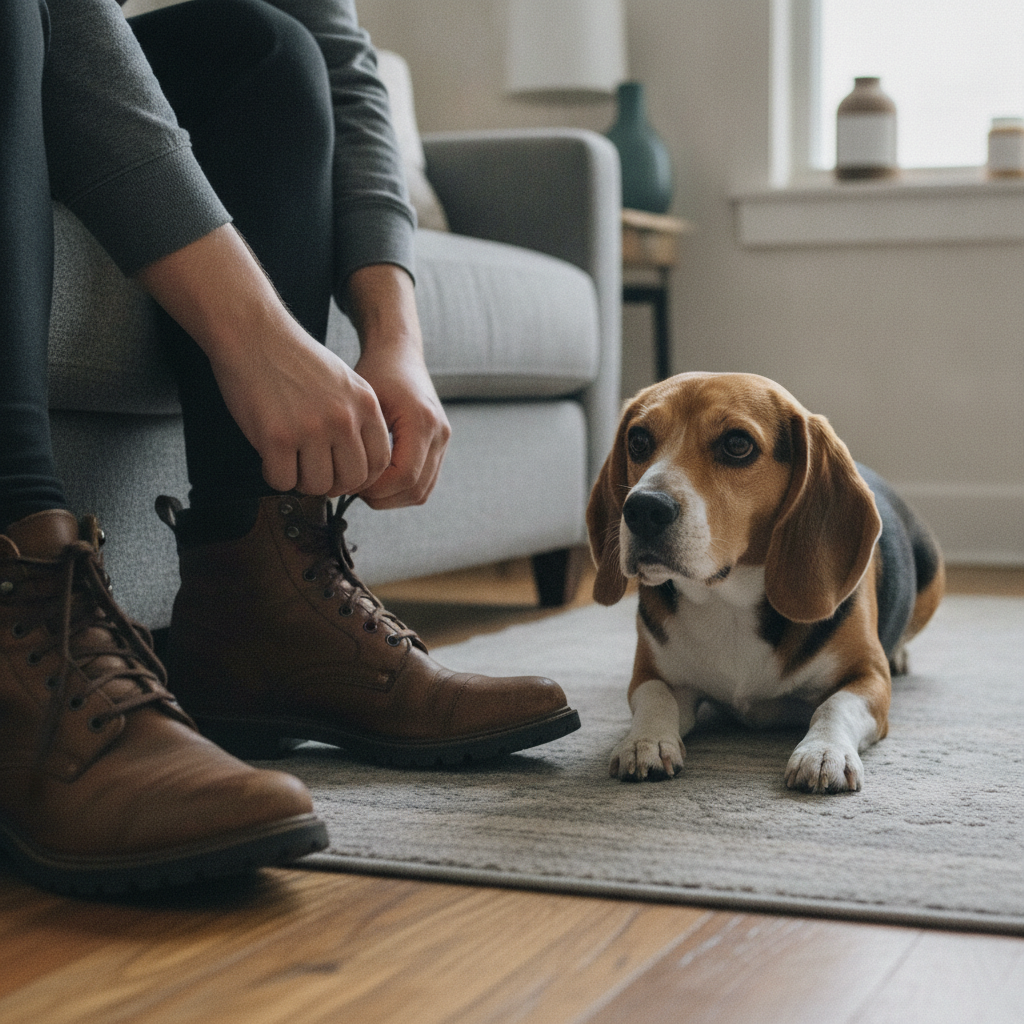
You’ll often need to break a single “task” into smaller pieces to find the real trigger. Putting on your shoes looks like one thing, but it’s really a chain: sitting down, reaching for the shoes, touching them, sliding your foot in, tying the laces. Any one of those links could be the one that flips the switch. To know for sure, you have to watch your dog through every step. The moment you catch them reacting, stop. Let them come back down, then reset and repeat the action only up to that point, over and over, until it stops meaning anything.
Done right, and practiced in short bursts throughout the day, most dogs stop caring about a given action after a day or two. Then you push a little deeper into the task until you reach the next spot that sets them off, and repeat the process there. Once you’ve cleared your whole list, keep sprinkling those actions into ordinary moments at random so they never regain their old power.
Step two: teach “alone” itself
Here’s the thing the cues can’t fix on their own. The reason any of this has power is that your dog feels bad about being left. Which means the cues are only half the job; to really move the needle you have to work directly on the being-alone part, using the same desensitizing logic.
Start absurdly small. Walk toward the door, then come right back. If your dog stays relaxed, put your hand on the knob, then turn it, then open the door, building up piece by piece. The instant your dog reacts at any stage, stop, let them settle, and try again. Eventually you’ll be able to step outside and close the door behind you. Stay out for ten seconds, then twenty, then thirty, always coming back before your dog starts to unravel. Push too long and trigger a meltdown, and you’ll have to back up a step or two to recover the ground.
Expect a short attention span. You might get five good minutes before the practice itself becomes stressful, so a single marathon session is the wrong approach. Break it up: a few short reps of three to five minutes, scattered three or four times across the day, works far better. This is slow work, and rushing it backfires.
What not to do
Managing separation issues is genuinely frustrating, but a few well-meaning instincts make it worse:
- Don’t punish the aftermath. Coming home to a chewed shoe or a torn cushion is maddening, but punishment stacks more fear onto a dog who’s already drowning in it, and makes the next departure harder, not easier.
- Don’t just crate them and call it solved. A crate can help a dog feel secure, but feeling safe in a crate and feeling okay about being alone are two different projects. Trying to force both at once tends to overload the dog.
- Keep your comings and goings boring. A big emotional goodbye or a joyful reunion pours fuel on the anxiety. That may mean building extra time into your morning so you can leave calmly instead of tearing around in a last-minute frenzy that winds your dog up too.
- Skip the pre-exit walk and cuddle. It feels kind, but exercise and affection are stimulating, and leaving right after you’ve revved your dog up can supercharge the anxiety. Let them settle first.
- Don’t hand over food as you walk out. It seems like a nice distraction, but the evidence is that food-based counterconditioning doesn’t do much for separation-related behavior, and a treat delivered at departure can actually sharpen your dog’s anticipation of you leaving.
When to bring in a pro
Don’t treat professional help as the last resort. Separation problems are complicated, easy to misdiagnose, and can genuinely make an owner feel like a prisoner in their own house, afraid to run an errand. A skilled trainer or veterinary behaviorist can watch your dog in ways you can’t and tailor a plan you’d never think of. Just as important, they can tell you whether it’s really separation anxiety at all, because what looks like it is sometimes something else entirely, and a simple change to the dog’s environment turns out to be the fix. Training can be a real expense, but it’s an investment in your dog’s wellbeing and your own sanity.
What newer research adds
The modern approach to separation training leans hard on one idea: keep the dog under threshold. Rather than white-knuckling through long absences, current methods (the graduated-absence protocols popularized by separation-anxiety specialists) build tolerance in tiny, always-successful increments, exactly the ten-seconds-then-twenty logic above. The consensus has also moved away from stuffing a food puzzle at the door as a cure, since that treats the symptom while sometimes heightening the very anticipation you’re trying to calm. And for dogs whose anxiety is severe, behaviorists increasingly pair this training with veterinary support, including anti-anxiety medication, not as a shortcut but because a brain flooded with panic can’t learn. If your dog is in that category, medication plus training tends to work far better than training alone.
The bottom line
Your dog isn’t being dramatic when they start shaking at the sight of your shoes. They’re reading a countdown you didn’t know you were broadcasting. Find the cues, defuse them one at a time, teach the being-alone part in tiny doses, keep your exits dull, and get help early. It’s slow, unglamorous work, but it’s how a dog learns that the keys don’t have to mean the end of the world.
References
- American Society for the Prevention of Cruelty to Animals. “Separation Anxiety.” aspca.org
- de Assis, L. S., et al. “Developing Diagnostic Frameworks in Companion Animal Behavioral Medicine: Separation-Related Problems in Dogs.” Frontiers in Veterinary Science, 2020. ncbi.nlm.nih.gov
- Sargisson, R. J. “Canine Separation Anxiety: Strategies for Treatment and Management.” Veterinary Medicine: Research and Reports, 2014. ncbi.nlm.nih.gov