Nobody tells you that the single most damaging thing you can do to a pet stain is treat it like a normal mess. You get out the steam cleaner. You reach for the all-purpose spray under the sink. You scrub. And in doing all of that, you take a stain that would have lifted in ten minutes and set it into the carpet for the life of the carpet.
The urgency advice you have heard is right. Professional cleaners treat pet accidents as time-critical, and the longer a mess sits, the deeper it grabs into fiber. But urgency without order is how good rugs die. Speed matters less than sequence.
Here is the sequence, plus the two mistakes that undo everything else.
Paw prints and drool are not stains. Treat them differently.
Start by separating the easy category from the hard one, because the products are not interchangeable.
Muddy prints and dried slobber are grime plus body oil. A pad is essentially a foot, and it leaves the same oily film your bare feet leave on a floor. Acid handles oil, which is why a simple 1:1 mix of white vinegar and water in a spray bottle, wiped up with a microfiber cloth, clears prints and drool on hard surfaces without any special product at all.
Two caveats. Plenty of pets loathe the smell of vinegar, and if yours flees the room every time you spray, a very dilute castile soap solution, roughly one part soap to ten parts water, does the same job. And keep vinegar off unsealed natural stone and waxed hardwood, where the acid can dull the finish over time.
That is the whole protocol for the easy category. Everything below is for the messes that came out of your pet.
Mistake one: you brought heat
This is the big one, and it is the reason so many people end up convinced their carpet is simply ruined.
Urine, vomit, and feces are protein-based. Protein denatures with heat, which is a scientific way of saying it cooks and bonds. Consumer steam cleaners operate around 90 to 100°C. Protein starts reacting destructively somewhere around 65°C. Run a steamer over an untreated accident and you are not lifting the stain, you are searing it into the fiber, along with the uric acid that carries the smell.
Hot water from the tap is milder but the same principle. A warm room during a slow dry-out is fine. Applied heat is not.
There is a second, sneakier version of this mistake: heat also kills the thing you are about to use. Enzymatic cleaners work because they contain live, active enzymes. Hot water, a steamer, or a blast from a hair dryer denatures those enzymes just as efficiently as it denatures the stain. You can neutralize a fifteen-dollar bottle of product with a thirty-second shortcut.
Heat comes at the end, if ever. Never at the start.
Mistake two: you grabbed the wrong bottle
Look at what is under most people’s sinks and you will find a general-purpose spray, and very often an ammonia-based glass or floor cleaner. Both are wrong here, and one of them is actively counterproductive.
Ammonia is one of the principal breakdown products of urine. To your dog or cat, an ammonia-cleaned spot does not smell clean, it smells like a fresh territorial marker from some other animal. You are not erasing the message. You are underlining it, and then acting surprised when they re-offend on the same square foot of rug.
Bleach is not the answer either. Chlorine bleach can bond with the proteins in the mess and set the stain, and mixing it with a residue that is quietly outgassing ammonia is a genuinely bad idea in an enclosed room.
What you want instead is something that breaks the uric acid apart at the molecular level. Uric acid crystals are the reason a spot that looks and smells fine on a dry day comes roaring back the first humid week of summer. They are not water-soluble in any useful way. They have to be dismantled.
“The stain is the part you can see, and it’s the part people fix. The uric acid underneath is the part your pet can still smell six months later, and that’s the part that makes them go back,” says Dr. Priya Nair. “If your dog keeps returning to one corner of the rug, the corner is still talking to them.”
Two product classes do that work. Enzymatic cleaners use proteases and other enzymes to chew the molecules apart. Oxidizing cleaners, the hydrogen-peroxide family, break them apart chemically instead. Both work, and which one wins depends more on the surface and the age of the spot than on the marketing.
The order that actually works
- Get every bit of the mess off the surface first. Pick up the solids, then blot, never scrub, and keep blotting until a fresh towel comes away clean. Scrubbing drives material sideways into fiber and widens the stain. Most cleaning products need a reasonably dry surface to bind to, so this step is not optional prep, it is the step that makes the next one work.
- Apply the cleaner sparingly. This is the counterintuitive part on carpet and upholstery. More product is not more cleaning. Every extra milliliter you soak in is another milliliter you have to pull back out, and residue left behind in padding is its own long-term odor problem. Cover the stain, not the neighborhood around it.
- Let it sit for the time on the label. Enzymes are slow. Thirty to sixty minutes is typical, and rushing it is the most common reason people decide “enzyme cleaners don’t work.”
- Keep it damp while it works. Enzymes need moisture to stay active. If the spot dries out in ten minutes on a hot day, lay a damp towel loosely over it.
- Blot out, air dry. No heat, no dryer, no steamer.
- Repeat if needed. Deep, old, or padding-soaked spots frequently take two or three cycles. That is normal and not a sign of failure.
For a stain you found too late
Dried does not mean lost, but it does change the first move. Lightly re-dampen the spot with cool water and blot up whatever releases, then start the process above. It may take several rounds of dampening and blotting before you have re-hydrated enough of the crystallized material for a cleaner to reach it. Be patient, and keep the heat rule in mind, because a dried bio-stain is exactly the kind of thing people are tempted to attack with a steamer.
Find the ones you don’t know about
This is the step almost nobody takes, and it is the reason a house can smell faintly of cat to every guest while the resident swears they cleaned everything.
Dried urine fluoresces. Turn off the lights, run a UV blacklight over baseboards, rug edges, sofa skirts, and the wall behind the litter box, and old spots glow a pale yellow-green. It is a slightly grim experience the first time. It is also the only reliable way to find the accidents that happened while you were at work, on a surface you never thought to check.
One quirk worth knowing: the light only works on dry urine. A fresh puddle will not glow much, which is fine, because you can see a fresh puddle.
Fur is a prevention problem, not a cleaning problem
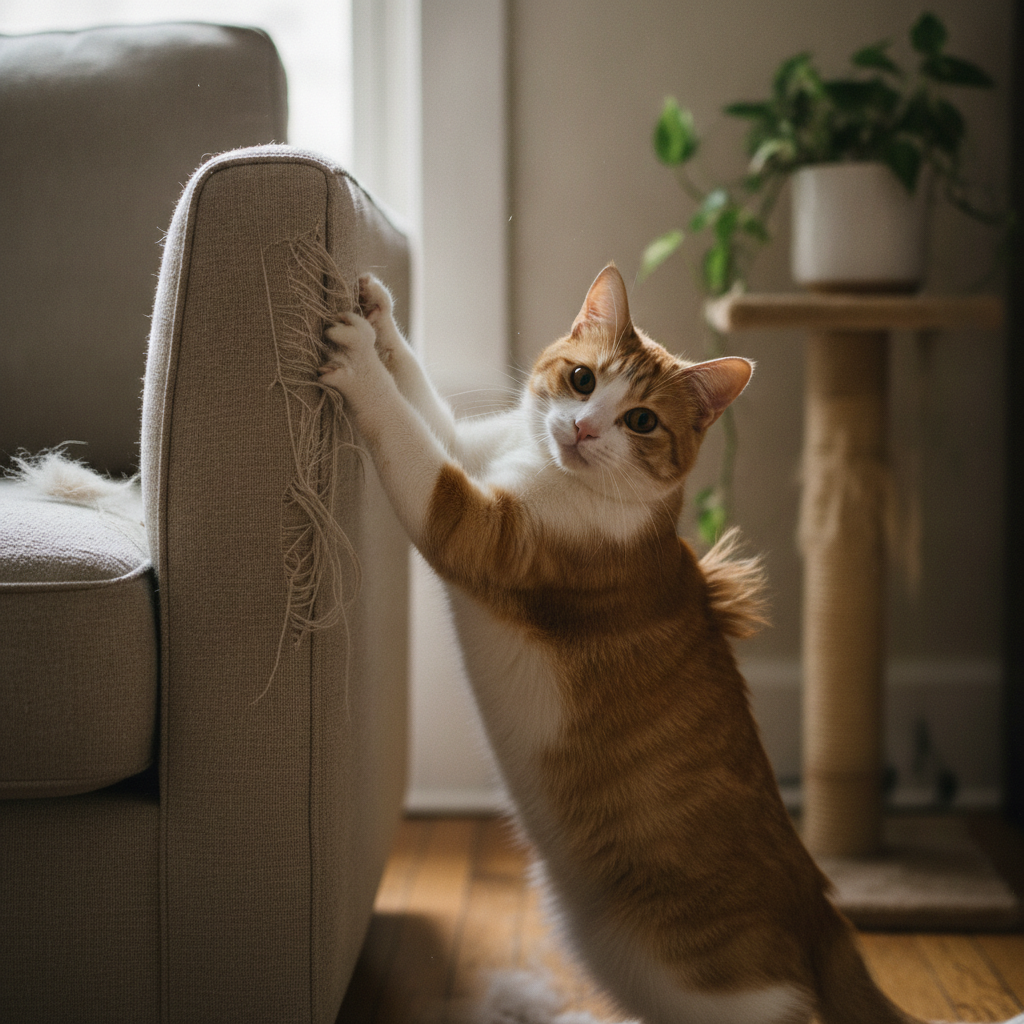
You cannot out-clean a shedding coat, so most of the win here happens before the fur ever hits the floor. Frequent brushing, with a tool that actually reaches the undercoat on a heavy shedder, and frequent vacuuming do the bulk of the work.
For fur that has already knitted itself into a rug or a couch cushion, baking soda earns its reputation. Sprinkle it on, work it into the fibers with your hand, and let it sit twenty minutes. It neutralizes odor, and it also neutralizes the static charge that makes hair cling, so a strong vacuum then pulls the fur up instead of skating over it.
And when you empty the canister, know that pet fur is compostable, and gardeners scatter it around beds as a mild pest deterrent.
The kit, in the order you’ll actually use it
Five things, sequenced the way the job runs: find the mess, kill the smell, target the surface, keep the floor from getting there again, and get the fur off everything. Not seven products. Five.
Step one, find it: a UV blacklight, around $15
Cheapest item here and the one nearly every pet-cleaning kit is missing. A basic UV flashlight lights up dried urine that is otherwise completely invisible, which means it is the only item on this list that helps with the spots you don’t already know about. Everything below is useless on a stain you never found.
Who it is for: anyone whose house smells faintly of pet and who cannot work out from where. Who it is not for: nobody, honestly. It is fifteen dollars.
Step two, kill the smell: Rocco & Roxie Stain & Odor Eliminator, $50
Rocco & Roxie has drawn 4.5 out of 5 stars from more than 100,000 reviewers, and the reviews are about odor, not appearance. Apply it, give it thirty to sixty minutes, and the smell does not get masked, it stops existing. This is your emergency bottle and the one to reach for on a spot you found late.
It is the priciest of the sprays here and the least surface-specific. If you own exactly one bottle, own this one.
Step three, target the surface: Nature’s Miracle
Where Nature’s Miracle beats a generalist is specificity. The cat urine formula and the dog stain and odor formula are not one product in two boxes. The enzyme blends are built for different molecules, and a formula designed around feline uric acid outperforms an all-purpose spray on it, noticeably.
Who it is for: a repeat offender, a known surface, a specific recurring problem. Who it is not for: someone who wants one bottle to do the whole house.
Step four, stop the next one: Biokleen Bac-Out, $12
Biokleen Bac-Out Floor Cleaner is enzyme-fueled and citrus-scented, and it is here for hardwood in particular, where reviewers consistently report it leaves no streaky film. It is not an emergency product. It is what you mop with on an ordinary Tuesday, so that fewer Tuesdays turn into emergencies.
Step five, the fur: Dyson V15 Detect, $677
The Dyson V15 Detect is an absurd amount of money for a vacuum, and it earns a place on a pet list for one reason: the laser head rakes a low green light across the floor and reveals fur and dander that are genuinely invisible under normal lighting. Notice that this is the same trick as the blacklight, applied to a different problem.
The use case is not your Tuesday clean. It is the pass you make before a guest with a cat allergy walks in. Who it is not for: anyone whose shedding is a weekly annoyance rather than a daily fact. A good corded upright is fine.
What newer testing adds
The enzyme-cleaner consensus has been quietly complicated. When Consumer Reports ran pet stain and odor sprays through controlled testing, the best overall performer was not an enzymatic formula at all, but an oxidizer, the hydrogen-peroxide class of cleaner. Oxidizers break the same molecules apart chemically rather than biologically, and they do it faster, without a dwell time and without the fragility that makes enzymes so easy to accidentally kill.
This does not make enzyme cleaners bad. They remain excellent, and they are gentler on more surfaces. But it does mean the reflexive advice, that an enzymatic cleaner is the only thing that works, is out of date. If enzymes have failed you twice on the same spot, an oxidizer is a reasonable next move rather than a compromise. Spot-test it first, because peroxide can lighten some dyes.
The other thing worth updating: if your pet is suddenly having accidents in a house where they never did, no cleaner is the fix. Repeated indoor urination in a previously reliable adult pet is a medical flag, not a housekeeping one, and it is worth a vet visit before it is worth another bottle.
References
- Consumer Reports. “The Best Spray for Tackling Pet Stains and Odors Is Not an Enzyme Cleaner.” Consumer Reports, 2025.
- American Society for the Prevention of Cruelty to Animals. “Urine Marking in Cats.” ASPCA Behavior Resources.
- American Veterinary Medical Association. “Household Hazards.” AVMA Pet Owner Resources.
- U.S. Consumer Product Safety Commission. “The Cleaning Product Combination That Can Hurt You” (on mixing bleach with ammonia). CPSC Safety Education.