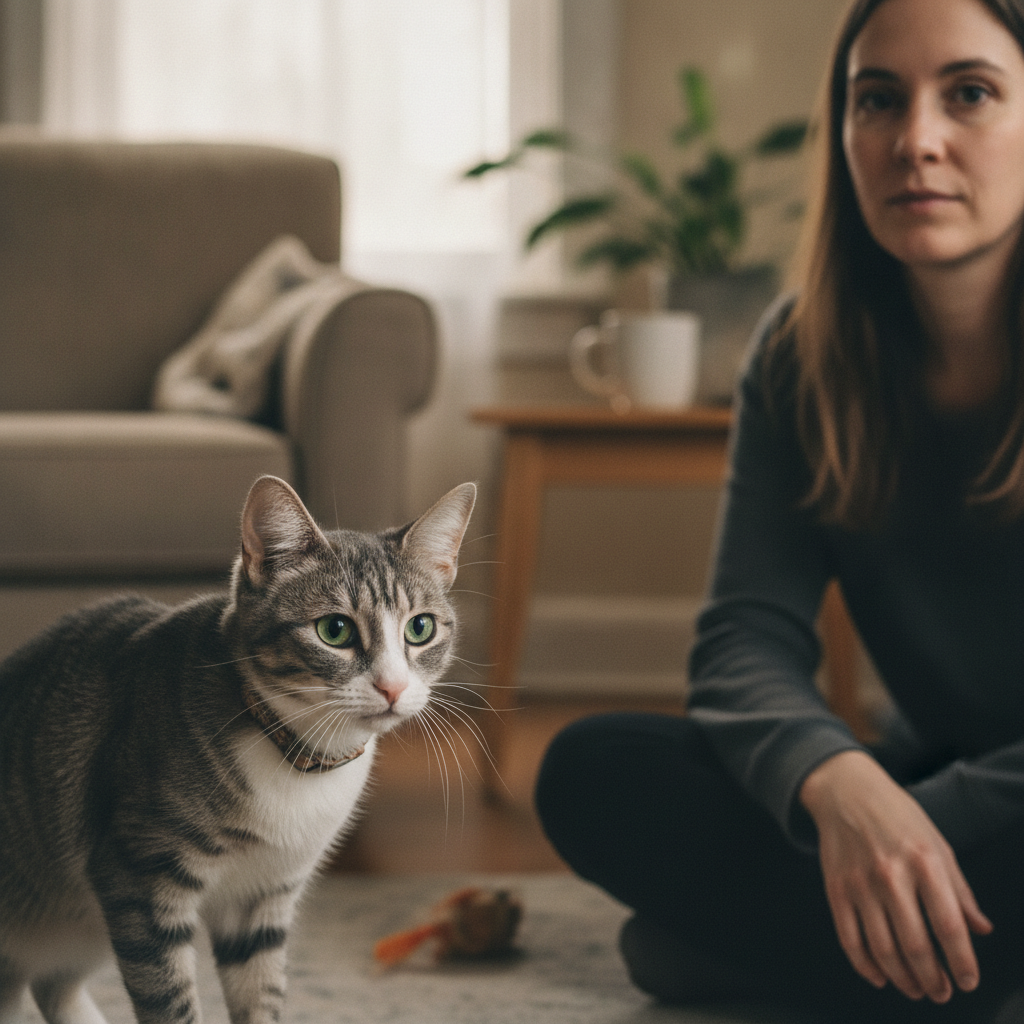
Bring a new cat home and you may spend the first week wondering if you adopted a piece of furniture that occasionally eats. They watch you from the top of the bookshelf. They vanish when you enter a room. They accept a chin scratch, then look faintly betrayed about it. It is easy to read all of this as a cat who does not care.
They care. What they are doing is running a background check on you, and the good news is that the results are usually in your favor.
Trust is not a mood. It’s an attachment bond you can measure.
For years the story about cats was that they tolerate us at best. Then researchers at Oregon State University ran cats through a version of the “strange situation” test, the same protocol used since the 1970s to measure the bond between human infants and their parents. A cat and owner spend time together in a room, the owner leaves, and the cat’s reaction when they return is what counts. A securely attached cat greets the owner and then relaxes back into exploring, using the person as a home base. An insecure cat clings, or bolts and hides.
The result was striking. Across 108 cats, 65.8 percent were securely attached to their owners. That figure is almost identical to the roughly 65 percent secure-attachment rate found in human infants. Your cat is not a mystery running on a different operating system. They form the same kind of bond a baby forms with a parent, and most of them form the secure version.
That reframes the whole project. You are not trying to win over an alien. You are trying to become the reliable, safe home base a cat is already wired to look for. And you do that with two currencies cats actually value: predictability and choice.
Currency one: be boringly predictable
Cats are not fans of surprises. Stability is what tells a cat’s nervous system that the environment is safe, and a safe environment is the soil trust grows in.
Predictability is smaller and more literal than it sounds. If you usually walk past while your cat is eating, keep walking; do not suddenly stop to scoop them up mid-meal. If your cat likes to hop into your lap when you sit down, let that be their move to make rather than lifting them there yourself. Feed at consistent times. Keep your voice and your movements on the calm, even setting. None of this is dramatic, and that is exactly the point. A cat who can predict what you will do next does not have to stay on guard, and a cat who is not on guard can start to relax into liking you.
Currency two: give them the choice
The single most common way people accidentally lose a cat’s trust is by removing the cat’s sense of control. Charging across the room, cornering, and picking up a cat who did not ask to be held all say the same thing: your body is not yours to command right now. That is expensive.
Let the cat make the first move, every time. Sit down and let them come to you. Offer a hand and let them decide whether to rub against it. Go at their pace on petting, and stop while they still want more rather than pushing to the point of a warning swat. Counterintuitively, the less you reach for a cat, the faster they tend to come to you, because you have proven you are safe to approach.
Choice also means exits. Give your cat places they can retreat to and be guaranteed not to be disturbed: a high shelf, a cat tree, a covered bed, a cardboard box in a quiet corner. Knowing they can always leave a situation is a huge part of what lets a cat choose to stay in it.
Build tiny good experiences on a loop
Trust is the sum of positive experiences minus the negative ones, so stack the positives. Short daily play sessions are one of the best trust-builders there is; use a wand toy or something that moves so your cat can chase, stalk, and pounce, and let them actually “catch” it often enough that the game feels like winning rather than teasing. Treats given by hand, or tossed near you, teach a cat that your presence predicts good things.
Training belongs here too, and not just for dogs. When a cat learns that offering a behavior on cue earns a reward, they are learning that interacting with you is safe and pays well. Simple targeting, teaching a cat to touch their nose to your finger or a stick, is an easy first win that turns handling into a cooperative game. Even nail trims and medication get easier once a cat trusts the hands doing them.
Learn to read the “no”
A cat is telling you how an interaction is going the entire time, in their ears, eyes, tail, and posture. A cat who is loose, blinking slowly, and leaning in is enjoying themselves. A cat whose ears are swiveling back, whose tail is twitching or thumping, whose skin is rippling, or who has gone still and tense is asking you to stop.
Honoring that request is not a failure. It is the whole game. Every time you notice a cat is uncomfortable and you back off before they have to escalate to a hiss or a swat, you make a small deposit in the trust account. Every time you push through the warning signs, you make a withdrawal. Cats keep meticulous books.
Protect the trust you’ve built
Winning a cat’s confidence the first time is far less work than repairing it once you’ve lost it, so play defense. Do not startle your cat, corner them, or pick them up if you know they hate it. Give them privacy in vulnerable moments; a cat who gets ambushed while using the litter box may start associating the box, or the room, with danger, and litter box problems often follow. Introduce new people, pets, and changes slowly and with escape routes available.
If you do break trust, whether by accident or through something out of your control like a vet visit, you rebuild it the same way you built it in the first place: predictability, choice, and a steady drip of good experiences. Cats are not grudge-holders so much as evidence-gatherers. Give them better evidence.
What newer research adds
Two findings from the last few years are worth folding into how you approach a new cat. The first is the attachment science above: the 2019 Oregon State work showing most cats form secure bonds, and that those bonds look developmentally like the ones babies form. It means a standoffish cat is not necessarily an unbonded one; even shy cats in the study were often securely attached, they just showed it quietly.
The second is about a signal you can send today. A 2020 study out of the University of Sussex found that when people slow-blinked at cats, the cats were more likely to slow-blink back, and were more likely to approach a stranger who slow-blinked than one with a neutral face. The researchers described it as something close to a feline smile. It costs nothing, it works on cats you have just met, and it is one of the few trust gestures a cat clearly reciprocates.
“People treat a new cat’s distance as rejection, and it’s almost never that,” says Dr. Nina Kohl. “It’s a cat gathering evidence about whether you’re safe and predictable. Stop trying to speed it up with affection they didn’t ask for. Feed on schedule, let them approach you, and give them a spot they’re never dragged out of. You’ll usually find the aloof cat was just waiting for proof.”
Give a new cat a quiet room, a routine they can count on, and the freedom to decide when to close the distance, and most of them will. The background check almost always clears.
References
- Vitale, K. R., Behnke, A. C., & Udell, M. A. R. (2019). Attachment bonds between domestic cats and humans. Current Biology, 29(18), R864–R865.
- Humphrey, T., Proops, L., Forman, J., Spooner, R., & McComb, K. (2020). The role of cat eye narrowing movements in cat–human communication. Scientific Reports, 10, 16503.
- Oregon State University. (2019). Cats, like children and dogs, develop attachments to their caregivers, study shows.