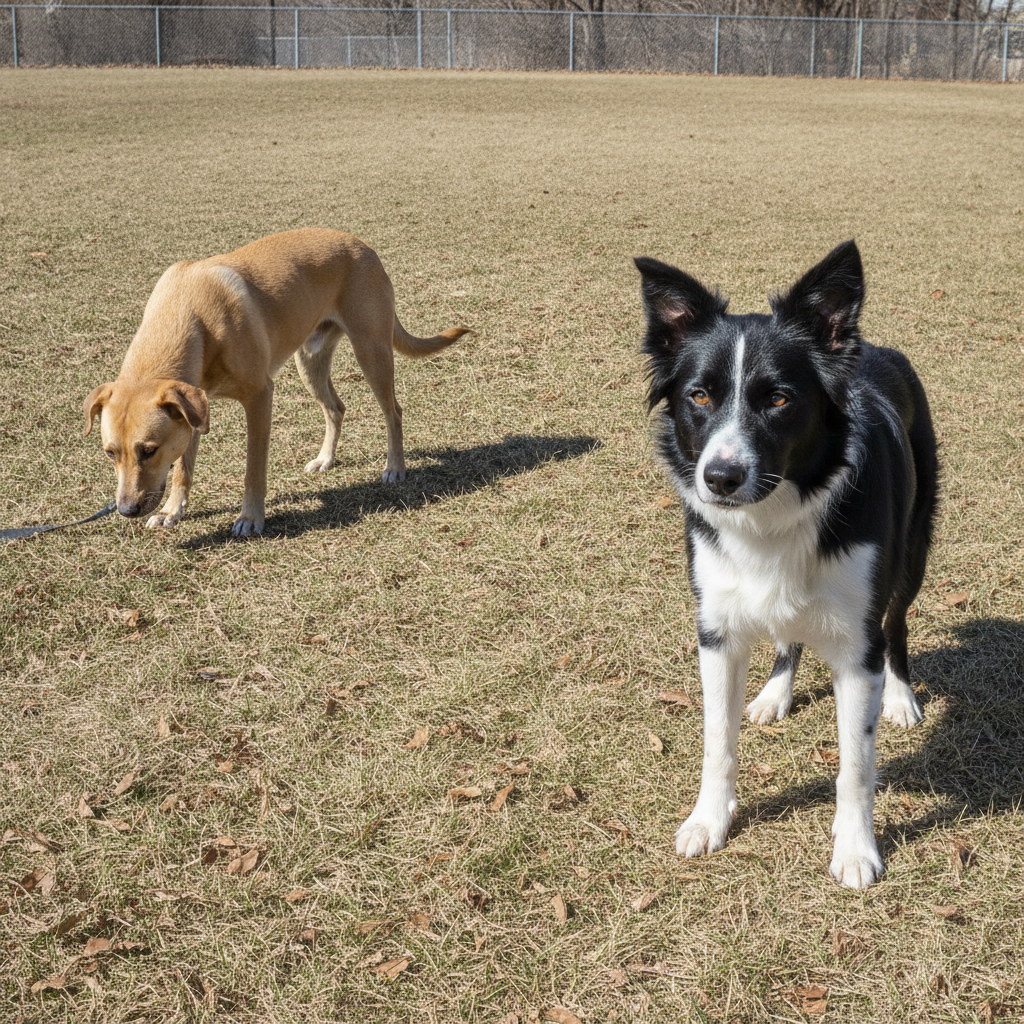
Every dog owner who has watched their sweet, biddable dog transform into a snarling gargoyle at the sight of one specific neighbor dog eventually arrives at the same theory. Usually it arrives at 11 p.m., mid-search-spiral: he only does this to intact males. And once you see it, you cannot unsee it. It feels like a pattern, and the pattern feels almost Freudian.
There is a real phenomenon in there, and dog owners have been swapping notes about it in forums for years. But when you put the theory to behavior specialists, the interesting thing is not that they confirm it. It is what they replace it with, which is duller, less flattering to our dogs, and considerably more useful.
Start with what dogs can actually smell
The premise is sound, at least. Dogs almost certainly can tell.
On top of the ordinary sense of smell they use for everything we can smell (and a great deal we cannot), dogs have a vomeronasal organ, a separate chemical-detection system wired more directly into the emotional parts of the brain. It is what a male dog uses to read a female in heat, whose pheromones set off a whole cascade of physiological preparation in both animals. Intact dogs, male and female, release compounds that altered dogs do not, and any dog should be able to register that as different, or new.
So your dog is reading something real off the dog across the street. What he is doing with the information is where the story gets less romantic.
The theory that does not survive contact
If hormones alone explained the outburst, then neutered dogs would reliably dislike intact ones. They do not. Behavior specialists describe this as an uncommon pattern rather than a rule, something they hear about from daycare staff and owners more often than they see as a persistent behavior. Plenty of households run a neutered dog and an intact dog side by side without incident, and most neutered dogs pass intact dogs on the sidewalk with no more than a polite investigation.
Which means the intact status is not doing the work. It is a correlation your dog has stumbled into, and there are three better explanations underneath.
1. It is not what he is. It is what he’s doing
This is the explanation the specialists reach for first, and it is the one owners resist hardest, because it means the villain of our story is boring.
Intact male dogs are, statistically, more likely to come at another dog with a stiff, forward, staring posture. They are also more likely to be young, or under-socialized, or belong to someone who has not done much leash work. Your dog is not reacting to a hormone profile. He is reacting to a dog who went rigid, or barked first, or came in too fast and too hard.
Body language is the whole conversation, and it is the part we routinely fail to watch because we are busy watching the outcome.
2. He remembers something you don’t
Dogs carry their histories the same way we do, and a bad experience can shape a preference for years. If a dog was attacked, startled, or hurt around a dog of a particular type, that type becomes a category worth avoiding. It does not have to have been an intact dog. It has to have been a dog who looked or moved like the one in front of him now: same size, same color, same forward, bristling posture.
Adopters especially should hold this loosely, because you often have no record of the first year or two of your dog’s life. The reaction is real even when the memory is invisible to you.
3. Unaltered dogs are simply unfamiliar
Here is the sleeper explanation, and the one that best fits the specific facts of the situation. In the United States, most pet dogs are neutered. Which means most dogs your dog meets are neutered, and an intact dog is genuinely novel: a smell profile your dog has encountered rarely, attached to a body language he has less practice reading.
Unfamiliarity produces uncertainty, and uncertainty in animals very often comes out as defensive behavior. Your dog is not enraged. He is out of his depth, and his way of managing that is to make a great deal of noise until the confusing thing goes away, which it eventually does, which teaches him that the noise worked.
“When a dog reacts to only one category of dog, owners want it to mean something about that category,” says Dr. Lena Park. “Nine times out of ten it means something about novelty. Dogs who rarely meet intact dogs have not learned how to read one, and a dog who cannot read the room defaults to bluster.”
So do you need to do something about it?
Yes, and gently.
Aggression between dogs is never a good outcome, and the honest position is that it should be avoided and, where possible, modified. But there is a real limit to how much we can referee interactions between two animals whose communication system we can only partly perceive. We are not dogs. We are guessing at what they are picking up on.
That argues for humility about why and firmness about what:
- Manage the distance. Do not walk your dog into the encounter to prove a point. Cross the street, add space, and let him observe from a distance at which he can still think.
- Do not let it rehearse. A reaction that gets to run its course every time gets stronger. The other dog walking away after 45 seconds of barking is, to your dog, a triumph.
- Change the association, don’t suppress the noise. Treats the moment the other dog appears, before your dog reacts, and then out of sight, out of treats. You are teaching him that intact dogs predict good things, not that barking is forbidden.
- Widen his sample size. If the problem is novelty, calm, distant exposure to more intact dogs is the cure. Ask a friend with a well-socialized intact dog for parallel walks.
- Watch the whole picture, not the label. Read each situation for what it is, rather than filing every encounter as always-safe or always-dangerous. Our dogs cannot tell us, and it is our job to be watching.
The grudge theory makes for a better story. But your dog is not carrying an ideological objection to other dogs’ anatomy. He is telling you, loudly, that he does not know what to do with the dog in front of him, and that is a problem with a training answer rather than a psychoanalytic one.
References
- Salazar, I., et al. “The vomeronasal organ of the dog: anatomical and functional considerations.” Journal of Anatomy, vol. 223, no. 1, 2013.
- Bradshaw, J.W.S., et al. “Dominance in domestic dogs: useful construct or bad habit?” Journal of Veterinary Behavior, vol. 4, no. 3, 2009, pp. 135-144.
- American College of Veterinary Behaviorists. “Aggression Toward Other Dogs.” ACVB Client Resources, 2024.
- Casey, R.A., et al. “Human directed aggression in domestic dogs: Occurrence in different contexts and risk factors.” Applied Animal Behaviour Science, vol. 152, 2014, pp. 52-63.