Most dog trainers will tell you that a little showmanship keeps a class engaged. Jeff Jenkins has more to draw on than most: before he was teaching free Pit Bull classes in Chicago, he spent years as a Ringling Brothers clown. It shows. He can turn a blown trick into a bit, and a bit into a lesson, in front of a crowd of strangers who came to laugh and leave having learned something. When he isn’t running those neighborhood classes, he’s the ringmaster and co-founder of Midnight Circus in the Parks, the traveling big top he and his wife, performer Julie Greenberg, built to raise money for Chicago’s parks and, in the process, its communities.
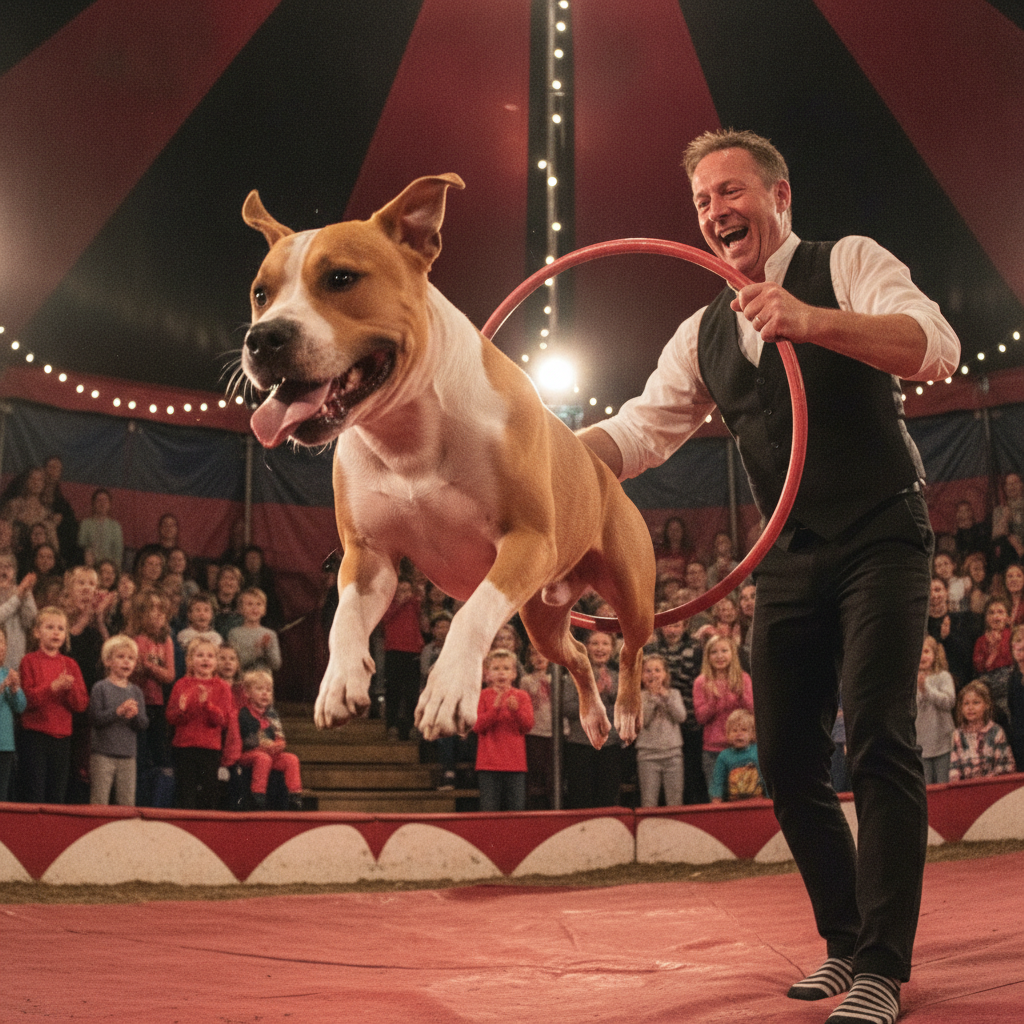
The circus has real stars, aerialists and contortionists and musicians, but two of the biggest are Jenkins’s own rescue Pit Bulls, who quite literally leap through hoops under what he calls the Little Big Top. That’s the hook. What Jenkins is actually doing is harder to fit on a marquee.
The trick is a Trojan horse
Jenkins figured out something a public-service announcement can’t buy: a well-behaved dog you meet in person beats a thousand you scroll past. A kid who sees a polite, funny, hoop-jumping Pittie at their own neighborhood park, six inches away, chomping popcorn that spilled into the ring, walks away with a different mental picture of the breed than any TV segment could paint. The comedy does the persuading. He’ll pretend to chase a “naughty” dog around the ring, or send one squeezing through hoops that shrink until the trick seems impossible, or jump rope alongside her while the crowd loses it.
Not every show goes smoothly, and the rough ones are often the most telling. He remembers a performance where a large group of kids was having a blast until the Pit Bulls came out and dozens of them bolted from the tent, terrified. A few scared children is normal; the dogs they know are rarely socialized. That many was not. So he slowed the whole act down, repeated the tricks with zero pressure, and afterward tracked some of the kids down to tell them the dog was friendly but would slobber all over them if they gave her a treat. That got the laugh, and the fear cracked.
Junebug and Rosie Rae
The stars didn’t come from a breeder. Jenkins met Junebug while teaching obedience for the Humane Society’s End Dogfighting campaign. A kid in Englewood, one of the tougher pockets of the city’s South Side, had turned up to class with his young Pittie, a dog who was clearly loved but just as clearly not being cared for. So Jenkins struck a deal: he’d take the puppy in, and the boy would sign on as his training assistant. When the circus finally performed in Englewood in 2014, Junebug’s return was a kind of homecoming, proof to the neighborhood that their own dogs could be this calm and this trained.
Rosie Rae, who came home from Chicago Animal Care and Control after what was supposed to be a look-only visit, was a tougher student. One hoop, fine. But the jump rope sent her running, and Jenkins had to inch forward, knowing that pushing too hard would give him a dog who’d perform in practice and freeze at a show. The secret, he says, is that the dog has to be having the time of her life. More recently, two new Pitties, Rickie and Bobbie, joined the roster and started learning the repertoire.
What the science says about the fear
Jenkins is selling in person what the research backs up on paper. A widely cited 2022 study found that less than 10 percent of a given dog’s behavior traces back to breed at all, a finding that quietly demolishes the logic behind judging, or legislating against, a dog by its silhouette.
“Breed tells you almost nothing about the dog in front of you,” says Dr. Nina Kohl. “It’s a rough guide to size and coat and not much else when it comes to temperament. What actually shapes how a dog behaves is early socialization, training, and how they’ve been treated, which is exactly why the same ‘scary’ breed can produce a therapy dog and a circus performer. Judge the individual, not the outline.”
Two worlds, one goal
Jenkins’s leap from Ringling to the Humane Society, which had spent years suing his old employer, ruffled some of his circus family. But he came to see the two worlds as less opposed than they looked. Both, he figures, are really about reaching people, using animals to connect across differences of culture and circumstance, especially with folks who don’t have many resources or much reason to trust an outsider. Help the people, and the dogs get helped too.
What’s new
Midnight Circus is still touring Chicago’s parks. In 2025 it brought the big top to a run of neighborhood parks, though tighter budgets pushed the show back to its original Welles Park home for part of the season. Since 2007, the circus has raised close to $2 million for Chicago Park Advisory Councils, money that’s gone into playgrounds, beautification, and programming, a long way from the figure Jenkins was working with in the early years. The formula hasn’t changed: a laughing crowd, a Pit Bull sailing through a hoop, and a neighborhood that leaves thinking a little differently than it arrived.