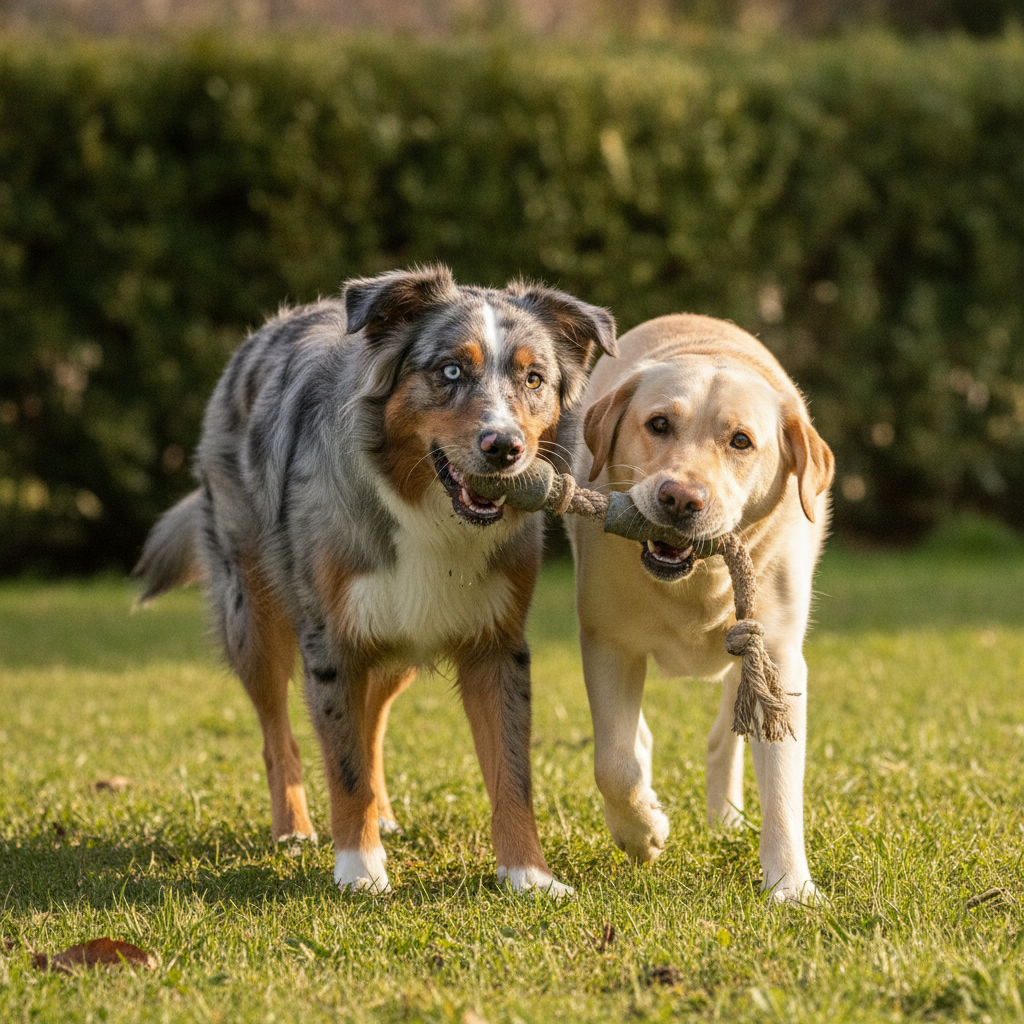
You cannot script a dog friendship any more than you can script a human one. You can introduce two dogs you are certain will adore each other and watch them decide, politely, to merely coexist. In the end the dogs pick, not us. But there is a real difference between leaving it entirely to chance and stacking the deck, and a handful of compatibility factors do exactly that. Weigh these before you set up the playdate, and you dramatically raise the odds of a genuine buddy instead of a tense standoff.
1. Do their play styles match?
Almost all dogs like to play. They do not all play the same game. Some are chasers, sprinting back and forth for as long as anyone will keep it up. Others are wrestlers, from gentle rolling around to full rough-and-tumble. Some are stalkers, some are calm pawers and bouncers, and some are body-slammers who throw a hip or shoulder into their partner at speed.
No style is better than another, but the two dogs need a shared favorite, or at least one game they both enjoy. The classic mismatch is one dog trying to start a chase while the other wants to grapple. Play only works when both partners are playing the same sport and both are having a good time.
2. Are they a reasonable size match?
Dogs of wildly different sizes can absolutely be devoted friends, but sharing a rough weight class carries real upsides. Closely matched dogs are less likely to hurt each other, and neither has to constantly hold back for the other’s safety. They can just go.
That said, some of the best duos are hilariously mismatched, with a giant dog who has mastered the art of playing small. It is genuinely charming to watch a big dog lie down and let a tiny one clamber over their paws, so long as both are safe and enjoying it. The line to watch is whether the bigger dog can control their body around the little one; a dog who plows through a small partner like a runaway train needs to stick to bigger friends.
3. How far apart are they in age?
Dogs do not need to be close in age to have a blast, but age drives energy, persistence, and stamina, so it is worth a thought. The usual friction is a young dog who wants to play all day long paired with an older dog who is delighted for about four minutes and then done.
Push a senior into an endless game with a relentless youngster and you get problems: at best the young dog ends up disappointed and hesitant about future play, and at worst they refuse to quit until the older dog gets snappy just to teach the pest some manners. Plenty of mixed-age pairs are wonderful together. The job of the human is to protect the older dog from a youngster who cannot take no for an answer.
4. Do the two humans agree on the rules?
A good play session is not only about the dogs. The people set the terms, and it goes best when both of you want the same things. Are treats allowed in the mix, or off-limits? Toys or no toys? Do you agree on what counts as fair play versus too rough, and on what behavior means it is time to call a break? Will you both actually watch the dogs, or does the other person think dogs should simply “work it out themselves,” which is the phrase that tends to precede trouble? Sorting this out before the dogs meet saves a lot of mid-play friction.
5. Is the other dog good company, and a good influence?
Two questions that travel together. First, does the other dog play nicely? Big energy is fine as long as both dogs are willing and having fun. But a dog who is relentless, pushy, or plain rude is not a good match, and if your dog seems frightened or overwhelmed, that is a hard stop. Even a confident dog deserves protection from bad-mannered play, partly because tolerating it can teach your dog that such behavior is normal.
Second, does the other dog have habits you would rather your dog not catch? Dogs are social learners, and they pick things up from each other during play, just like a kid who comes home with a new attitude after a bad-influence sleepover. Contagious behaviors can include nuisance barking, running the fence line growling and lunging, digging, and howling. It is easy to over-blame a play buddy for a habit your dog developed on their own, but the effect is real enough that choosing well-mannered friends is a smart hedge.
6. Does your dog actually like the other dog?
The simplest factor and maybe the most important. Is this a dog yours is drawn to and wants to spend time with? The heart wants what it wants. Barring any warning signs, the best reason to pick a play buddy is simply that your dog lights up around them. Book the playdates with the dog who makes yours happiest.
One safety note that overrides all of it
Before the play starts, think about gear. Collars, and to a lesser degree harnesses, are a real hazard during active play. Teeth and buckles snag, tags twist together, and in an instant two panicked dogs are physically stuck to each other and can hurt themselves or their partner trying to break free. The easy fix: pop the collars off at playtime. It takes five seconds and removes one of the scariest ways a good session can go wrong.
What’s new since this was written
Behavior researchers keep reinforcing two ideas that make this list more than intuition. One is that healthy play runs on fairness, self-handicapping (the stronger dog dialing it back) and role reversal are what let mismatched partners play safely, which is exactly why a big dog’s ability to modulate matters so much. The other is that “social with every dog” is a myth; dogs have distinct social preferences, and a dog who only wants a small circle of friends, or none at all, is normal, not broken. Matchmaking helps, but forcing it does not.
“The mistake I see most is treating dog friendship like a numbers game, more dogs, more socializing, better dog,” says Dr. Ravi Mehta. “It’s the opposite. One well-matched buddy your dog genuinely enjoys does more for them than a crowded dog park full of strangers they’re just tolerating.”
References
- Bekoff, M. The Significance of Ethological Studies: Playing and Peeing. ResearchGate (2013). https://www.researchgate.net/publication/284962897
- Bradshaw, J. W. S., Pullen, A. J., & Rooney, N. J. Why do adult dogs “play”? Behavioural Processes (2015). https://www.sciencedirect.com/science/article/abs/pii/S0376635714002289