Most people treat “sit” like a box to check. Teach it, move on. But the first cue your dog ever learns is doing something bigger than parking their rear end: it’s the moment your dog figures out how this whole arrangement works. Do something, get paid. Nail that lesson and every cue after it, down, stay, come, leave it, lands faster, because your dog already understands the deal. Rush it or make it frustrating, and you’re fighting that first impression for months. So it’s worth slowing down on the one skill everyone assumes is trivial.
The good news: sitting is genuinely easy to teach, because it’s a position dogs fall into on their own all day long. Your job isn’t to force it. It’s to catch it, name it, and pay for it, so your dog starts offering it on purpose. The cleanest way to do that is the lure method.
Why luring beats pushing
A lure is just a treat used as a magnet. You move the food, your dog’s nose follows, and their body arranges itself into the shape you want, no hands on the dog required. It works because of simple geometry: when a dog lifts their nose to track something above and behind their head, sitting is the path of least resistance for their spine. You’re not making them sit so much as setting up the one position that feels natural from there.
That “no hands on the dog” part is not a minor detail. Pressing on a dog’s hips to fold them into a sit teaches them nothing except that hands are pushy, and some dogs brace against the pressure or find it genuinely unpleasant. A lured sit is a decision your dog makes. A pushed sit is something that happens to them, and only one of those builds a dog who volunteers behaviors.
“The best-trained dogs I meet weren’t drilled, they were paid well and paid on time,” says Dr. Nina Kohl. “When a dog offers a sit and the reward lands in the same half-second, you’re not just teaching a position. You’re teaching them that offering behavior is worth doing, and that belief is the engine behind everything else you’ll ever ask for.”
What to have ready
You need almost nothing, which is part of the appeal. Two things make it go smoother.
First, treats worth working for, cut small. Small matters because you want to pay many times in a short session without stuffing your dog full; a treat the size of a pea is plenty. Keep a mix on hand so your dog never quite knows what’s coming, some ordinary, some jackpot-level special. Unpredictable rewards hold attention better than the same biscuit every time, the same reason slot machines are stickier than vending machines.
Second, a way to mark the exact instant your dog gets it right. Your voice works fine, a crisp “Yes!” delivered the moment their rear touches down. Some people prefer a clicker, a little box that makes a sharp, consistent click. The click’s advantage is precision: it always sounds identical, so it pinpoints the winning moment more cleanly than a voice that drifts in tone. Either way, the marker is a promise that a treat is coming, which is why your timing on it matters more than almost anything else.
A treat pouch you can clip to your waistband spares you from digging in a pocket mid-rep, and one that survives the dishwasher spares you from a permanently greasy bag. Not essential, but it removes friction.
The steps
Once you’re stocked, the sequence is short:
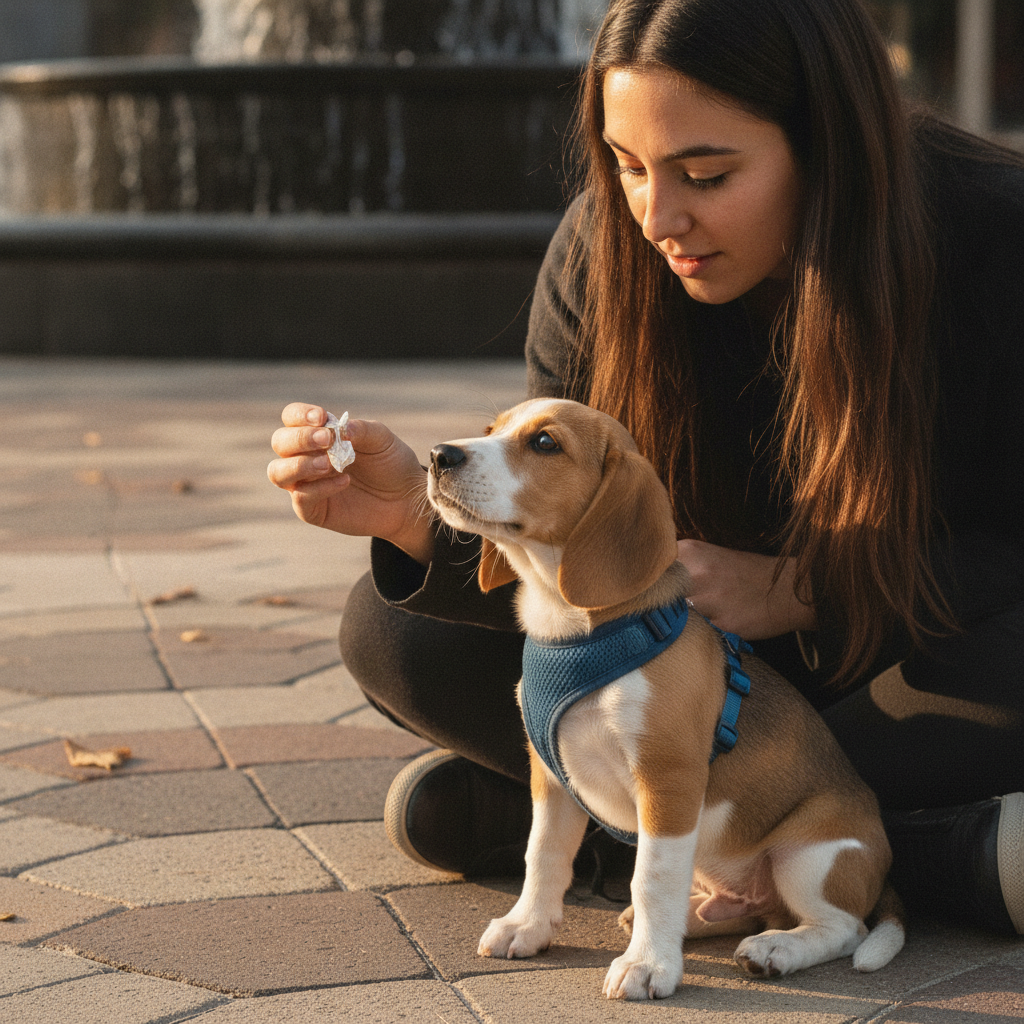
- Pinch the treat into a teardrop. Hold a treat between your fingertips so your hand forms a little teardrop point. Your dog should smell it but not be able to grab it.
- Meet the nose. Touch your fingertips lightly to your dog’s nose so they’re locked onto the scent.
- Lift up and back. Keeping that light contact, raise your hand slowly up and over their head. Their nose chases it, their head tips back, and their bottom sinks toward the floor.
- Mark and pay. The second their rear touches down, mark it (“Yes!” or click) and open your hand to deliver the treat.
- Repeat, then fade the food. Do about five smooth reps, then run the identical hand motion with an empty hand, paying from your other hand once they sit. This is how the treat stops being a bribe and becomes a reward.
That last step is the one people skip, and it’s the whole point. If the food stays in your luring hand forever, your dog learns to sit only when they can see a treat, which is useless the day you’re empty-handed. Fading the lure early, keeping the hand shape but losing the food, turns the gesture into a hand signal your dog reads on its own.
The mistakes that stall people
A few predictable snags account for most of the “my dog won’t sit” frustration.
Becoming a vending machine. Early on, pay every single sit. But once the behavior is reliable, switch to rewarding unpredictably: sometimes a word of praise, sometimes one treat, occasionally a handful all at once. A dog who never knows whether this sit is the jackpot stays far more engaged than one who’s learned the payout is always the same, or always coming.
Training a tired or overstimulated dog. If your dog suddenly can’t do a thing they knew yesterday, the usual culprit isn’t defiance, it’s the setting. A cue learned in your quiet kitchen isn’t automatically known at the dog park with squirrels everywhere. Ask for less when the world is louder, and never push a wiped-out puppy past the point of caring.
Getting stern. When a dog stops cooperating, people tend to raise their voice, as if volume were the missing ingredient. It isn’t. A dog struggling with a cue is usually over their head for the environment, and getting sharp with them turns training into something to dread. If a session is going sideways, that’s information, back up to an easier version rather than escalating.
Locking the cue to one tone. If you only ever say “sit” in the exact same clipped voice, that’s the only version your dog will recognize. Practice the word in a range of tones so the cue survives real life, where you’ll inevitably say it cheerfully, urgently, or half-distracted.
Once “sit” is solid
The reason to get this right is everything it unlocks. A dependable sit is the off-switch you reach for constantly: at the door before a walk, at the curb before crossing, when a guest arrives, when the excitement needs somewhere to go. It’s also the launchpad for tidier behaviors, a sit instead of a jump, a sit instead of a lunge, so teaching it well is really teaching the foundation for polite everything.
Keep sessions short, keep them fun, and treat it as a game the two of you play rather than a task to complete. A dog who enjoyed learning to sit is a dog who’ll lean into learning the next thing, which, in the end, is the actual skill you’re building.
What newer research adds
Recent work in dog training keeps reinforcing what reward-based trainers have argued for years: how you teach changes more than whether the dog learns. Studies comparing reward-based methods with aversive ones (leash corrections, stern discipline) have found that dogs trained with rewards show fewer stress-related behaviors and, in some tests, actually learn new tasks faster and stay more optimistic in problem-solving. The takeaway for a first cue like sit is practical, not just ethical: a dog who feels good during training pays better attention and offers behavior more freely, which is exactly what you want from the skill that sets the tone for all the rest.
References
- American Veterinary Society of Animal Behavior, Position Statement on Humane Dog Training
- China, L., Mills, D. S., & Cooper, J. J. (2020). “Efficacy of Dog Training With and Without Remote Electronic Collars vs. a Focus on Positive Reinforcement.” Frontiers in Veterinary Science. Link
- Vieira de Castro, A. C., et al. (2020). “Does training method matter? Evidence for the negative impact of aversive-based methods on companion dog welfare.” PLOS ONE. Link