Medically reviewed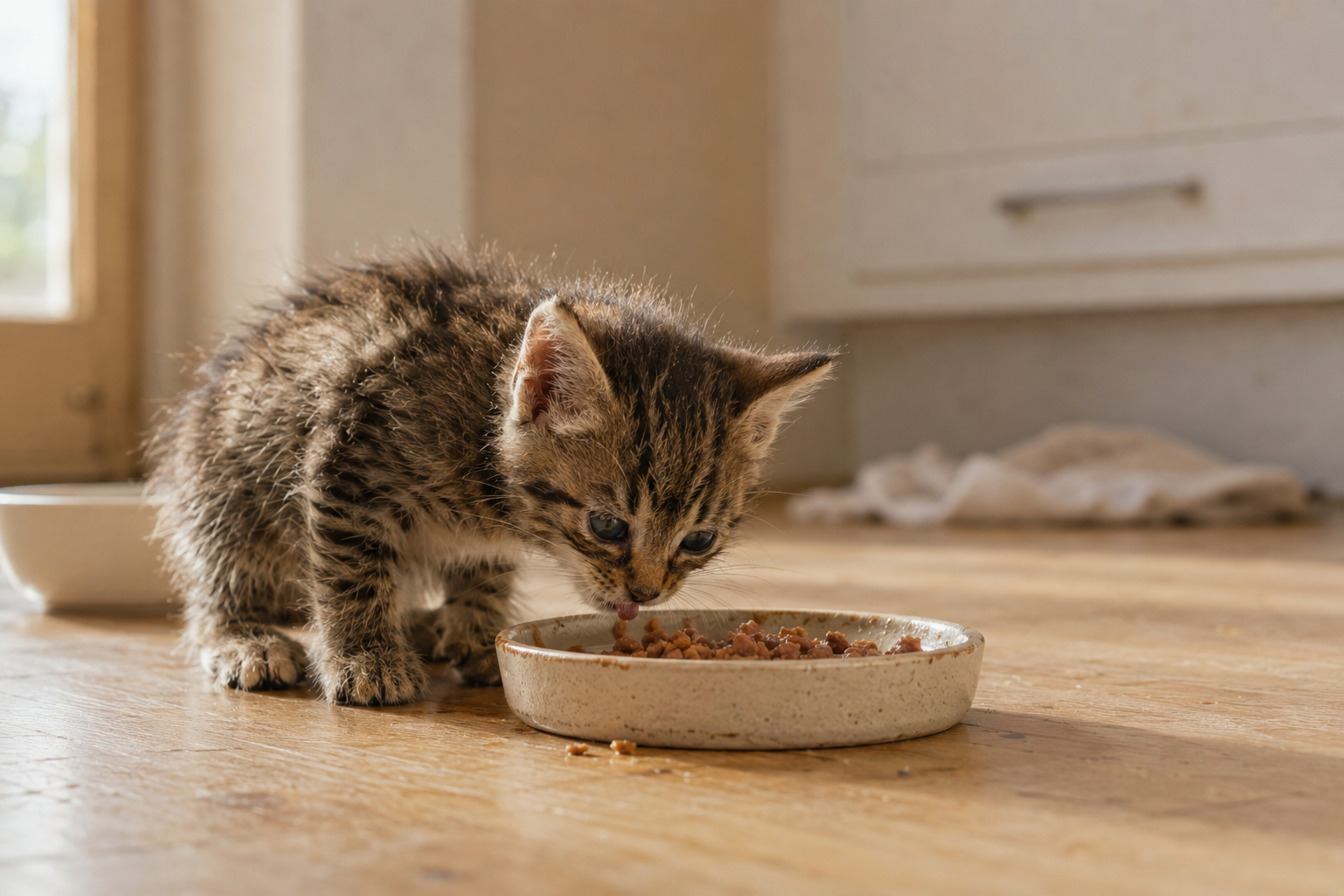
The fastest way to get kitten feeding wrong is to treat it like feeding a cat. A kitten is not a small cat. It is a body doubling in size on a deadline, burning up to three times the calories of an adult per pound, and its diet changes almost week to week for the first few months, from its mother’s milk, to a soupy gruel, to real food in a bowl.
That pace is why a single “how to feed a kitten” answer never fits. What a three-week-old needs and what a seven-month-old needs are barely the same task. So here is the whole arc in one place: what to feed, how often, and what to watch for at each stage, on one chart.
The kitten feeding schedule, by age
| Age | What to feed | Meals per day | Notes |
|---|---|---|---|
| 0–4 weeks | Mother’s milk, or kitten milk replacer by bottle | 5–8 (newborns) tapering to 4 | Never cow’s milk. If you’re bottle-feeding an orphan, this stage is delicate and worth a vet’s input. |
| 3–4 weeks | Weaning begins: wet kitten food as a warm gruel | ~4 | Introduce the gruel alongside milk; let them explore it. Don’t force the transition. |
| 6 weeks | Thicker gruel, then softened kitten food | ~4 | Most kittens are lapping and chewing by now. |
| 6–8 weeks | Wet and/or moistened dry kitten food | 3 | Fully weaned by roughly 8 weeks. An 8-week kitten is about 2 lb and needs ~160 calories a day. |
| 2–4 months | Complete kitten food, wet, dry, or both | 3–4 | Peak growth and energy. Frequent small meals suit the tiny stomach. |
| 4–6 months | Complete kitten food | 3 | Growth is still fast; keep the calories coming and monitor body condition. |
| 6–12 months | Complete kitten food | 2–3 | Settle into a routine. Stay on kitten formula, not adult, until about a year. |
| ~12 months | Transition to adult cat food | 2 | Switch gradually over a week or so. Large breeds may stay on kitten food a bit longer. |
Amounts vary by the kitten, the brand, and whether you feed wet, dry, or both, so treat the calorie figures as a starting point and let the feeding guide on your food and your vet fine-tune the portion.
The two mistakes that cause the most trouble
Almost every kitten-feeding problem clusters at the two ends of this timeline.
The first is weaning too fast. A kitten hurried off milk and onto solids before it’s ready tends to get an upset stomach, and the weaning window rewards patience, not speed. Start with a loose gruel, keep it warm, and let the kitten set the pace over a couple of weeks.
The second is getting the adult-food switch wrong in either direction. Move a four-month-old off kitten food and you cut the calories and nutrients right when growth needs them most. Leave a healthy one-year-old on kitten food and its richness starts to become extra weight. Match the food to the age.
“The two moments that trip people up are the ends of the timeline,” says Dr. Priya Nair. “Weaning too fast gives you a kitten with a sour stomach, and leaving a one-year-old on kitten food, or switching a four-month-old off it too soon, quietly sets up a weight problem. Feed the week they’re in, not the size they look.”
Why kittens eat so differently
A kitten’s stomach is tiny and its energy demand is enormous, which is the whole reason for small, frequent meals and calorie-dense kitten formulas. Those formulas are built to pack growth nutrients, protein, fat, and specific minerals, into a small volume a kitten can actually finish. It’s also why free-choice grazing on dry kitten food works for many kittens in a way it doesn’t for weight-prone adults: a growing kitten is usually spending everything it takes in.
Fresh water matters at every stage past weaning, especially if you lean on dry food. And whatever you choose, the label should say it’s complete and balanced for growth or for all life stages. Adult “maintenance” food is not built for a kitten, no matter how convenient the bag.
A note on the switch
The move to adult food isn’t a birthday event; it’s a short, gradual transition you make around the one-year mark by mixing increasing amounts of the new food over about a week. Rushing it is the quickest way to a few days of digestive upset. As with the very first weaning, patience at the transition is the whole trick.
References
- Cornell Feline Health Center. “Feeding Your Cat.” Cornell University College of Veterinary Medicine. vet.cornell.edu
- PetMD. “Feeding Kittens 101: What to Feed, How Much, and How Often.” petmd.com
- American Animal Hospital Association / American Association of Feline Practitioners. “Feline Life Stage Guidelines.” catvets.com
- Royal Canin. “How much should a kitten eat?” royalcanin.com