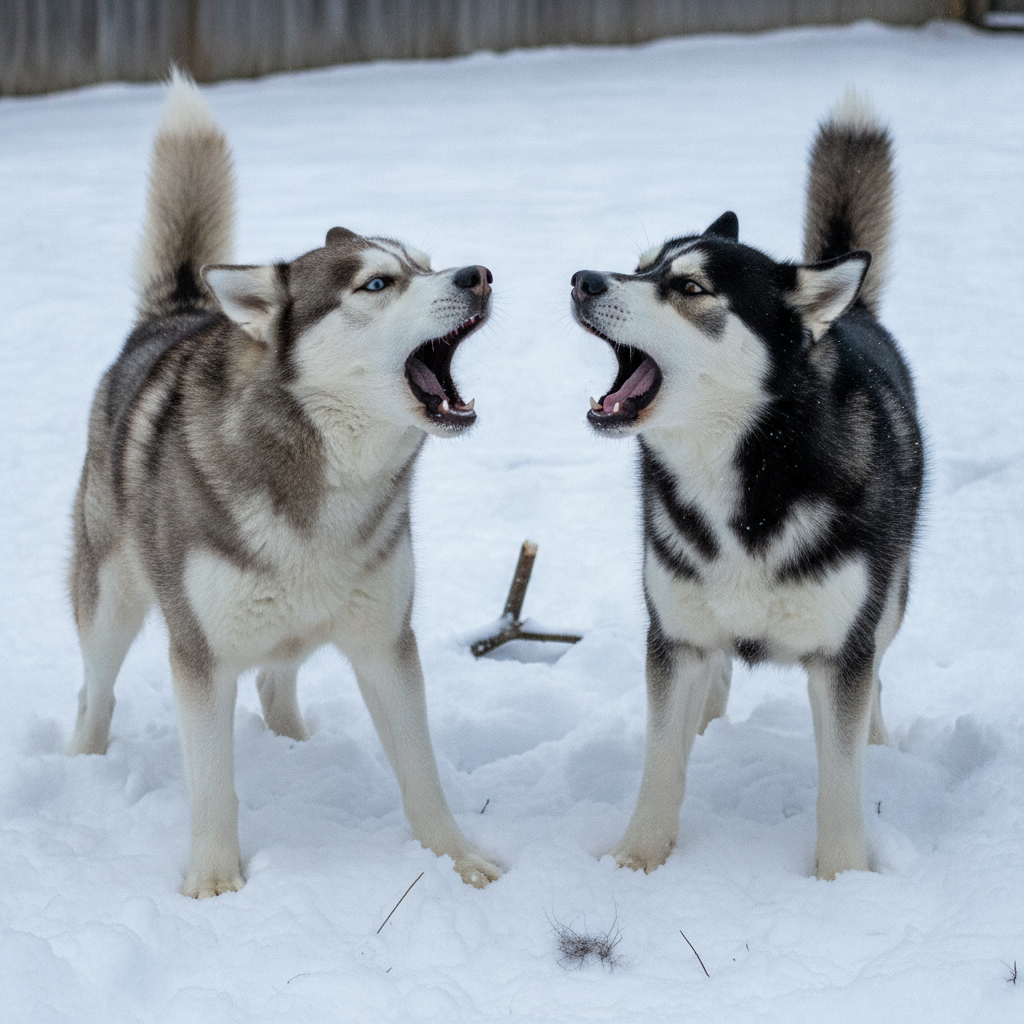
Tell a Siberian Husky it is time for a bath and you will not get a dog that slinks away. You will get a rebuttal. A long, escalating, deeply theatrical rebuttal, delivered in a series of howls, yodels, groans, and that specific rising “roo-roo-rooo” that has made the breed the undisputed champion of the pet internet.
It is funny. It is also, and this is the part that gets lost, the breed working exactly as designed.
Your Husky is not being difficult. Your Husky is a specialist communication tool, and you have given it nothing to communicate about except the bath.
The dog was built to talk
Siberian Huskies descend from the sled dogs of the Chukchi people, animals bred for long-distance team pulling across some of the most punishing terrain on the planet.
Think about what that job actually requires. A team of dogs, running in harness, through terrain where visibility can drop to nothing. Snow, wind, whiteout. The dogs cannot always see each other. They certainly cannot see the musher.
So they talk. Howls, whines, yodels, grumbles, and a wide vocabulary of “talking” noises that let the team coordinate with each other and respond to the person behind them, in conditions where every other channel of communication has failed.
That is the ancestry sitting on your sofa objecting to a bath. It is not noise for the sake of noise. It is a working communication system with nothing left to coordinate.
The wolf part is real, but it is not what people think
Huskies sit among the breeds that stayed genetically closer to the wolf, and the wolf is a talker. Howling, whining, and yipping are how a pack keeps track of itself across distance.
The tempting conclusion is that a Husky is “more wolf” and therefore more wild. That is the wrong inference, and it does the breed a disservice.
What Huskies retained is not wildness. It is sociality. A vocal animal is a social animal, because vocalizing is only useful if someone is listening. The Husky howling at you is doing so precisely because it considers you part of the group. A truly aloof dog would not bother.
“People come to me thinking their Husky is stubborn or dominant, and what they actually have is a dog with an enormous social vocabulary and nobody to use it on,” says Dr. Ravi Mehta. “This is a breed that was selected for hundreds of years to have opinions and share them with the team. Then we put it in an apartment and act surprised. The talking is not the problem. It is the one part of the job we left intact.”
So what does the arguing actually mean?
Honestly? We do not fully know, and anyone who tells you they can translate a specific “roo” is selling something.
What can be said with confidence is narrow but real: the dog has something going on internally, and it is broadcasting it to whoever is in the room, animal or human. Beyond that, the specifics are guesswork.
Some things it commonly is:
A response to sound. Huskies vocalize back at other dogs, at sirens, at doorbells, at raised human voices, at music. The famous videos of dogs howling along with a song, sometimes with uncanny pitch accuracy, are this. Some Huskies will even attempt to mimic human speech patterns, which is unsettling and delightful in equal measure.
Frustration or resistance, expressed rather than acted on. This is the most useful reframe in the article. Ask your Husky to move off the sofa, endure thirty seconds of grumbling opera, and then watch them move off the sofa. That is not disobedience in any meaningful sense. That is a complaint being lodged. The closest human analogue is a child protesting bedtime and then going to bed. The protest is not defiance. It is a feeling being aired on the way to compliance.
Excitement, boredom, annoyance, or a bid for attention. All of it goes through the same channel, because that channel is the one the breed has.
And, very often, because it works on you.
The uncomfortable bit: you probably trained this
Here is the thing to be honest about.
If your Husky breaks out its cutest arguing voice and you laugh, film it, coo at it, or produce a treat, you have just rewarded the behavior with your undivided attention. Huskies learn quickly that vocalizing gets a reaction, and a reaction is currency.
Every viral Husky video is, at some level, documentation of a behavior being reinforced.
This is not a scolding. It is just worth knowing that if your Husky argues a lot, and you have been an appreciative audience, the two facts are related. And if the theatrics have become genuinely disruptive, the intervention is the boring one: stop paying for them. Reward the quiet instead.
When it is not funny: read the body
This is the part that actually matters, and it is where the internet is least useful.
The vocalizing is almost never aggression on its own. As one of the standard framings has it, a “loud argument” between two dogs may be perfectly friendly. The sound tells you very little. The body tells you everything.
A dog that is enjoying this looks like:
- Loose posture, wiggly, bouncy
- Relaxed mouth, often open, tongue possibly lolling
- Floppy, soft ears
- A gently wagging tail
- Play bows
A dog that is stressed or agitated looks like:
- Stiff posture, frozen or rigid
- Tight lips, or a mouth drawn back into a stiff, almost clownish grimace
- Ears standing hard up, or pinned flat back
- A tail held high and stiff
Two Huskies making an absolutely appalling racket at each other, with loose bodies, play bows, and wagging tails, are having a conversation, not a fight. They are negotiating about a toy or some space, and they are doing it with their voices, which is exactly what you want.
The same racket with stiff bodies, hard eyes, and rigid tails is a different event entirely.
The rule is simple: listen to the noise, but look at the dog. People do the reverse, and it is why so many “husky argument” videos are cheerfully captioned as comedy when the dog in frame is visibly uncomfortable.
What newer research adds
The recent thinking on dog vocalization has moved in a direction that flatters the Husky.
Barking, specifically, appears to be largely a domestication product. Wolves bark rarely; dogs bark constantly. The current view is that dogs developed an expanded vocal repertoire directed at humans, because humans respond to it, and that this is one of the genuinely novel things about dogs as a species.
Which puts the Husky in an interesting position: a breed that kept the ancestral howling repertoire and acquired the human-directed communication drive. It is not that Huskies are less domesticated. It is that they are, vocally, doing both jobs at once.
The other useful finding is the ASU work published in 2025 showing that people judge a dog’s emotional state overwhelmingly from the situation around the dog rather than the dog itself. That is precisely the failure mode with Husky videos. The scene is funny, the caption tells you it is funny, and nobody looks at the ears.
So enjoy the theatre, and it is genuine theatre. Just remember that you are living with a dog bred to have something to say, and that the fastest way to reduce the shouting is not to shut it up. It is to give it a job, a run, a puzzle, and a team.
They were never arguing. They were reporting in.
References
- American Kennel Club. “Siberian Husky.” Breed history and characteristics. https://www.akc.org/dog-breeds/siberian-husky/
- Larson, G., et al. “Rethinking dog domestication by integrating genetics, archeology, and biogeography.” Proceedings of the National Academy of Sciences, vol. 109, no. 23, 2012. https://www.pnas.org/doi/10.1073/pnas.1203005109
- Pongrácz, P., Molnár, C., and Miklósi, Á. “Acoustic parameters of dog barks carry emotional information for humans.” Applied Animal Behaviour Science, vol. 100, 2006. https://www.sciencedirect.com/science/article/abs/pii/S016815910600062X
- Molinaro, H. G., and Wynne, C. D. L. “Barking up the wrong tree: Human perception of dog emotions is influenced by extraneous factors.” Anthrozoös, 2025. https://www.tandfonline.com/journals/rfan20
- Texas A&M School of Veterinary Medicine. “Doggie Decoding: Understanding Canine Body Language.” https://vetmed.tamu.edu/news/pet-talk/understanding-canine-body-language