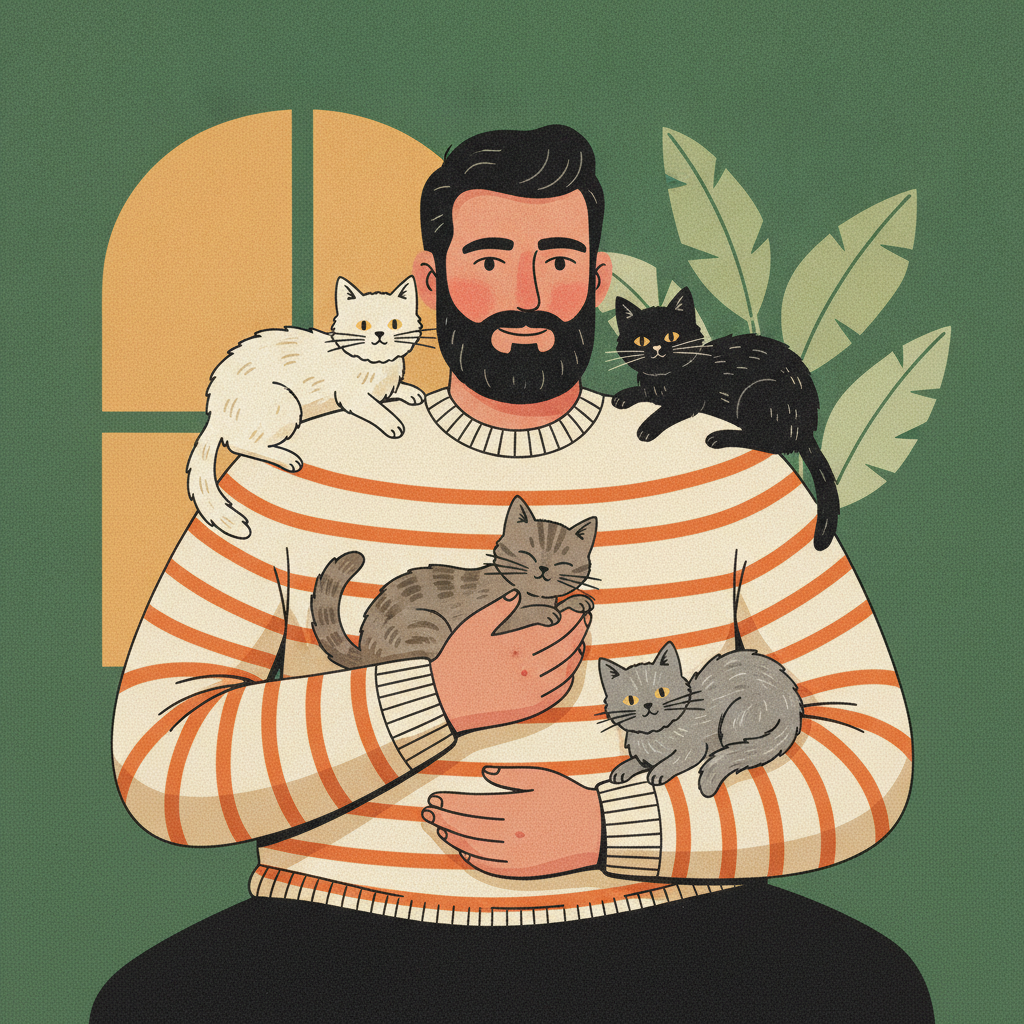
Moisés Zamora spent most of his adult life refusing to get attached to an animal.
He grew up in El Limón, Jalisco, surrounded by them, dogs, chickens, the ordinary animal population of a rural Mexican town. At eleven, his family left for the United States, and he remembers pulling away from the front entrance while his great-grandaunts waved goodbye, knowing with complete certainty that he would never see them again because they were old. He had to leave his dog behind too. It took five or six years to get everyone’s immigration status settled.
They eventually landed in central California, on land with cattle, goats, chickens, dogs, cats. And he simply would not attach. It was too heartbreaking. He kept himself at a distance from all of them, for decades.
Then the pandemic hit, he was in therapy working through immigration, being BIPOC in a country that keeps asking you to explain that you belong, coming out to a conservative family, eleven years of sobriety, and his partner had a cat named Masha.
The wall came down. It came down all the way.
Pepito, and then the flood
He applied to adopt through Kitten Rescue, an organization that vaccinates, quarantines, and socializes kittens before adoption, so that by around four months they are ready. He picked out a black-and-white tuxedo kitten and named him Pepito, the Spanish diminutive for a little kid, roughly a Dennis the Menace.
Masha’s review of this decision was a three-day hunger strike. They introduced them slowly, with Pepito in the bathroom so the two could see each other, and Masha would walk past and hiss. At one point she walked past, forgot to hiss, and doubled back to hiss.
Pepito, meanwhile, would not leave Zamora alone. He was writing pilots at the time and describes the kitten leaning against his arm while he worked, a distraction while the world outside fell apart.
The following summer, kittens started turning up on the streets of South LA. A neighbor a few blocks over had them in her bushes. He offered to help, got roughly ten cats spayed and neutered, and called the rescue when the kittens were ready for fostering. The answer he got is the one every rescue gives, because it is always true: every foster home was full, and they would be delighted if he became one.
So he signed up. The household peaked at roughly nine cats, six of them kittens.
And then it went wrong
Three of the kittens had to be separated into another room with ringworm, which is contagious, treatable, and a nuisance.
The other three got something else.
One started getting sick with what Zamora refers to as Parvo, the term people use for feline panleukopenia, feline parvovirus. She was at the vet within hours of the first sign. She died in his hands.
They were warned they would probably lose all of them. The rescue’s network of people got them through it, injecting the kittens with fluids, vitamins, and Cerenia so they would eat. Zamora and his partner cancelled business trips to stay with them. A second kitten held steady for four days under his care, seemed to be turning the corner, and then crashed. She died in his hands too. He watched her take her last breath.
One of the remaining kittens tested positive and survived.
What he says about that stretch is the part I would ask anyone considering fostering to read twice: they realized they had not actually grieved. Not for the kittens, and not for the family members they had lost to COVID. The kittens opened the door on all of it.
The disease, plainly
Feline panleukopenia deserves to be understood, because the version most people have in their heads is far too gentle.
It is a parvovirus, and it attacks the body’s fastest-dividing cells. That means the bone marrow, where white blood cells are made, and the lining of the gut. The name is literal: pan-leuko-penia, an absence of all the white cells. A kitten with panleukopenia is stripped of their immune system and their intestinal barrier at the same moment, which is why they crash so fast and why sepsis follows.
The signs are vomiting, profuse diarrhea, profound lethargy, refusal to eat or drink, and a kitten who sits hunched over a water bowl without drinking. The progression can be measured in a day or two. In unvaccinated kittens, mortality is high even with aggressive treatment, and treatment is entirely supportive: fluids, anti-nausea drugs, nutritional support, antibiotics for secondary infection. There is no drug that kills the virus.
Two facts make it especially cruel in a fostering context.
The virus is extraordinarily durable. It can survive in an environment for months, potentially up to a year, and it resists a lot of ordinary household disinfectants. A correctly diluted bleach solution is one of the things that reliably inactivates it. This is why shelters take outbreaks so seriously, and why a foster home that has had a case needs a real decontamination protocol before the next litter arrives.
It is vaccine-preventable. Panleukopenia is covered by the core FVRCP vaccine, and vaccination is the reason it is now rare in owned, vaccinated cats and still devastating in street and shelter populations. The kittens who die of it are, overwhelmingly, kittens who were born outside and got sick before anyone could protect them.
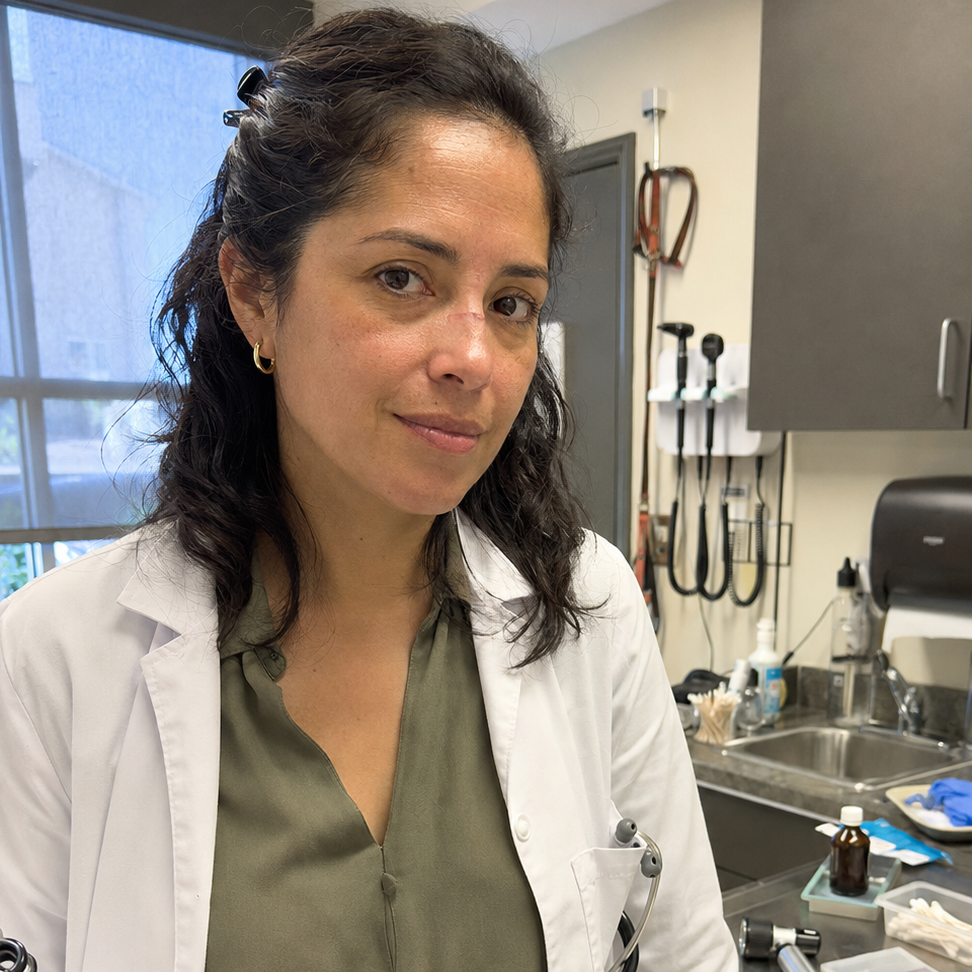
“Panleuk is the disease that makes people quit fostering, and I understand why. But the kittens who die of it are dying of the thing that happened before you met them,” says Dr. Amara Solis. “A vaccinated cat, a bleached room, and a foster who knows what day-one lethargy looks like are the three things that break the chain.”
What a foster should actually know going in
Get every animal in the home fully vaccinated, on schedule, before you take a kitten in. This is not negotiable, and it protects your own cats.
Quarantine new arrivals. A separate room, separate litter box, separate bowls, and change clothes or wash hands between rooms. Ringworm and panleukopenia both travel on you.
Know the emergency signs. In a kitten, lethargy plus not eating is an emergency, not a wait-and-see. Kittens have no reserves. Vomiting and diarrhea together in an unvaccinated kitten is a same-day vet visit.
Ask the rescue what their protocol is before a crisis, not during one. A good organization, like the network that got Zamora through, will have a vet relationship, a fluids-and-Cerenia protocol, and people who answer the phone at 11pm. That support is the actual difference between a foster who continues and one who never does it again.
Understand that some kittens die, and that it is not your failure. This is the sentence the recruitment pitch leaves out. Fostering means standing between an animal and the worst outcome, and sometimes you lose. The alternative is that they die alone in a bush behind somebody’s house.
Why he kept going
Zamora retrofitted his house for cats. He rearranged his professional life, in the middle of co-founding a production company and developing two TV series, to make sure the kittens got what they needed.
And the reason is the thing he could not have predicted when he spent thirty years refusing to get attached: the animals did not protect him from grief. They gave him a place to finally put it down.
If you have been avoiding a pet because you are afraid of losing one, that is not cowardice. It is a rational response to having lost things. It is also, as he found out, the exact thing standing between you and the joy he could not believe the kittens brought into the house.
References
- American Association of Feline Practitioners. “2020 AAFP/AAHA Feline Vaccination Guidelines.” https://journals.sagepub.com/doi/10.1177/1098612X20941784
- Cornell Feline Health Center. “Feline Panleukopenia.” https://www.vet.cornell.edu/departments-centers-and-institutes/cornell-feline-health-center/health-information/feline-health-topics/feline-panleukopenia
- Barrs, V.R. “Feline Panleukopenia: A Re-emergent Disease.” Veterinary Clinics of North America: Small Animal Practice, 2019. https://pubmed.ncbi.nlm.nih.gov/31047647/
- University of Wisconsin Shelter Medicine Program. “Panleukopenia Disinfection Protocols.” https://sheltermedicine.wisc.edu/
- Kitten Rescue Los Angeles. https://kittenrescue.org/