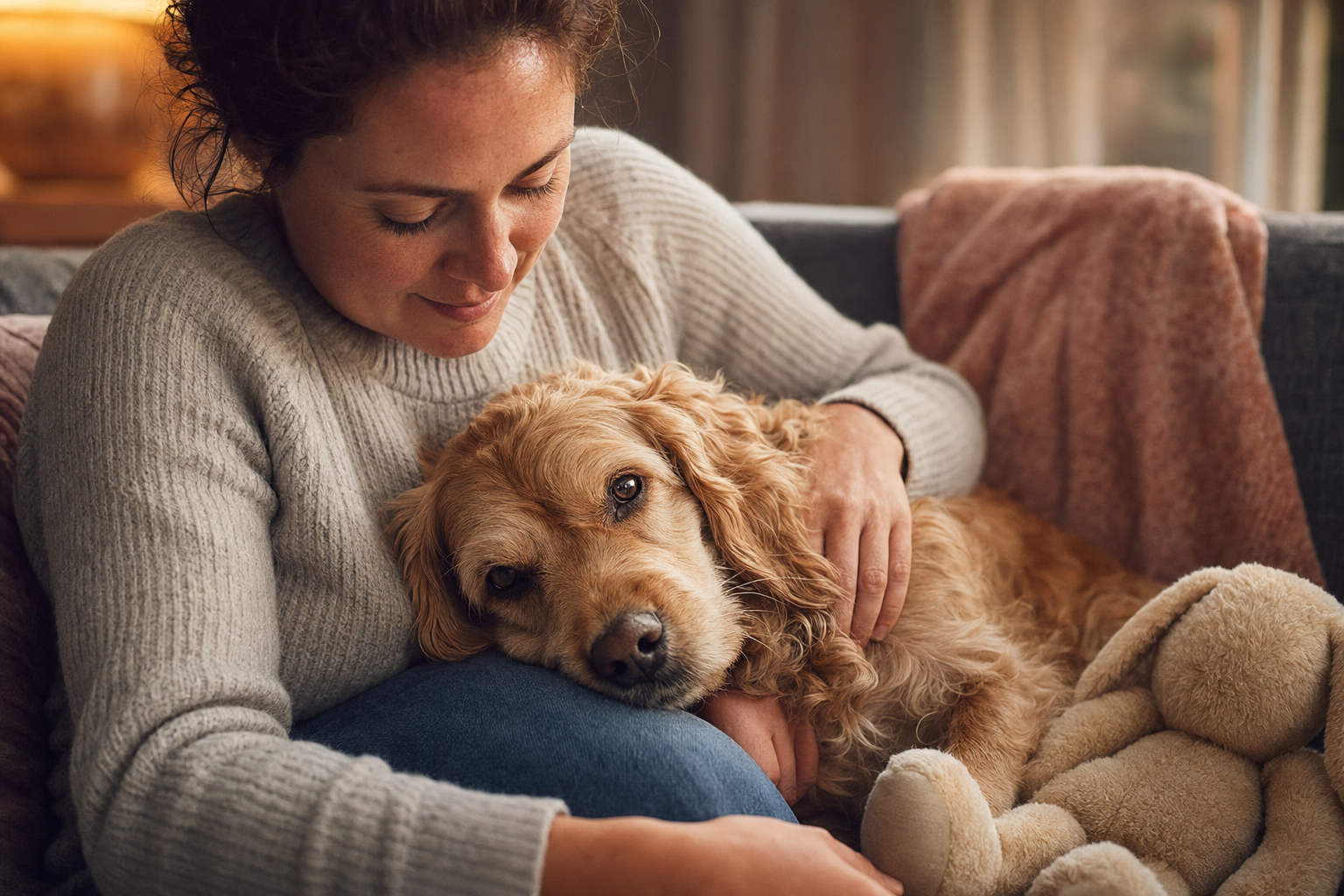
You come home and your dog is curled protectively around a stuffed toy she ignored for months, carrying it from room to room, guarding it, tucking it into a makeshift nest. Her belly and mammary area look fuller than usual, she’s licking at them, and on a closer look there seems to be actual milk. The obvious thought arrives in a rush: is she pregnant? Except she hasn’t been anywhere near a male dog. So what is going on?
She isn’t pregnant. Her hormones simply haven’t gotten the memo. This is false pregnancy, and while it can be unsettling to witness, it’s a well-understood condition with a surprisingly deep backstory, one that usually needs nothing more than patience and a single precaution.
What false pregnancy really is
False pregnancy, known medically as pseudopregnancy or pseudocyesis and sometimes called phantom pregnancy or nervous lactation, is when a female dog who is not pregnant starts showing the bodily and behavioral hallmarks of carrying or nursing a litter. Any breed can develop it once she’s past puberty, at any age. It shows up most often in intact females, though spayed dogs can experience it too.
The reason it happens at all traces back to how dogs evolved. In wild canine groups, females who hadn’t given birth would sometimes still produce milk and help care for the litter of another, a shared-parenting arrangement that helped pups survive. The hormonal machinery that made that possible still runs in the modern pet dog, which is why an unbred house dog can slip into full maternal mode over a plush toy. It isn’t a malfunction so much as an ancient program firing at an inconvenient time.
The hormone timing behind it
To see why it happens when it happens, it helps to know the dog’s heat, or estrous, cycle, which runs in four phases. Proestrus is the lead-in, when estrogen prepares the body for potential mating. Estrus is the fertile window, when a surge in luteinizing hormone triggers ovulation. Then comes diestrus, and this is the stretch where false pregnancy takes hold. Early in diestrus, progesterone rises whether or not mating happened, priming the body as if for pregnancy. Later in diestrus, progesterone drops sharply and prolactin, the hormone that drives the changes of pregnancy and nursing, climbs. That rapid hand-off from progesterone to prolactin is what tips a dog into pseudopregnancy, and it typically lands about two months after she went into heat. Anestrus, the quiet rest phase, follows before the cycle begins again.
Because the trigger is the natural hormone swing itself, mating is irrelevant. The same shift can also be set off if a dog is spayed during diestrus, though, to be clear, that is not a reason to avoid spaying.
What it looks like
The signs range from subtle to hard to miss, and they can be physical, behavioral, or both. On the physical side, you may notice enlarged mammary glands, lactation or discharge from them, and constant licking at them, along with nesting, a swollen abdomen, weight gain, loss of appetite, or lethargy. Behaviorally, dogs often “mother” an inanimate object like a toy or piece of clothing, and may become restless, anxious, or unusually irritable or even aggressive as they guard their adopted charge.
When to involve your vet, and the one red flag
Most cases clear up on their own within two to three weeks, so treatment often isn’t necessary. But any dog showing these signs should still be seen by a vet, and here is the non-negotiable part: every change in the mammary glands needs to be evaluated, because the same swelling and discharge can signal mastitis or a mammary tumor rather than a harmless hormonal episode. Do not assume it’s just a phantom pregnancy and wait it out on your own. If there’s any chance your dog actually mated, the vet has tools to tell the difference, imaging like ultrasound or X-ray to look for puppies, and a blood test for relaxin, a hormone the placenta produces that would be elevated in a true pregnancy.
Helping her through it
When the case is mild and confirmed, the goal is comfort and not accidentally prolonging it. The single most important thing is to leave the mammary glands alone. Nursing normally stimulates prolactin, which drives more milk, so any handling, massaging, milking, or warm and cold compresses, can extend the symptoms. A well-fitted t-shirt or a recovery collar can stop a dog from licking or suckling at herself. On the behavioral side, gently remove the objects she’s adopted and redirect that energy elsewhere; a food puzzle or other engaging task can take the place of the mothering ritual with less stress.
“The instinct is to comfort her by fussing over the area that looks sore, and that’s exactly the thing to resist,” says Dr. Lena Park. “Every bit of stimulation to those glands tells the body to keep the milk coming. Distraction and hands-off are what actually shorten it.”
When symptoms are severe, continuous lactation or big behavioral changes, medical help is warranted. A vet may prescribe a prolactin inhibitor to bring prolactin down and ease the signs, though it won’t prevent future episodes, and antibiotics if mastitis develops alongside. The definitive long-term fix is spaying, but the timing is genuinely important: it should be done during anestrus, when hormones are at their lowest, roughly three months after heat. Spaying while she’s actively symptomatic risks dragging the episode out, so if she’s mid-false-pregnancy, the surgery waits until she’s recovered.
What newer guidance adds
The old default advice, spay every female before her first heat, has been complicated by more recent research, and it directly affects how you prevent false pregnancy. Studies over the last several years have found that for some breeds, especially large and giant ones, holding off on the surgery until she’s physically grown may reduce the odds of certain cancers and orthopedic problems, which means the ideal timing is now a genuine conversation with your vet rather than a one-size rule. That trade-off matters here because a dog kept intact longer will keep cycling and can keep having false pregnancies in the meantime, so the plan has to weigh her recurrence against those developmental benefits. The practical upshot is unchanged in spirit but sharper in detail: spaying remains the most reliable prevention, but when to do it is now tailored to your individual dog rather than assumed.
References
- American College of Veterinary Internal Medicine. “Pseudopregnancy in the Bitch.” https://www.acvim.org/
- Merck Veterinary Manual. “False Pregnancy in Dogs.” https://www.merckvetmanual.com/dog-owners/reproductive-disorders-of-female-dogs/false-pregnancy-in-dogs
- Hart, B. L., et al. “Assisting decision-making on age of neutering for individual dog breeds.” Frontiers in Veterinary Science, 2020. https://www.frontiersin.org/articles/10.3389/fvets.2020.00388/full